Showing Up in AI Search Results: What LLMs Extract and Cite
Find clear answers on showing up in AI search results, understanding how language models extract web data, and securing factual brand citations.

Showing up in AI search results requires a useful distinction: a brand mention, a website citation and an accurate product recommendation are different outcomes. For marketing leaders, the practical task is to publish claims that retain their meaning when extracted, then measure what appears in generated answers. This question-led article explains a conceptual retrieval process, the information your pages should preserve and a repeatable way to audit visibility. It separates publishing decisions you control from citation outcomes you must observe.
What counts as appearing in an AI search answer?
Your brand appears when an answer names it, links to one of its pages or describes it in a relevant recommendation. Record those outcomes separately because each answers a different business question.
A mention establishes that the brand name appeared in that response. An owned-page citation establishes that the response linked to your website. An accurate recommendation establishes that the description fits your product, audience and stated constraints.
These outcomes can diverge. A response might mention your company while citing a third-party article. It might link to your documentation without naming the brand prominently. It might recommend your product with an incorrect description.
For an audit, capture:
- Whether the brand appears in the answer text.
- Whether an owned URL receives a citation.
- Which claim the citation appears to support.
- Whether the description preserves relevant limitations.
Keep the answer and its cited URLs together. A dashboard count without that record leaves reviewers unable to distinguish useful exposure from a misleading reference.
Start by deciding which outcome matters for each query: discovery, source attribution or suitability for a buyer’s requirements.
How does a search-grounded model turn a page into an answer?
In a retrieval-augmented generation design, retrieved material becomes context for a generated response. Use that as a conceptual model rather than a description of any particular search provider.
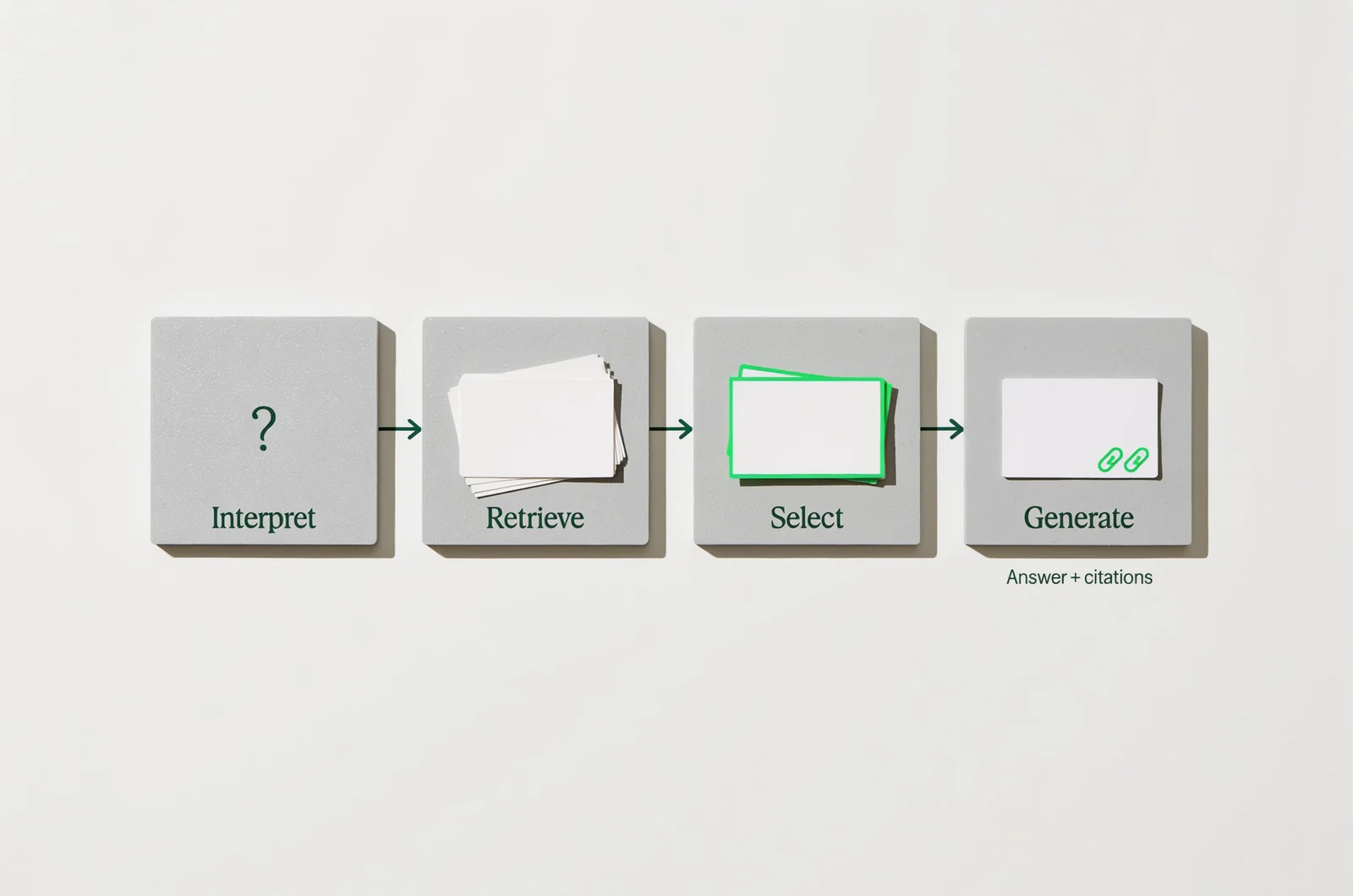
The process can be understood through four operations:
- Interpret the question and identify information needed to answer it.
- Retrieve potentially relevant documents or passages.
- Select material to include in the model’s context.
- Generate an answer, with citations where the system provides attribution.
Each operation creates a different editorial concern. A page can address the right topic while providing little evidence for the specific question. A useful passage can also lose meaning if its qualifications sit elsewhere.
Extraction does not necessarily mean copying a sentence. A generated answer can condense, paraphrase or combine information. Consequently, sentence matching alone is an incomplete accuracy check.
Training and retrieval also describe different processes. Publishing a page does not establish that its contents entered a model’s training data. An answer with a citation provides an observable link to a page, but it does not reveal the full retrieval process.
When reviewing an answer, inspect whether the cited passage supports the associated claim. Keep uncertainty about the underlying process separate from that observable check.
Which details should a page make extractable?
Make each important claim understandable with its subject, relationship and limits close together. The editorial objective is to preserve meaning when a reader encounters a passage independently.
For a product claim, useful details include the product name, capability, eligible user, applicable plan and geographic scope. For research, include the population, method, measurement period and limitations.
Consider a hypothetical SaaS product that supports CSV exports for workspace administrators on its business plan. A useful passage keeps the export format, authorised role and plan together. Separating those conditions across distant sections creates more work for anyone checking the claim.
Use a claim record during editing. For every substantive assertion, identify:
- The entity the statement describes.
- The capability, result or relationship being asserted.
- The conditions under which the statement holds.
- The evidence and person responsible for maintaining it.
This is an editorial record, not a proposed ranking factor. Its purpose is to expose ambiguity before publication.
Read priority paragraphs without their surrounding copy. Replace unclear pronouns, attach units to measurements and bring exceptions beside the statements they qualify. If a passage requires several neighbouring sections to make sense, rewrite it.
Does semantic HTML or structured data make a page more citable?
Treat semantic HTML and structured data as clarity checks; their presence alone does not establish that a page will receive citations.
Start with the visible document. Use headings that describe the questions answered beneath them. Put substantive information in readable text. Use lists for parallel conditions and tables when readers need to compare several options across concrete attributes.
For a publishing review, inspect whether:
- The page has a clear title and coherent heading hierarchy.
- Links describe their destinations.
- Product names and qualifications remain visible together.
- Structured data agrees with the visible content.
- Important information remains understandable outside decorative components.
Structured data should describe what the page actually contains. Do not add unsupported credentials, ratings or capabilities to make the markup appear more complete.
Keep the distinction between availability and selection explicit. Confirming that content is accessible addresses one question. Observing whether an answer cites it addresses another.
A useful editorial check is to read a plain-text version of the page. Note where meaning depends on colour, positioning or an unexplained icon. Rewrite those passages so the text carries the claim and its conditions.
What makes a claim worth citing?
A claim is a stronger editorial candidate when a reader can verify it, understand its scope and identify why the page is an appropriate source.
Choose claims your organisation can substantiate. Product documentation can describe supported behaviour. A research article can report a measured result with its method. An operational guide can explain a process with clear boundaries and worked examples.
For original research, publish enough context for scrutiny: what was measured, how observations were selected, how terms were defined and which limitations affect interpretation. A percentage without its denominator leaves an incomplete claim.
For product information, name the applicable configuration and exceptions. For a comparison, explain the basis of comparison and identify information that remains unknown.
Preserve the difference between evidence and recommendation. A proposed workflow can be useful without being presented as a proven performance improvement.
Before publication, ask an editor to locate the support for each material assertion. Revise claims whose evidence is missing or weaker than the wording suggests.
Apply the same discipline to citations in generated answers: check the associated sentence against the linked passage, including its qualifications.
How should you audit visibility across different questions?
Build a stable panel of relevant prompts, preserve the answers and repeat the same review process. Treat the panel as a defined sample rather than a measurement of every possible AI search.
Include questions from different buyer tasks: understanding a problem, comparing approaches and checking whether a solution fits specific requirements. Separate branded questions from unbranded discovery questions.
For prompt selection, connect long-tail keyword planning to the decisions buyers need to make. Avoid filling the panel with minor rewrites of one favourable question.
For each observation, record the exact prompt, service, date, language, market context and available search settings. Save the response, cited URLs and reviewer notes. Record conversation history where it could affect interpretation.
Choose a repeat schedule before comparing results. If you alter the panel, retain the previous version and label the change. Otherwise, an apparent improvement could reflect a different set of questions.
Keep failed runs and unavailable answers visible in the record. Define how they affect the denominator.
The resulting report should let another reviewer reconstruct what was asked, what appeared and how the outcome was classified. Start with a manageable panel that your team can inspect consistently.
Which measures distinguish citation coverage from business value?
Report mentions, owned-page citations, accuracy and attributable visits separately. Each measures a different part of the relationship between generated answers and your business.
Use explicit definitions:
- Mention coverage is the proportion of valid responses in the defined panel that name your brand.
- Owned citation coverage is the proportion that link to at least one page on your domain.
- Description accuracy is the proportion of reviewed brand descriptions that satisfy your published correctness criteria.
- Attributable visits are visits your analytics can associate with the relevant referral source.
Attach the panel version, observation period and denominator to every rate. Do not combine results across different services or languages without showing their separate values.
Clicks need a different interpretation from citations. An answer can contain a citation without producing a recorded visit. A visit can also arrive without a matching observation in your prompt panel.
If SiaSEO quality scoring is part of your workflow, keep its editorial score separate from observed citation coverage. One describes an assessment of the content; the other describes recorded answers.
Choose reporting measures that lead to decisions. Incorrect descriptions require a content investigation. Qualified visits require analysis of what those visitors do next.
What should you change when a page is absent or misquoted?
Choose a change based on the observed failure and treat the diagnosis as provisional. Absence from a sampled answer does not reveal its cause.
If the page’s content is unavailable during your technical checks, investigate access and rendering before rewriting it. Preserve the evidence from those checks.
If the page is available but does not answer the tested question, review topic fit. A broad overview may provide insufficient detail for a question about a particular capability, condition or use case.
If a cited answer drops a qualification, inspect the passage around the claim. Bring the restriction closer, make the subject explicit and remove ambiguous wording.
If an answer cites an outdated third-party description, check that description against your current source material. Record the discrepancy separately from errors on your own website.
Change one meaningful element at a time where practical. Log the original wording, revision, reason and publication date. Repeat the relevant observations using the same panel settings.
An improved result after an edit is an association, not proof that the edit caused it. Preserve that distinction in client reporting.
Prioritise changes that improve factual accuracy and reader usefulness even if the citation outcome remains unchanged.
How do language and geography affect the content you need?
Treat language, market availability and audience requirements as separate publishing decisions. An English-language page serving France and Benelux should state its applicable market conditions explicitly.
Keep supported languages separate from supported countries. Place currency, billing period, availability and service restrictions beside the relevant claims when those details apply.
For multilingual content, maintain a shared factual record while reviewing each language version independently. Check that translations preserve product names, exceptions and dates. Confirm that each version answers a question relevant to its intended audience.
Avoid creating location pages whose only substantive difference is a country name. Give each page a distinct purpose grounded in actual information.
Apply the same separation to measurement. Record language and market context for each prompt panel. Do not infer visibility for French-language buyers from an English-only sample.
Where information is unknown, leave the limitation visible rather than filling it with a plausible assumption.
Assign an owner to market-specific statements so that changes to availability or supported languages trigger a content review across the affected pages.
How can content teams improve visibility while retaining publishing control?
Use a publishing workflow that connects each article to its evidence, reviewer and subsequent observations. Keep responsibility for factual approval explicit.
For a team using SiaSEO for site-aware drafting and CMS publishing, attach a claim record to the article review. Ask the reviewer to check factual support, scope and consistency with the customer’s current website.
Give each priority page an owner. Record which changes require renewed approval, such as revised product capabilities, research findings or market availability. Separate formatting corrections from substantive claim changes.
A useful interactive checklist could ask whether each priority claim has a named entity, supporting evidence, applicable conditions and a review owner. It could then flag missing fields for the editor.
Keep that checklist focused on editorial readiness. Passing it would establish that the specified fields were reviewed, without predicting citation selection.
After publication, connect the page to relevant prompt-panel observations. When an answer misstates a fact, preserve the response and compare it with the published passage before editing.
Close the loop with a dated change record. The operational objective is a traceable sequence from evidence to publication, then from observed answers to a justified revision.