The Best Platforms for Showing Up in AI Search Results
Compare the top platforms for showing up in AI search results, with benchmark scores on LLM crawler access, source attribution, and seat pricing.

Choosing software for showing up in ai search results starts with a purchasing question: which part of the work needs fixing? A marketing director may need evidence of brand citations. An agency may need a repeatable optimisation process. A content lead may need tighter control between drafting and publication. This guide organises platform candidates around those decisions, then sets out the demonstrations and cost checks needed before selection.
The shortlist is provisional. Current prices, engine coverage and comparative performance have not been independently verified, and no hands-on benchmark supports a universal winner. The fit statements below are evaluation briefs. They give each candidate a specific job to prove, without treating content generation, publishing automation and citation measurement as interchangeable capabilities.
Choose the visibility problem before the platform
The strongest platform choice addresses a measurable gap in your AI-search operation. Define that gap before comparing dashboards or accepting a product category label.
Separate measurement from content production
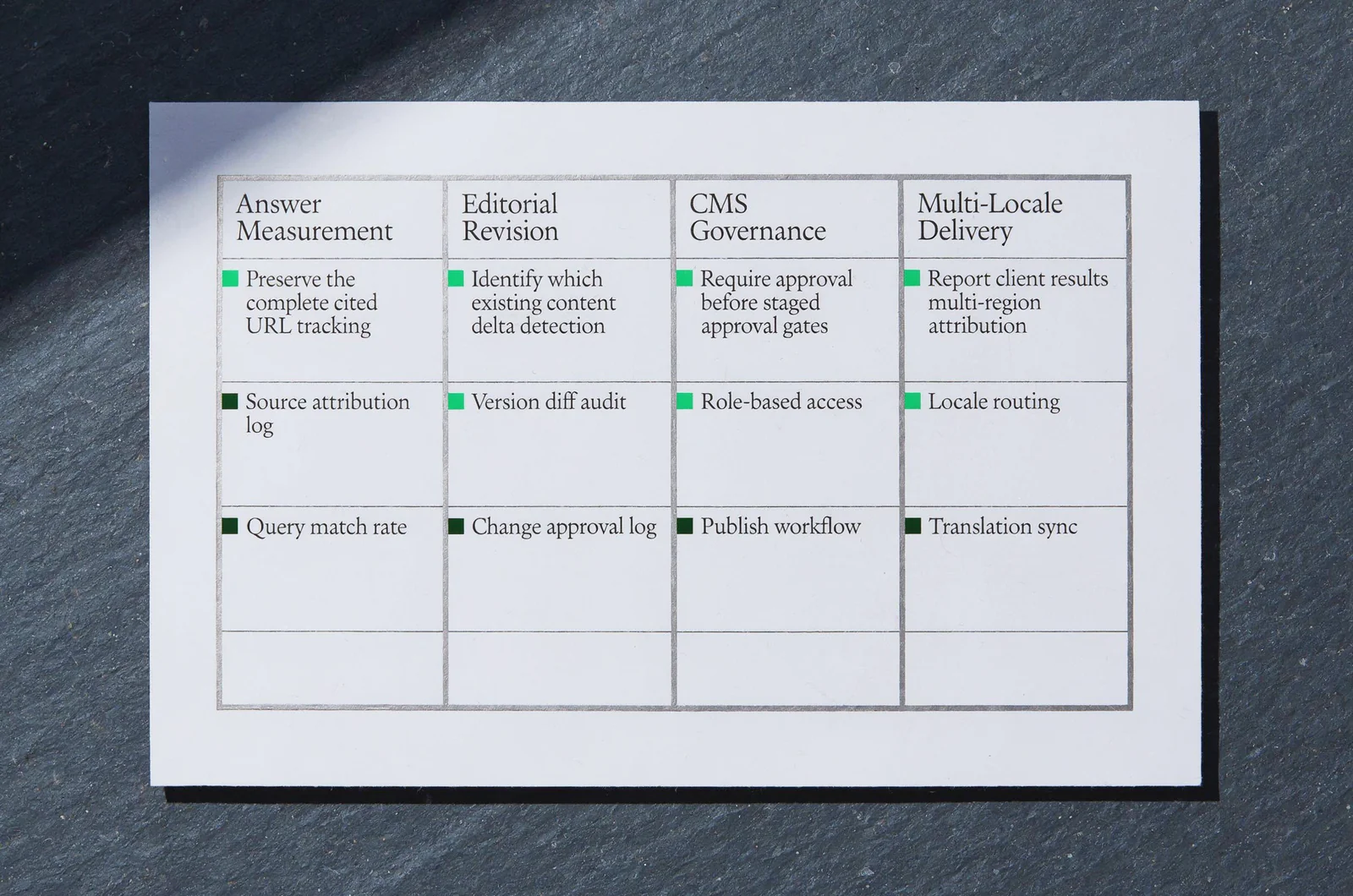
Write the purchasing requirement as an observable outcome. “Improve AI visibility” leaves too much room for interpretation. A more useful requirement might be:
- Preserve the complete answer and cited URLs for an agreed prompt set.
- Identify which existing pages need editorial changes.
- Require approval before a draft reaches the CMS.
- Report client results separately by market and language.
These are different jobs. Require vendors to identify which they can demonstrate and which need another system.
Define the reporting events too. For your evaluation, count a brand mention when the answer names the organisation. Count an owned-domain citation when the answer links to one of its pages. Record a recommendation separately, with the surrounding wording. Keep those definitions consistent throughout the trial.
For a Netherlands-focused business, specify whether the evaluation concerns English-language buyers, Dutch-language buyers or both. Store language and geographic context alongside each prompt.
Set a purchase gate for evidence and cost
Before reviewing candidates, agree on the evidence required for approval. A sensible gate includes inspectable outputs, a repeatable workflow and a written account of usage limits.
Treat technical readiness as a separate requirement. Ask for evidence of crawler access checks, relevant page inspection and structured-data validation where those functions are claimed. Require the vendor to show the affected URL and the underlying issue.
For costs, request a quote against the same operating brief. Include domains, users, clients, languages, prompts, reporting frequency and approval requirements. Record implementation work and ongoing review time separately from the subscription.
A platform enters the final shortlist when it can demonstrate the required job within that operating brief.
Platform candidates and the jobs they need to prove
These candidates cover different evaluation priorities across SEO and content operations. Their order carries no ranking. Current plan details and prices are unknown here, so each review identifies a capability to demonstrate, a cost question and a selection condition.
Surfer for evaluating SEO workflow consolidation
Consider Surfer when the purchase brief centres on the relationship between SEO planning, content changes and reporting. Its evaluation should start with an existing page and a specific editorial problem.
The standout capability to establish is traceability: can the platform connect a recommendation to the page, preserve the proposed change and support a review decision? Ask for the complete sequence using material from your own site.
Request pricing for the people and sites that will participate, including any separate requirements for reporting or additional usage. Include the time needed to review recommendations in the cost comparison.
The evidence gap is its precise role in AI-search measurement. Workflow relevance alone does not establish citation tracking across ChatGPT, Perplexity or another named service.
Keep Surfer on the shortlist if it demonstrates a useful SEO production workflow. Require a separate demonstration before selecting it to measure answer-engine visibility.
Clearscope for evaluating editorial relevance
Assess Clearscope when the central question is whether an existing article adequately addresses a buyer’s information needs. This evaluation brief suits teams that already publish regularly and need a more disciplined revision process.
Ask the vendor to work through an article with a clear intended audience. The capability to establish is an inspectable explanation of what should change and why. A reviewer should be able to accept, reject or amend each material recommendation.
Request the cost of the actual review workload, including contributor access and any limits relevant to document evaluation. Compare that with the editorial time required to resolve recommendations.
The evidence required is a worked example with visible inputs and outputs. A score by itself provides too little information for a purchase decision, and an editorial score should remain separate from citation outcomes.
Shortlist Clearscope if its demonstration improves the team’s revision decisions. Add cross-engine monitoring to the requirement only when the vendor can prove that function.
MarketMuse for evaluating content portfolio decisions
Consider MarketMuse when the difficult decision concerns an entire content library: which pages deserve revision, consolidation or additional coverage?
Use a representative group of existing URLs in the evaluation. Ask the vendor to explain its proposed order of work and identify the evidence behind each recommendation. The standout capability to establish is prioritisation that an editor can interrogate.
Request a quote for the inventory and planning workload you expect to maintain. Ask which limits affect the scope of an assessment and how much preparation your team must complete.
The limitation is attribution. A useful content plan still needs a separate process for recording publication dates, observing answer outputs and assessing subsequent changes. No verified evidence here establishes MarketMuse’s current monitoring coverage or comparative performance.
Keep it under consideration if the demonstration produces a defensible revision queue. Require the vendor to show how editors can challenge a recommendation before committing production resources.
Copy.ai for evaluating repeatable drafting work
Assess Copy.ai when recurring drafting work consumes the team’s capacity. Frame the evaluation around a bounded assignment, such as preparing an article from an approved outline and evidence pack.
The capability to establish is repeatability under constraints. Provide required terminology, prohibited claims, source material and an approval boundary. Check whether the resulting draft respects those inputs across several examples.
Request pricing for the expected workload and the people who will review it. Include correction time, revision cycles and any integration work in your cost estimate.
The evidence required is an inspectable set of drafts and reviewer decisions. This article makes no verified claim about current workflow functionality, pricing or AI-search tracking.
Keep Copy.ai on the shortlist if the demonstration produces usable drafts with an acceptable correction burden. If citation monitoring is part of the purchase brief, require a distinct measurement demonstration before treating it as covered.
Jasper for evaluating brand consistency in production
Consider Jasper when several contributors need to produce material with consistent terminology, claims and tone. The evaluation brief should reflect the points where your current process loses control.
Provide the same approved source pack and assignment to the candidate workflow. The standout capability to establish is consistent adherence to editorial constraints across multiple outputs, with a practical route for correcting errors.
Ask for pricing against your contributor count, review workload and implementation requirements. Request written clarification of any usage or collaboration limits that affect the proposed process.
The evidence gap concerns both operational fit and search outcomes. A convincing sample draft does not establish how the workflow behaves across repeated assignments or whether published pages gain citations.
Keep Jasper under consideration if the demonstration shows repeatable editorial control at an acceptable total cost. Record citation performance through a separately defined observation process unless that capability is demonstrated directly.
SiaSEO as a later option for publishing operations
SiaSEO belongs in the discussion when the purchasing problem spans site context, content planning, drafting, quality review and CMS publication.
Its stated scope includes site-aware article drafting, keyword research, content calendars, quality scoring and direct CMS publishing. Those descriptions establish its intended role in content operations. They do not provide comparative evidence of citation gains.
The standout capability to verify is control across that sequence. Ask for a demonstration that starts with a site-specific assignment, exposes the draft’s evidence and quality review, and shows what happens before publication.
Current pricing and detailed plan limits are not established here. Request a quote against the same workload used for other candidates, including review and integration time.
Keep SiaSEO under consideration if the operating requirement includes those connected production tasks. Assess any visibility-tracking requirement against inspectable answer outputs, named engine coverage and exportable records before selection.
Make the demonstration produce decision evidence
A platform demonstration should produce records your team can inspect after the sales call. Set the evaluation design in advance so every candidate works against the same requirements.
Build a bounded observation set
For an illustrative pilot, use 20 prompts across two engines and two scheduled runs. That creates 80 response records before repeats or language variants. This is a proposed evaluation design, not a performance benchmark.
Include commercial, comparison and problem-led questions that reflect your actual buying journey. Keep the wording fixed during the observation period. Store the full prompt, response, timestamp, engine context, cited URLs and any failed run.
Separate English and Dutch prompt sets if both audiences matter. A translated question deserves its own record and review.
Define the denominator before calculating visibility rates. An unsuccessful collection attempt should be recorded as a failure to collect, rather than silently classified as a response with no citation.
Ask each vendor to export the underlying records. Check whether a reviewer can reconstruct the reported result from that export.
Connect content changes to an editorial record
For content platforms, select a manageable group of pages and document their starting condition. Record the intended audience, purpose, evidence, review owner and proposed changes.
Use search intent templates to agree on the appropriate format before asking a drafting system to revise the page. That keeps a software trial from becoming an uncontrolled change of page purpose.
Require an editor to review substantive claims before publication. Preserve the approved version and publication date so later observations have a clear reference point.
If visibility changes after publication, retain the original and revised pages alongside the observation records. Treat the sequence as evidence to investigate. Avoid assigning the entire change to the platform without considering other changes during the same period.
Compare the operating cost
Calculate a planning estimate for monthly operating cost:
Subscription + additional usage + reviewer time + allocated setup cost
For a drafting workflow, divide that estimate by approved outputs. For a monitoring workflow, divide it by usable observations. Define “approved” and “usable” before comparing candidates.
Keep those measures separate because they answer different purchasing questions. Also record who handles failed runs, corrections and CMS issues.
A useful interactive selector could ask for the team’s largest bottleneck, required engines, languages, review capacity and CMS. Its result should recommend an evaluation brief and required evidence, without inventing a platform score.
Choose the candidate that clears the required capability gates at an acceptable operating cost. Where the evidence remains incomplete, leave the requirement unresolved in the purchase record.
Questions to resolve before signing
AI-search software selection leaves several questions that should receive explicit answers in the evaluation record.
What counts as a useful visibility result?
Require the platform to distinguish a brand mention, an owned-domain citation and a recommendation in the answer text. Preserve the complete response behind each event.
For the purchase decision, define which event matters to your business. If the objective is citations to product documentation, a report dominated by unlinked brand mentions should not satisfy that requirement.
Should schema support influence the choice?
Include schema inspection when technical readiness is part of the purchase brief. Ask the vendor to identify the page, explain the issue and show how a reviewer can validate the proposed correction.
Keep technical validation and observed citations in separate reporting fields. A schema check alone is insufficient evidence that a platform improved citation performance.
How should an agency handle several clients?
Require a demonstration with separate client workspaces or an equivalent documented separation process. Inspect permissions, exports, reporting boundaries and publication controls.
Ask for the price of the actual client portfolio and identify who owns account administration. Before approving the purchase, confirm how a client’s data, reports and connected publishing access can be removed.