Best SEO Agency UK: What to Compare Before Signing
Compare UK SEO agency options on retainer scope, reporting and AI-search work before committing to a long contract.

Shortlisting a UK seo agency is the part most buyers get wrong, because the market gives you almost nothing neutral to compare against. Every pitch deck claims technical depth, content capability and AI-search readiness. The results page for this decision is a mix of forum threads, self-published agency lists and a handful of genuine buyer guides, which tells you something useful: there is no independent league table, so the comparison has to happen inside your own evaluation process.
This article is built for that process. It sets out what to compare before you sign — retainer scope, contract length, reporting depth, and whether AI-search or AEO work is included or billed separately — then applies those criteria to three UK agencies that surfaced in live search evidence, and closes with the questions that separate a real answer from a rehearsed one.
What the UK agency market looks like in 2026
The commercial picture matters before you start scoring providers. AgencyAnalytics found that AEO and SEO for AI-driven search engines jumped to the top of the list of services clients are asking agencies to add in 2026, edging out performance-based paid ads and short-form video. That is the sharpest service-category shift in the five years the report has run.
Demand is real, but delivery is uneven. A 50+ stat roundup of the SEO agency industry puts annual client churn at roughly 38%, with AI Overviews appearing on 15–30% of Google queries depending on the dataset and 61% of agencies adding AI-search optimisation to their service menus. Those three numbers together explain most bad agency experiences: a crowded, high-churn market where a majority of providers are bolting a new label onto an old retainer.
Search Engine Land's survey data adds a naming problem you will hit in the first call. 81% of marketers still refer to their internal AI search visibility strategy as SEO, and 70% would search for either "AI search optimisation" (46%) or simply "SEO" (24%) when looking for help. C-suite marketers use "GEO" (28%) and "AEO" (17%) at roughly three times the rate of individual contributors. When an agency says "AEO", ask what they mean by it. The vocabulary is not standardised, and neither is the work behind it.
One structural anchor is worth holding onto. Google's own documentation states that AI Overviews and AI Mode rely on the same core search systems, with no special technical requirements beyond standard SEO fundamentals. An agency that treats AI visibility as a separate technical discipline with its own mysterious requirements is either confused or selling you a second retainer for the same work.
The comparison criteria that predict outcomes
Fix the criteria before you look at any provider. Four carry the most weight in a UK retainer decision, and each has a specific question that exposes whether the agency has thought it through.
Retainer scope: what sits inside the monthly fee
Scope is where quotes diverge most. Two agencies can both say "£3,000 per month" and deliver wildly different volumes of work. Ask for a written breakdown covering technical work (crawl budget, indexation, Core Web Vitals, structured data, migrations), content volume and who writes it, whether digital PR and link acquisition are included or separate, reporting hours and who does the analysis, and whether AEO work is inside the fee.
A 2026 industry report found that 54.8% of agencies integrate GEO into existing SEO retainers, while only 27.1% offer it as a standalone paid service. If your shortlist is split across those two models, you are not comparing like with like. Normalise scope before you compare price.
Contract length and notice periods
UK retainers commonly run on 3, 6 or 12-month minimum terms, and the minimum term is the most expensive clause in the document. A 6-month minimum on a £3,000 retainer is an £18,000 commitment. Three things to check: the minimum term itself and whether it starts at signature or kickoff; the notice period after the minimum term, where 30 days is workable and 90 days is a trap; and whether the minimum resets if scope changes mid-engagement. Ask for exit terms in writing at proposal stage. An agency confident in its delivery will not resist that.
Reporting depth: activity versus outcome
Most agency reports list activity. Fewer explain outcome. The distinction matters because activity reports look busy while telling you nothing about whether the work is compounding. A useful report connects three layers: what was done, what changed in the search results, and what that did to pipeline. If the report stops at rankings and sessions, you cannot tell whether the retainer is working until the renewal conversation. Ask to see a redacted sample from a comparable client, not a template.
AI-search and AEO deliverables
This is the newest criterion and the least standardised. The practical test is whether the agency can name specific deliverables. Reasonable answers include citation tracking across AI platforms and generative search tools, share-of-voice measurement inside AI answers, branded search volume trend reporting, and content structured for extraction rather than ranking alone.
Ad-times reported that several large independent agencies have begun restructuring SEO service definitions to include content citation tracking inside AI platforms, share-of-voice metrics across generative search tools, and branded search volume trends as formal KPIs alongside traditional organic session reporting. That is a contractual shift rather than a marketing one, and it is the right benchmark for what "AEO included" should mean.
Applying the criteria to three UK agencies
The three providers below surfaced in live search results for this decision. Each gets the same treatment: what the evidence shows, what it implies for a buyer, and where the limits of that evidence sit. No prices, awards, locations or capabilities are asserted beyond what the supplied sources state.
StudioHawk UK
StudioHawk UK presents itself as a UK search agency and references UK Search Award recognition on its site. The relevant buyer signal is positioning: an agency leading with awards and global framing is usually selling brand credibility as part of the retainer, which suits buyers who need internal stakeholder cover as much as output.
What to test in the first call: how much of the monthly fee goes to senior time versus junior execution, and whether the award-winning work was delivered on retainers of your size. Award submissions tend to showcase the most interesting client, not the median one. Ask for two references at your budget level.
Push
SEO Agency in London is how Push describes itself, alongside an AI-powered SEO positioning for the London market. The "AI-powered" framing is common enough now that it carries little information on its own, so the useful question is what the AI actually does in the workflow — research, drafting, QA, reporting, or all four — and where a human still signs off.
This is where the AEO criteria do real work. An agency positioning on AI capability should be able to show citation tracking or share-of-voice reporting as a live deliverable, not a roadmap item. If it cannot, the positioning is ahead of the service.
Bird
SEO Agency UK is Bird's own description, and it markets itself as an award-winning UK SEO company. As with StudioHawk, the award framing is a credibility signal rather than capability proof. The buyer question is the same: which parts of the service are standardised across all clients, and which are bespoke?
Agency model matters here. Productised services tend to be more consistent and easier to forecast; fully bespoke engagements tend to fit unusual technical situations better. Neither is superior in the abstract. A site with a complex migration history needs bespoke work; a site with a clean technical base and a content gap needs consistency.
What the buyer conversation looks like across all three
The which is the best seo agency in england ? is worth reading precisely because it is not an agency list. A commenter describes meeting several agencies before choosing one, and names the one that stood out on UK SEO services. That is the honest shape of this decision: a shortlist built from conversations, not from a published ranking. Treat every list, including this one, as a starting point for those conversations.
A scoring rule for your shortlist
Score each agency against the same five rows on a 1–5 scale, then weight the rows to match your situation. A company with a fragile technical base should weight technical depth higher; a company with a strong site and a content gap should weight content throughput higher.
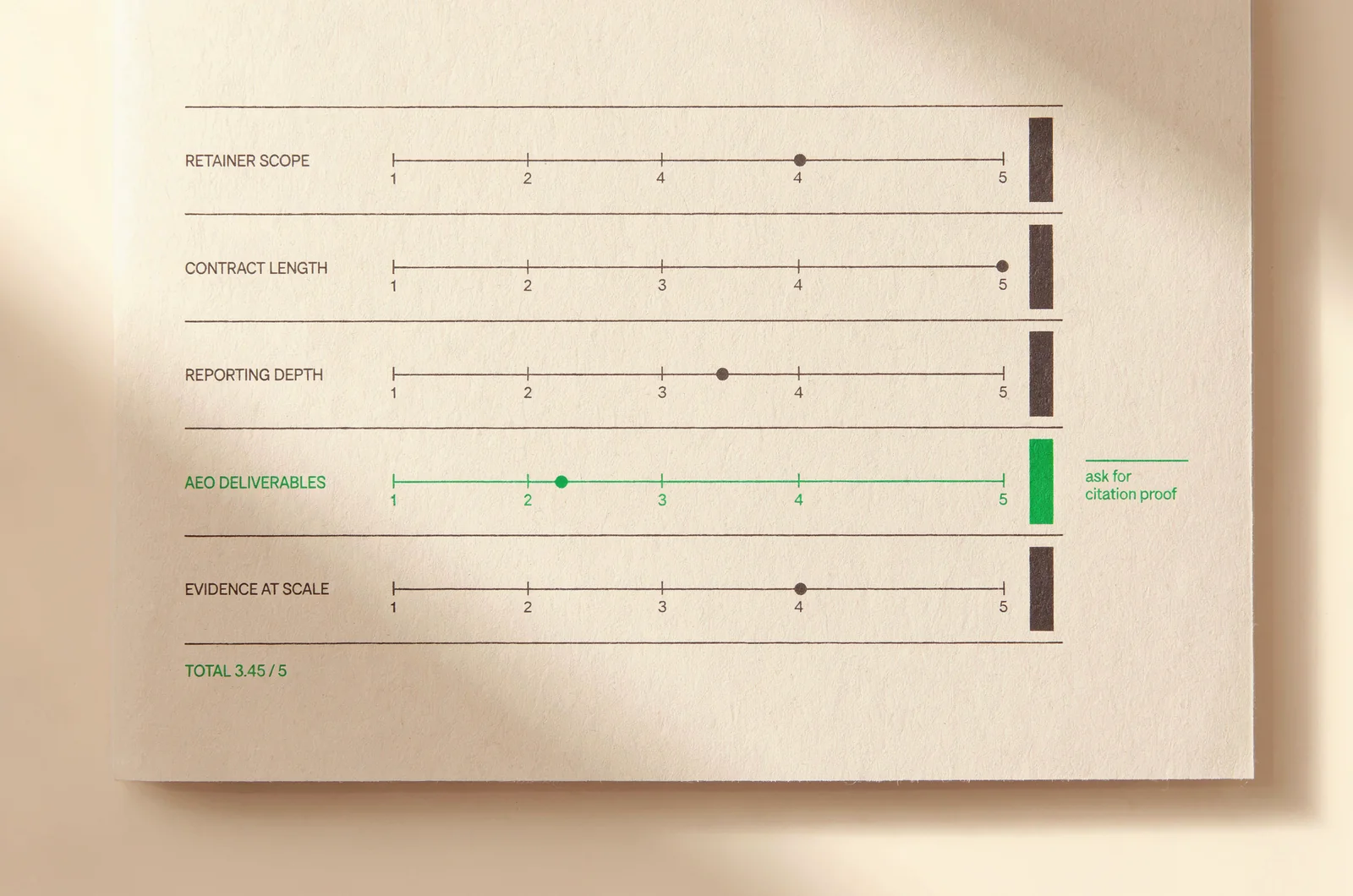
| Criterion | What a 5 looks like | What a 1 looks like |
|---|---|---|
| Retainer scope | Written breakdown of technical, content, links, reporting and AEO hours | Vague "full-service SEO" with no hour allocation |
| Contract length | 3-month minimum, 30-day notice thereafter | 12-month minimum, 90-day notice, auto-renewal |
| Reporting depth | Connects activity to ranking change to pipeline, with a named analyst | Monthly PDF of rankings and sessions, no analysis |
| AEO deliverables | Citation tracking and share-of-voice reporting as live KPIs | "We're exploring AI search" with no deliverable |
| Evidence at your scale | Two references at your budget, redacted sample report | Case studies from enterprise clients only |
Two rules for using this. Score before the pitch, not after, because proposals are designed to move your criteria. And treat any row where you cannot get a straight answer as a 1, since ambiguity in the sales process usually reflects ambiguity in delivery.
If you want a faster version, build a one-page checklist with these five rows and a yes/no column for "answered in writing". Agencies that answer in writing are the ones whose scope survives contact with month three.
Where AI-assisted content operations fit alongside a retainer
There is a separate decision running underneath the agency choice, and it changes what you should buy.
Agencies bill for content production inside the retainer, and content volume is usually the first thing squeezed when the fee is fixed. That is the gap AI-assisted content operations address: not replacing strategy, but absorbing the production load so the retainer's senior hours go to technical work, internal linking architecture and measurement rather than drafting.
The practical split looks like this. The agency owns strategy, technical remediation, link acquisition and interpretation of results. An AI content platform owns the repeatable production layer — keyword-to-calendar planning, drafting against your site's existing context, quality scoring before publication, and CMS sync. SiaSEO sits in that second layer: it reads a site to build a content calendar and draft articles that match existing structure, then scores them for quality and semantic drift before publishing. That is a neutral option to weigh alongside a retainer, not a substitute for the judgement a good agency brings to the technical and commercial side.
The reason this matters for your evaluation is that it changes the questions you ask. If production is handled elsewhere, you can push the agency on work that genuinely needs senior attention and hold them to a smaller, sharper scope. If production stays inside the retainer, ask how many senior hours per month are protected from drafting work.
Questions that separate a real answer from a rehearsed one
Bring these to the second call, after the pitch. The first call is for positioning; the second is for evidence.
On scope: "Send me the hour allocation for a typical month at this fee." An agency that cannot produce this has not scoped your account.
On contract: "What are the exit terms if we stop after the minimum term?" Get this in the proposal, not in a verbal aside.
On reporting: "Show me a redacted report from a client at our budget." Templates are not evidence.
On AEO: "Which AI platforms do you track citations in, and how do you report share of voice?" Vague answers are common here; a specific answer tells you the capability is live.
On measurement: "What would make you tell us the retainer isn't working?" An agency with a real answer has a review process. One that deflects does not.
On the team: "Who does the work, and how many accounts does that person hold?" Named individuals with visible capacity beat a rotating bench.
On references: "Two clients at our scale, and I'll ask them about reporting." Reference calls you control are worth more than testimonials the agency selects.
Weighing the trade-offs before you commit
Three tensions run through every UK agency decision, and naming them makes the choice clearer.
Cost against senior time. A lower retainer usually buys more junior hours. If your site needs technical judgement, a smaller scope with senior attention beats a larger scope with execution you have to supervise.
Speed against compounding. Content and link work compound slowly. An agency promising visible movement in month one is either doing something risky or measuring the wrong thing. Ask what the 6-month and 12-month expectations are, in writing.
Coverage against depth. Agencies claiming technical, content, digital PR and AEO excellence at a mid-market fee are spreading thin. Decide which two capabilities matter most to your situation and weight the shortlist accordingly.
The evidence base for this decision is thinner than the market suggests. There is no independent ranking of UK agencies, the top organic result is a forum thread, and the published lists are largely self-interested. That is not a reason to avoid the decision. It is a reason to run the comparison yourself, with written answers, scored criteria, and references at your own scale.
Testing AEO claims specifically
If AEO capability is on your shortlist criteria, the questions get more specific. The market vocabulary is unsettled, so you are testing for substance behind whichever label the agency uses.
Ask which platforms they track, what a citation looks like in their reporting, and how they distinguish a citation from a mention. Ask whether they measure branded search volume trend, since that is one of the KPIs agencies have begun formalising in restructured service definitions. Ask how they handle content that ranks well but is not being extracted into AI answers, because that is a distinct problem from ranking.
A useful sanity check: Google Search Central states that AI Overviews and AI Mode draw on the same core search systems, with no special technical requirements beyond standard SEO fundamentals. If an agency's AEO proposal involves work with no relationship to crawlability, indexation, content quality or structured data, ask them to connect it back. The ones who can are the ones whose AEO work will still make sense in a year.
How published agency lists distort your shortlist
Two sources that rank for this query are worth examining for what they reveal about list-building. A 6 Best GEO SEO Companies for 2026 places its own publisher at number one, then lists Graficodo, Metric Theory, SEOWorks and Second Nature behind it. A Elevate Your Rankings concludes that the publishing agency is the best SEO company in the UK. Neither is evidence of anything except the incentive structure behind ranked lists.
That is not a reason to dismiss them. It is a reason to read them as market maps rather than verdicts. A list tells you which names are competing for the same positioning and which service categories they are claiming. It does not tell you which one fits your site, your budget or your internal capacity.
Use them for vocabulary. If four of five entries lead with GEO or AI-search language, that is a signal about what the market is selling this year, and it tells you which claims to interrogate hardest in the pitch. If none of them mention contract length or reporting structure, that is a signal about what buyers are not being told. Then go back to your own criteria and score on those. The list gave you names; the matrix gives you a decision.
What a defensible shortlist looks like at the end
By the time you reach a signature, you should be able to state four things in writing. The scope, broken into hours by work type. The minimum term and the notice period after it. The reporting structure, with a named person accountable for the analysis. And the AEO deliverables, named specifically enough that you could check them in month two.
If any of those four is missing, the gap will surface later as a dispute rather than a decision. The agencies worth signing are the ones that treat those four questions as reasonable, because they have already answered them for every other client.