How to Rank in AI Search as Organic Clicks Keep Falling
A step-by-step walkthrough for ranking in AI search results as AI Overviews absorb organic clicks, covering citations, brand mentions, and visibility tracking.

Your rankings held, your impressions held, and your clicks fell anyway. That is the signature of AI Overviews and AI Mode absorbing the click that used to be yours. The recovery task is not "do more SEO" in the old sense. It is to become the source the answer engine quotes, so the impression still carries your brand even when the session ends without a visit.
This walkthrough covers the full sequence: diagnosing which queries lost clicks, restructuring pages so an answer engine can lift a clean passage, earning the third-party citations that models weight heavily, tracking whether any of it worked, and knowing when to stop optimizing a page and start rebuilding the query set. It assumes you already run technical SEO and have Search Console access. Budget two to four weeks for the first measurable signal, and treat the steps as a loop rather than a one-time project.
Establish the Baseline Before You Change Anything
You cannot recover visibility you have not measured. Start by separating three numbers that most dashboards blend together: impressions, clicks, and average position, segmented by query.
Pull a 16-month window in Search Console and compare the last 90 days against the same period a year earlier. Sort by impression change, not click change. Pages that lost clicks while holding impressions are the AI-absorption cases. Pages that lost both are ordinary ranking declines and belong in a different workstream.
Then classify each declining query into one of three buckets:
- Definitional and factual queries ("what is X," "how much does Y cost"). These are the most exposed to AI Overviews because the answer is short and extractable.
- Comparison and evaluation queries ("X vs Y," "best Z for small teams"). Partially exposed. The engine summarizes, but buyers still click through to verify.
- Task and troubleshooting queries ("how do I configure X," "why is my Y failing"). Least exposed. The reader needs a sequence, and sequences are hard to compress into a paragraph.
That classification tells you where to spend effort. A page ranking third for a definitional query will not recover its old click volume no matter how well you optimize it. A page ranking third for a configuration query often will.
Set one success metric before you start. For most teams the honest one is citation share: the percentage of tracked queries where your domain appears as a named source in the AI answer. Clicks become a lagging indicator of that. Searchscore's 2026 guide to ranking in AI search makes the same argument, framing visibility as a citation problem rather than a position problem.
Restructure Pages So an Answer Engine Can Lift a Passage
Answer engines do not rank pages. They assemble answers from passages, and they prefer passages that stand alone. A paragraph that says "as noted above, this approach works well" is unusable to a retrieval system. A paragraph that says "schema markup for FAQ pages requires Question and Answer types nested under FAQPage" is directly quotable.
Rewrite your highest-value pages with that constraint in mind. The practical moves:
Lead each section with the answer, then explain. Put the direct response in the first sentence of the section, before context, caveats, or history. Retrieval systems weight early sentences in a section more heavily, and readers scanning for a specific fact get it faster.
Keep one idea per paragraph and name the subject explicitly. Replace pronouns with the entity. "It reduces latency" becomes "Edge caching reduces latency." The model needs the noun to attribute the claim correctly.
Use the question as the heading, verbatim where it matches real query phrasing. If people search "how long does indexing take," an H2 that reads "How Long Does Indexing Take" gives the engine a clean question-answer pair. This is also where intent mapping shifts: the query set you optimize for is now the set of questions the engine answers, not the set of head terms you want to rank for. The AI search intent mapping process is worth running before you rewrite anything, because it changes which pages deserve the effort.
Add structure the engine can parse. FAQ schema, HowTo schema where it genuinely applies, clean heading hierarchy, and tables for anything comparative. Structured data does not guarantee a citation, but it removes ambiguity about what your page claims. The AI search citation tactics covered in more depth elsewhere on this site go further into schema specifics.
Cut the preamble. Long introductions, mission statements, and "in this article we will cover" paragraphs are dead weight. Google's own guidance on AI features states that AI Overviews and AI Mode run on core Search ranking systems with no separate AI index, which means the fundamentals still apply: crawlable, indexable, useful pages. There is no separate AI ranking lever to pull.
One caution before you start deleting: keep the pages that earn links. A page that ranks for a definitional query and attracts editorial citations is still doing work even if its own click volume fell. Measure the citation value before you consolidate.
Earn the Third-Party Mentions Models Actually Weight
Here is the part most teams underinvest in. Language models do not only read your site. They read what other people say about you, and they weight corroboration. A claim that appears only on your domain reads as marketing. The same claim repeated in an industry publication, a review site, a documentation page, or a well-moderated community thread reads as fact.
That is why brand mentions now function as a ranking input in a way they did not a decade ago. The mechanism is straightforward: when a model assembles an answer, it draws on sources it has seen make consistent claims. If your brand appears in those sources alongside the claim, you become part of the answer.
Build the mention surface deliberately:
- Get into the comparison and roundup content that already ranks. If a third-party listicle covers your category, being absent from it is a citation gap. Reach out with factual corrections and specifics, not a pitch.
- Publish original data. Survey results, benchmark numbers, and aggregate platform data get cited because nobody else has them. This is the highest-leverage mention play available to a mid-market team.
- Maintain the entity facts. Consistent naming, a complete knowledge panel, accurate descriptions across directories. Models resolve entities; ambiguity costs you citations.
- Answer in public where the questions are asked. Technical forums, documentation comments, and community threads feed retrieval systems. Answer substantively and attribute the answer to your organization.
The distinction between generative engine optimization and classic SEO matters here, and it is worth getting the vocabulary right before you brief anyone. The GEO vs SEO difference is mostly about where the leverage sits: classic SEO optimizes a page's position, while GEO optimizes whether a claim about your brand exists in enough places to be treated as established.
Track your mention rate the same way you track rankings. Pick 20 queries that matter commercially, run them through the major engines monthly, and log whether you appear, in what form, and which competitor appears instead. That log is your real dashboard.
Match Content to the Query Patterns Engines Cite
Not all queries get cited the same way. Long, specific, multi-clause queries tend to produce answers that name sources, because the answer requires synthesis and synthesis requires attribution. Short head terms tend to produce answers that state facts without naming anyone.
That asymmetry is an opportunity. If you want citations, write for the query shapes that generate them. The long-tail citation patterns that consistently earn attribution share a few traits: they contain a constraint ("for B2B SaaS," "under 50 employees"), they imply a comparison or a decision, and they cannot be answered with a single sentence.
Practically, that means building pages around constrained questions rather than broad topics. "Content marketing" is a losing target. "How to structure a content calendar for a five-person B2B marketing team" is a winning one, because the engine has to assemble the answer and will name the sources it assembles from.
Two structural notes that follow from this:
First, your page needs to actually answer the constrained question, not gesture at it. If the query includes a team size, your page should address team size explicitly. Partial matches get skipped.
Second, keep the answer current. Time-sensitive claims need visible dates. If your page says "as of 2025" and the engine is answering in 2026, it will prefer a fresher source. Add a last-reviewed date and honor it.
Verify the Work With Visibility Tracking That Survives Scrutiny
Optimization without verification is guesswork, and AI search makes verification harder because the click no longer confirms the impression. You need a tracking layer that does not depend on sessions.
Build it from three signals:
Citation presence. For each tracked query, record whether your domain appears in the AI answer, at what position in the source list, and which URL was cited. Run this weekly. Manual checking is viable up to about 50 queries; beyond that you need a platform.
Brand mention volume. Count new mentions across publications, forums, and review sites monthly. This is the leading indicator for citation presence, usually by four to eight weeks.
Search Console impressions with flat clicks. Rising impressions and flat clicks on a query means the answer is being shown and you are not in it, or you are in it and the reader did not need to click. Both are informative. Segment by query to tell them apart.
For teams running this at scale, the tracking problem is really a content operations problem. If you are producing 30 or more articles a month, manual citation checks stop being feasible, and the workflow needs to fold visibility tracking into the same system that produces the content. That is the gap SiaSEO's LLM visibility tracking is built to close: it reads your site, drafts against your actual context, scores the output, and tracks whether the published work shows up in AI answers, so the citation log updates as part of publishing rather than as a separate quarterly audit.
A short tool idea if you want to build this yourself: a citation tracker that takes a list of 20 queries, runs them through each major engine on a schedule, and outputs a simple matrix of query by engine with your domain marked present or absent. Even a spreadsheet version of that matrix will change how your team prioritizes within a month.
Diagnose the Cases That Do Not Move
If a page has been restructured, cited externally, and tracked for six weeks with no citation gain, work through this list in order.
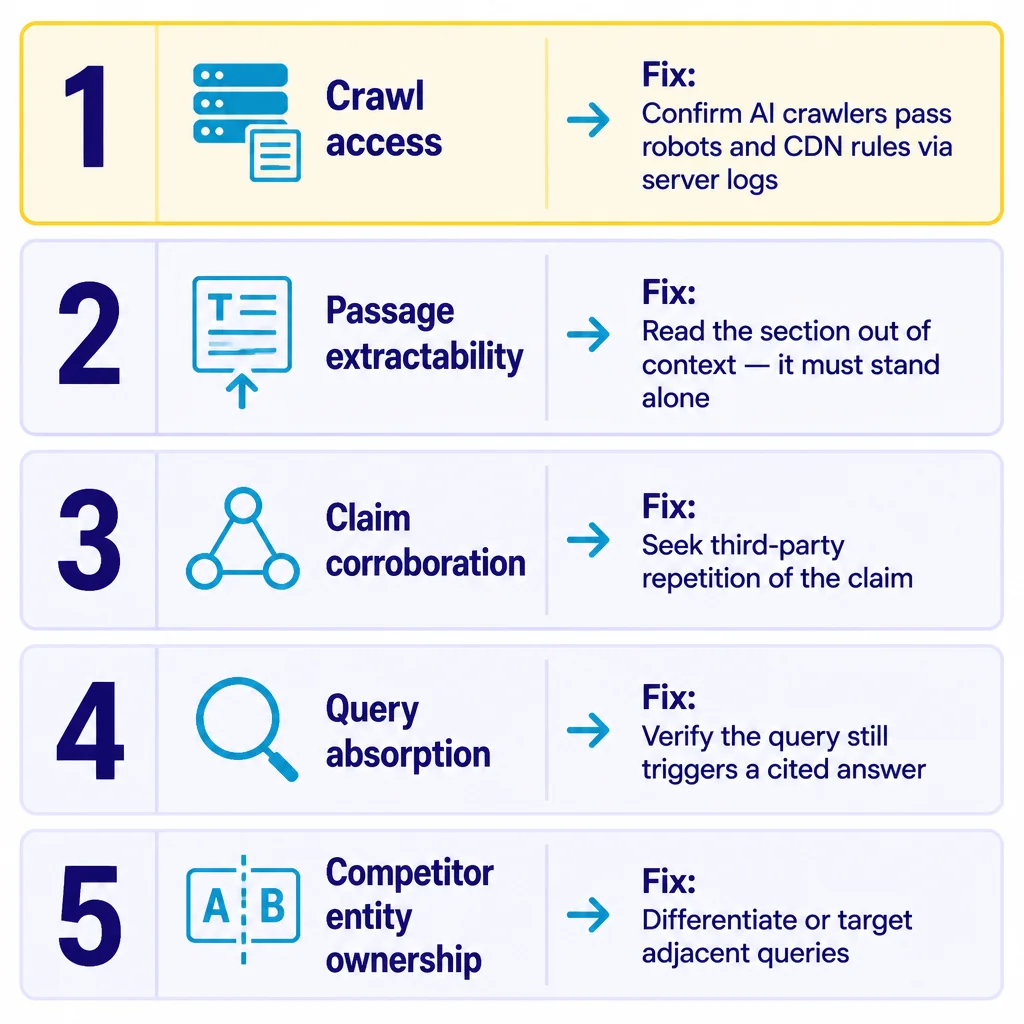
The page is not being retrieved at all. Check crawl access. If AI crawlers are blocked at the robots or CDN level, nothing else matters. Verify that your robots directives allow the crawlers you intend to allow, and confirm with server logs rather than assuming.
The passage is not extractable. Read the section out of context. If it does not make sense without the preceding three paragraphs, it will not be quoted. Rewrite it to stand alone.
The claim is uncorroborated. If your page is the only source making a specific claim, the engine has no reason to attribute it. Get the claim into a third-party source or soften it.
The query is fully absorbed. Some definitional queries now resolve entirely inside the answer with no citation. There is no recovery for those. Reallocate the effort to constrained, task-oriented queries where citations still happen.
A competitor owns the entity. If a competitor is named in nearly every answer for your category, you are fighting an entity association, not a page. That takes months of consistent third-party mention work, not a rewrite.
The honest framing: some of your lost clicks are not recoverable, and the sooner you accept that, the sooner you can move the budget to queries where visibility still converts. The teams handling this well are not defending every page. They are triaging.
What to Do in the Next Two Weeks
Week one: pull the Search Console comparison, classify declining queries into the three exposure buckets, and pick the ten pages with the highest commercial value and the lowest absorption risk. Week two: rewrite those ten pages with answer-first sections, add the structured data that fits, and start the citation log for the 20 queries you will track monthly.
Then leave it alone for four weeks before judging results. Citation changes lag content changes, and mention changes lag outreach. The teams that quit at week three are usually the ones that would have seen movement at week six.
If you want the terminology settled before you brief your team, the GEO SEO whitepaper covers the definitions and the operating model in one place.
Questions That Come Up Mid-Recovery
Does blocking AI crawlers protect my traffic? No. Blocking the crawler that feeds AI answers removes you from the answer without restoring the click. The click is already gone. Blocking only makes you invisible in the surface that replaced it.
How long until citations appear after a rewrite? Four to eight weeks for pages that were already indexed and had some authority. New pages take longer, and pages with no third-party mentions may never get cited regardless of quality.
Should I stop publishing new content while I fix old pages? No, but slow the cadence and raise the bar. A steady trickle of well-structured, constrained-topic pages outperforms a high-volume stream of broad ones in AI answers, because the constrained pages are the ones that get attributed.
Do I need a separate AI SEO strategy from my regular SEO? For Google, no. Google states that AI Overviews and AI Mode use core Search ranking systems with no separate AI index. For ChatGPT, Perplexity, and other engines, the retrieval and citation behavior differs enough that a separate tracking layer is worth having.
What if my category is fully absorbed by AI answers? Shift the target. Move from definitional queries to implementation, troubleshooting, and constrained decision queries. Those still produce citations because they require synthesis the engine cannot complete from a single source.