Long Tail Keyword Patterns That AI Search Engines Cite
Why long tail keywords win AI search citations: exact-match phrasing, structured answers, and semantic depth that LLMs prefer over generic head terms.
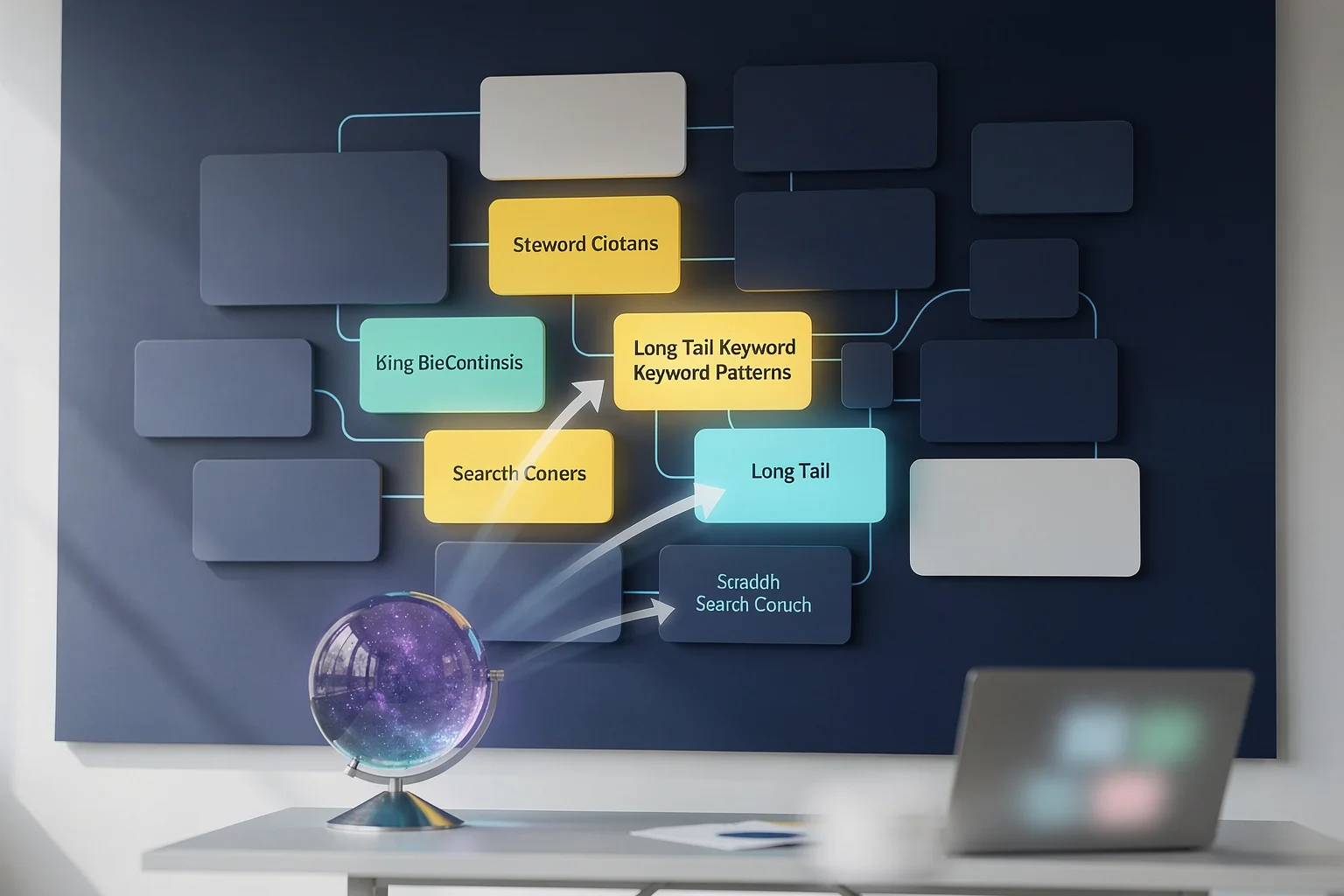
The gap between ranking on Google and getting cited in AI search answers has widened into a chasm. Research from 2026 shows the overlap between top organic positions and AI citations has collapsed from roughly 75% to between 17% and 38%, depending on which engine you check. That means your page can sit at position one and still never appear in a Perplexity summary, a Gemini response, or a Bing Copilot answer.
What replaces raw ranking power? Specificity. AI search engines need extractable, attributable sentences they can quote without flattening meaning. Long tail keywords—those precise, multi-word queries that signal intent rather than vague interest—create the exact conditions LLMs need to pull a clean citation. But not all long tail patterns perform equally. Some structures get cited repeatedly; others sit in the index, technically eligible but never chosen.
This list ranks the long tail keyword patterns that show up most often in AI search citations, based on SERP feature analysis, citation studies, and content scoring data. Each entry includes what the pattern looks like in practice, why AI engines favor it, who should prioritize it, and where it falls short.
The Selection Logic: What Makes a Pattern Citation-Worthy
Before the rankings, the criteria. AI search engines choose sources through a pipeline that resembles retrieval-augmented generation more than traditional ranking. A page must be discoverable, parseable, specific enough to quote, and supported well enough that a generated answer can use it without distorting meaning.
HubSpot's 2026 State of AEO research found that pages with more heading depth—H3s and H4s beneath H2s, not flat structures—correlated with higher citation rates. Citations peaked for pages carrying 7 to 15 H2s. The pattern matters because AI engines map query structures onto document structures. A question-shaped query seeks a heading that mirrors that shape.
The patterns below are ranked by citation frequency and structural fit for AI extraction, not by search volume. High volume without extractability wins nothing in generative search.
Pattern 1: Problem-Solution Pairs with Explicit Outcomes
The structure: "[Problem] + [solution] + [quantified result]"
Examples that earn citations:
- "how to reduce customer churn 30 percent SaaS"
- "fix duplicate content penalties recovery time"
- "lower CAC with content marketing case study"
Why AI engines cite it: LLMs need concrete claims they can attribute without hedging. A problem-solution pair with a number gives them a self-contained sentence that answers the query directly. The pattern maps cleanly to how people ask questions in conversational search—"how do I fix X" rather than "X."
Best fit for: B2B SaaS companies, agencies publishing case studies, any site with original performance data.
Limitation: Requires real numbers. Fabricated statistics get filtered by quality scoring or trigger attribution penalties when engines cross-check sources.
Verdict: Highest citation potential for sites with proprietary data. Without numbers, the pattern degrades to generic advice that AI engines can synthesize from dozens of sources.
Pattern 2: Comparison Queries with Differentiated Options
The structure: "[Option A] vs [Option B] for [use case]" or "[Tool category] comparison [year]"
Examples:
- "Notion vs Confluence for technical documentation teams"
- "best CRM for real estate agents 2026 comparison"
- "Ahrefs vs Semrush for local SEO"
Why AI engines cite it: Comparison content provides structured differentiation that LLMs need to generate balanced answers. The format naturally produces extractable attributes—pricing, features, best-fit scenarios—that map to how AI engines construct responses.
HubSpot's research notes that comparison and definition pages carry the highest citation potential for B2B industries. The engine can pull a specific contrast rather than synthesizing a vague summary.
Best fit for: Review sites, B2B software vendors with honest competitor analysis, industry publications with testing methodologies.
Limitation: Superficial comparisons get outranked by detailed ones. AI engines increasingly weight depth over breadth. A 2,000-word comparison with hands-on testing beats a 500-word table every time.
Verdict: Essential for commercial investigation queries. The pattern fails when writers avoid taking positions or omit clear recommendations.
Pattern 3: Process and Method Queries with Numbered Steps
The structure: "how to [achieve outcome] in [number] steps" or "[Process name] workflow for [audience]"
Examples:
- "how to migrate WordPress to static site in 8 steps"
- "content audit workflow for enterprise marketing teams"
- "set up GA4 ecommerce tracking without developer"
Why AI engines cite it: Step structures provide scannable, sequential extraction points. Each H2 or H3 becomes a potential quote. The numbered format signals completeness, which reduces hallucination risk for the generating model.
This pattern connects directly to AI search citation tactics around structured data and formatting. Pages with clear step hierarchies and corresponding HowTo schema see higher inclusion rates in AI Overviews.
Best fit for: Tutorial sites, SaaS onboarding documentation, technical marketing teams with implementation expertise.
Limitation: Generic steps ("research your keywords, write your content, publish") add no value. AI engines already know the standard sequence. Citation requires specific tool configurations, edge cases, or failure modes that demonstrate lived experience.
Verdict: Reliable citation pattern when steps include tool-specific details, screenshots, or troubleshooting notes. Avoid without original process insights.
Pattern 4: Definition and Concept Clarification Queries
The structure: "what is [term] in [context]" or "[Term] vs [related term] difference explained"
Examples:
- "what is semantic drift in AI content generation"
- "GEO vs SEO explained for marketing directors"
- "canonical tag vs 301 redirect when to use each"
Why AI engines cite it: Definitions require precise, bounded explanations. LLMs prefer sourcing these from pages that state the definition upfront, then elaborate with context and examples. The pattern reduces ambiguity in generated answers.
This aligns with GEO SEO fundamentals: generative engine optimization prioritizes content that functions as "auditable evidence packages" with explicit definitions, named authors, and testable claims.
Best fit for: Educational content hubs, glossary builders, B2B companies defining category terms they want to own.
Limitation: Commodity definitions—"SEO is search engine optimization"—get synthesized without citation. The pattern requires definitional depth: etymology, edge cases, common misconceptions, and relationship to adjacent concepts.
Verdict: Strong for establishing topical authority. Weak without surrounding semantic cluster content that demonstrates expertise beyond the definition itself.
Pattern 5: Tool and Resource Queries with Specific Constraints
The structure: "best [tool category] for [constraint]" or "[Tool] alternative that [specific capability]"
Examples:
- "best keyword research tool for multiple client dashboards"
- "Surfer SEO alternative with API access"
- "free schema markup generator for local business"
Why AI engines cite it: Constraint-specific queries signal purchase intent or implementation urgency. AI engines cite these when they need to acknowledge limitations, pricing tiers, or integration requirements that generic roundups gloss over.
The constraint creates extraction value. "Best SEO tool" produces generic synthesis. "Best SEO tool for agencies managing 20+ clients" requires specific attribution.
Best fit for: Software review sites, consultants with tool-agnostic expertise, vendors with transparent feature comparisons.
Limitation: Tool landscapes change fast. A 2024 recommendation for a discontinued product damages citation trust. Freshness signals—visible last-updated dates, current-year references—matter heavily.
Verdict: High commercial value, moderate maintenance burden. Best for teams with ongoing tool testing workflows.
Pattern 6: Temporal and Trend Queries with Forward Projection
The structure: "[Topic] trends [year]" or "what changed in [field] [timeframe]"
Examples:
- "AI search optimization strategies 2026"
- "how Google SGE impact on organic traffic changed Q2"
- "content velocity benchmarks SaaS this year"
Why AI engines cite it: Temporal queries require current information that training data lacks. LLMs must retrieve from indexed sources. Pages with explicit dates, forward projections, and trend analysis become mandatory citations.
This pattern benefits from AI search intent mapping: temporal queries carry high informational intent with low synthesis confidence, forcing engines to attribute rather than generate.
Best fit for: Industry analysts, research firms, publications with quarterly reporting rhythms.
Limitation: Requires genuine forecasting or original data analysis. Restating known trends without new angle or evidence produces uncited synthesis fodder.
Verdict: Essential for news-adjacent content strategies. The pattern degrades quickly without consistent publishing cadence and data partnerships.
Pattern 7: Audience-Specific Adaptation Queries
The structure: "[Strategy] for [specific audience segment]" or "how [role] should approach [task]"
Examples:
- "content calendar automation for solo marketing founders"
- "SEO pricing packages for nonprofit organizations"
- "how technical founders should write landing page copy"
Why AI engines cite it: Audience specificity reduces ambiguity. A general guide to content calendars requires heavy synthesis. A guide calibrated for solo founders with no design support provides extractable constraints and tool recommendations.
This pattern connects to GEO vs SEO explained: generative engines prioritize content that acknowledges user context explicitly, rather than assuming universal applicability.
Best fit for: Niche B2B services, vertical SaaS companies, consultants with deep segment expertise.
Limitation: Requires authentic audience knowledge. Generic persona dressing—"for busy professionals"—adds no extraction value. Specificity means named constraints: team size, budget range, regulatory environment, technical stack.
Verdict: Strong differentiation mechanism in saturated topics. The pattern fails when audience segmentation is cosmetic rather than structural.
Pattern 8: Error and Troubleshooting Queries with Diagnostic Structure
The structure: "[Error message or symptom] + [cause] + [fix]" or "why [system] shows [unexpected behavior]"
Examples:
- "why Google Search Console shows discovered currently not indexed"
- "fix structured data validation errors in Shopify"
- "AI Overviews not showing for branded queries why"
Why AI engines cite it: Troubleshooting content provides high-confidence extraction. The diagnostic structure—symptom, cause, fix, prevention—maps directly to how AI engines construct problem-resolution answers.
Best fit for: Technical support documentation, agencies with client troubleshooting expertise, product companies with transparent error handling.
Limitation: Requires verified solutions. Speculative fixes that don't resolve the issue generate negative citation signals when users report failure.
Verdict: Highest trust-building potential, highest accuracy requirement. Best for teams with direct access to platform support channels or internal testing environments.
What These Patterns Share: The Extraction Architecture
Across all eight patterns, three structural elements determine whether AI engines can actually use your content:
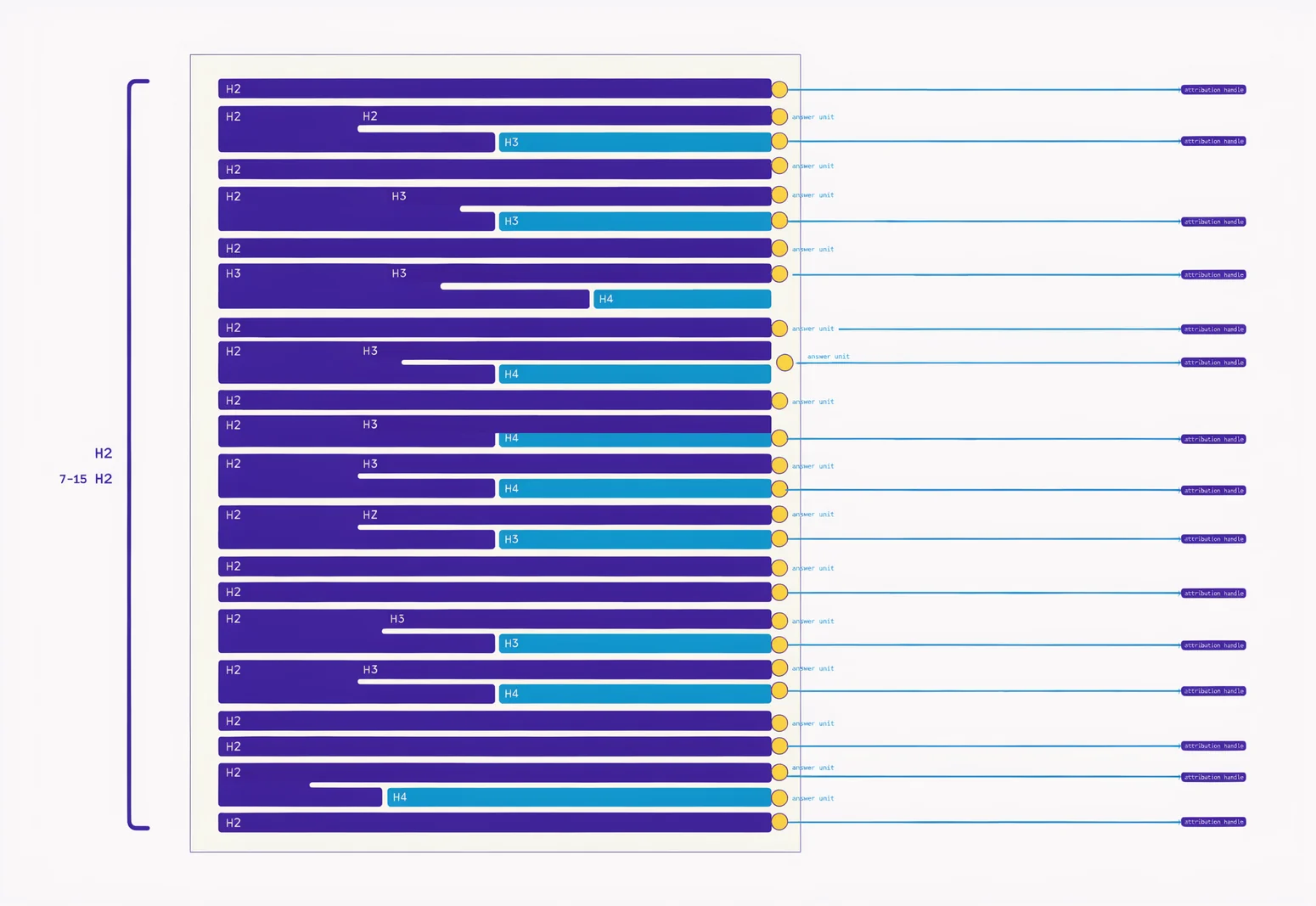
Heading depth that mirrors query structure. Flat articles with H2-only structures force LLMs to synthesize across large text blocks. H3 and H4 subsections create precise extraction targets. The 7-to-15 H2 range identified by HubSpot research provides enough granularity without fragmentation.
Self-contained answer units. Each section should answer a specific question completely enough to quote in isolation. Cross-references are fine, but no section should require reading three others to understand its core claim.
Attributable specificity. Numbers, dates, tool names, version numbers, and named sources create extraction handles. Vague qualifiers—"many," "some," "often"—force synthesis and reduce citation probability.
Google's guidance on AI Features and Your Website confirms that no additional technical requirements exist beyond standard search eligibility—indexing, snippet eligibility, policy compliance. The differentiation happens in content architecture, not hidden markup.
Reader Questions: What Teams Ask About AI Citation Patterns
Do I need to abandon head-term keywords entirely?
No. Head terms still drive discovery and branded search. The shift is in allocation: reserve head terms for pages with strong domain authority, and build long tail patterns into new content specifically designed for AI extraction.
How quickly does AI citation data update?
Citation visibility shifts faster than traditional rankings. Pages published or updated with current-year dates and fresh statistics can appear in AI answers within days, though sustained citation requires consistent quality signals.
Can I optimize for multiple AI engines simultaneously?
Partially. Perplexity, Gemini, Copilot, and Google AI Overviews share retrieval preferences for structured, specific content, but each weights sources differently. Perplexity favors academic and primary sources; Gemini integrates more heavily with Google's knowledge graph; Copilot surfaces Microsoft ecosystem content. The structural patterns above apply across engines, but source authority signals vary.
Does FAQ schema still matter for AI citations?
Schema supports machine parsing but doesn't guarantee inclusion. Google's guidance notes that FAQ, HowTo, and Article markup may support AI Overviews but aren't guaranteed. Schema amplifies well-structured content; it cannot rescue poorly structured content.
Patterns in Practice: Building Your Keyword Stack
The ranked patterns above function as a decision framework, not a rigid template. Most teams should start with pattern 1 (problem-solution with outcomes) if they have proprietary data, pattern 3 (process steps) if they have implementation expertise, and pattern 4 (definitions) if they're building topical authority in a defined category.
The critical step is mapping each pattern to your existing content inventory. Audit current pages for extraction fitness: heading depth, self-contained sections, attributable specifics. Most legacy content fails on at least two of three. Refresh priority pages before building new, or you'll compound structural debt.
For teams scaling this analysis across hundreds or thousands of pages, AI keyword research guide workflows can identify which long tail patterns already appear in your search console data but lack optimized landing pages.
Where Citation Strategy Meets Content Operations
Optimizing your content for inclusion in ai search answers is not a one-time audit. It's a production discipline. The patterns that win citations in 2026 will shift as AI engines improve at synthesis and as publisher strategies converge on the same structural signals.
The sustainable advantage is operational: building content systems that can test pattern performance, refresh temporal elements, and maintain heading architecture at scale. Teams that treat citation optimization as a template problem—add FAQ schema, write shorter paragraphs—will see diminishing returns. Teams that treat it as a measurement problem—track which patterns produce citations for which query types, then iterate—will maintain visibility as the engines evolve.
References
- Google Search Central — , which could ... commodity content (such as " ... Waived the Inspection & ... Look Inside the ... takes that go ... what your users ... , and avoid overdoing it. While it ...
- What high — HubSpot’s State of AEO found that pages with more headings and more heading depth (think: H3s and H4s, not just H2s) correlated with higher citation rates — and that citations