
Keyword Research for AI Search: How Intent Mapping Changes in 2026
AI search engines read intent, not just keywords. Learn how to rebuild your keyword research for semantic clusters and conversational queries in 2026.

For years, an SEO team’s keyword list was the same object it had been since the early 2000s: a spreadsheet of target terms, a search-volume column, a difficulty score, and a plan to sprinkle those exact strings into title tags and H2s. That object is now breaking. By mid-2026, AI-generated search results appear in 43% of Google queries, up from 15% a year earlier, according to Similarweb data. The average AI Mode query is three times the length of a traditional search query, Google’s own research shows. Those long, conversational questions seldom contain the keywords a team spent months tracking. The shift is structural, and keyword research ai search strategies that ignore it are already costing traffic.
This article isn’t another “SEO is dead” piece. It’s a map of how the underlying mechanics have changed, and what a working intent-mapped research process looks like now. We’ll move from entity modeling and retrieval-augmented generation to audit frameworks and tooling — including where site-aware automation can shoulder the load.
When Search Stopped Matching Strings
Traditional keyword research optimizes for exact or near-exact lexical match. Google’s early ranking system treated a page as relevant to a query largely because the query’s words appeared in the page’s text, often in particular positions. That model began eroding with Hummingbird in 2013 and accelerated with BERT, MUM, and now AI Overviews. Where a searcher once typed “sink drain sulfur smell”, in 2026 they type “my kitchen sink won’t drain and there’s a strong sulfur odor coming from the pipe — is this something I can fix myself or do I need a plumber?” The second query doesn’t match any commodity keyword in a legacy list. Yet it’s the query that actually gets answered.
This shift has upended keyword volume as a primary signal. When the surface form of a query becomes a variable rather than a constant, the search volume of any one phrase loses predictive power for traffic potential. Teams need to map the intent space that a page occupies, not the phrases it repeats. The algorithm shifts reshaping search have made relevance a function of relationship strength between entities rather than of term frequency.
Entity Clusters as the New Keywords
An entity, in search taxonomy, is a uniquely identifiable thing: a person, place, concept, product, event. Google’s Knowledge Graph has catalogued billions of them, each with attributes and interconnections. When a query arrives, modern search systems don’t just tokenize words — they recognize the entities mentioned and attempt to resolve the relationship the searcher is exploring. A query about “how to clean a Dyson V15 filter” activates the entity Dyson V15 (with subtype vacuum model), the task cleaning a filter, and the implied resolution type step-by-step instructions.
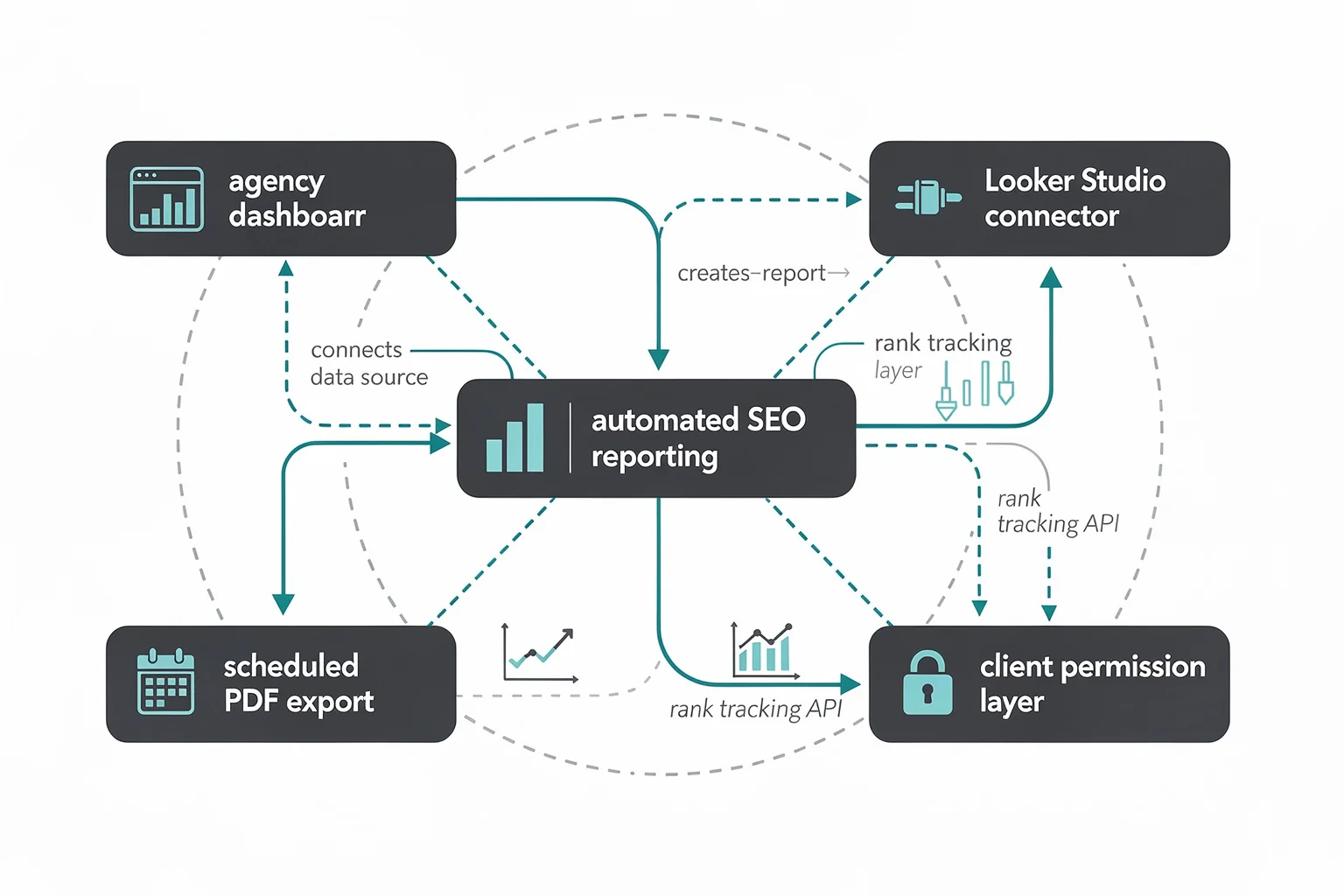
Intent mapping replaces the keyword list with an entity cluster: the set of entities a page should cover to be the best answer for a domain of related questions. For a B2B SaaS company, the cluster might center on automated SEO reporting, link to agency client dashboards, and to Google Looker Studio connectors. Each relationship node becomes a content unit, and the keyword research task morphs into cluster definition and coverage analysis. This approach leans heavily on semantic SEO frameworks for AI search, which walk through entity scoring and topical authority signals in detail.
Wikipedia, for its part, describes keyword research as generating “a large number of terms that are highly relevant yet non-obvious to the given input keyword.” That definition still works — only now the “input keyword” is a central entity, and the “highly relevant terms” are the conversational variants users actually speak.
Why AI Search Doesn’t Need Your Exact Phrase
To understand why a page can rank for a query that never appears in its copy, you have to look at the retrieval pipeline. Modern systems embed both queries and documents into high-dimensional vector spaces where semantic similarity is measured by angular distance, not by n-gram overlap. When Google’s AI Overview or Bing Copilot assembles an answer, it often pulls from multiple passages across different sites, recombining them into a new text. The system selected those passages because their entity profiles matched the intent of the question, not because they contained a specific keyword.
This retrieval-augmented generation (RAG) pattern makes the page’s entity density, predicate clarity, and internal structure far more important than the presence of any single phrase. In practice, that means a plumbing company that has deeply covered the entity kitchen sink drain repair and its connected tasks can surface for dozens of conversational drain queries — even if its content never mentioned “sulfur smell.” The search journey mapping for AI answers framework from our earlier work shows how these multi-step, multi-entity queries break across the traditional keyword funnel.
A helpful operational rule: if you can remove your target keyword from a page and still describe exactly what the page is about, your entity coverage is probably strong. If you can’t, the page likely depends on keyword density to signal relevance, which is a fragile signal in AI search.
Auditing Your Keyword List for AI-Generated Answers
Most teams won’t throw out their existing keyword lists. The practical first step is to audit them for entity density and intent alignment. The process involves three passes:
- Group by shared intent, not shared lemma. Two keywords like “buy ergonomic office chair” and “best chair for back pain home office” share almost no tokens, but they share a strong commercial-investigation intent with the entity office chair. Merge them into a single intent cluster.
- Score each cluster for entity coverage. Within each cluster, list the main entity, its attributes (price, material, adjustability, warranty), and its relationships (compared to alternatives, recommended by physiotherapists, compatible with standing desks). Mark missing properties as content gaps.
- Check for conversational query diversity. For each cluster, use a seed phrase to generate natural-language questions with a tool like AlsoAsked or AnswerThePublic, then verify that your existing page structure can answer those questions without being rewritten for each variant.
This audit is essentially a keyword stack audit methodology, expanded to cover entity and intent signals rather than raw rankings. Combining it with site-aware automation that reads your existing pages and maps their entity profile — as SiaSEO does during its initial site scan — can reduce the manual overhead from days to under an hour.
Building Conversational Query Maps
Once your keyword clusters are audited, you need to generate the conversational queries that your pages must address. Google’s Use Keyword Planner still surfaces related terms, but its suggestions lean toward keyword-centric variants. To build a conversational map, augment its output with:
- People Also Ask scraping: Export the PAA results for each cluster head and treat the questions as entity-intent pairs.
- Search Console query filtering: Look for long queries (10+ words) that generated impressions in the last 16 months. Group them by the core entity they mention.
- LLM-based expansion: Prompt a model with “Generate 20 natural-language questions a user might ask about [entity + intent]” and deduplicate against your existing list.
The goal isn’t to craft a page for each question — that way lies content bloat. Instead, the map shows which pieces of your existing pillar content already answer which subsets of queries, and where you have coverage holes that need a standalone article or an expanded section.
The Google Ads API Keyword Planning page notes that historical keyword metrics refresh monthly and recommends caching results. That monthly cadence aligns with a calendar approach: once you’ve built an entity cluster and its conversational map, lock it for a content cycle, produce the coverage, then re-audit quarterly rather than chasing weekly volume shifts.
Where Semantic Systems Fit into the Pipeline
As the volume of conversational queries grows, the writing bottleneck shifts from “what phrase to target” to “how to produce entity-coherent content at scale.” The hidden risk is semantic drift: when a team publishes 40 articles a month across freelancers and AI drafts, individual pieces start to lose connection to the site’s core entity graph. That drift confuses the search layer, because contradictory entity signals dilute topical authority.
Some platforms now address this by modeling the site’s entity map before any writing happens, then scoring each new draft against that map. SiaSEO, for example, ingests a site’s existing content, extracts its entity profile, and uses that as a constraint layer during AI drafting — so that a new article on marketing automation for mid-market SaaS reinforces, rather than contradicts, the site’s existing coverage of CRM integrations and lead scoring. When you publish through a system that enforces entity consistency, the semantic quality of the overall domain improves with each piece, and you reduce the number of articles that silently underperform because they’re citing an entity the rest of the site disavows.
This is a practical expression of the AI keyword research fundamentals we laid out earlier: the research process doesn’t end at a keyword list — it’s a continuous loop of entity modeling, content generation, and drift detection.
Common Errors When Adopting Intent Mapping
Teams that move from keyword-first to entity-first research tend to trip over the same edges.
Equating entity mapping with topic clustering. Topic clusters are static hierarchies; entity maps are dynamic relationship graphs. A topic cluster places “email marketing” under “digital marketing.” An entity map includes “email marketing,” “Mailchimp,” “open rate,” “CAN-SPAM,” and “marketing automation suite” with directed relationships. The map can answer queries that span multiple branches.
Overvaluing zero-volume conversational queries. Just because a long question could be asked doesn’t mean it will be, at least not at a frequency that moves revenue. Prioritize queries that appear in Search Console impressions or that map to high-intent task entities, not every plausible question an LLM can hallucinate.
Assuming AI-generated content automatically covers the entity graph. An LLM without site-specific entity constraints will produce grammatically fluent text that drifts into generic entity usage — mentioning competitors’ product names, referencing outdated features, or omitting the relationships your audience cares about. The human point-of-view call on what entities define your brand remains the editorial act.
Ignoring the page-level semantics of internal links. Surface-level strategies often overlook how AI internal linking tactics can reinforce entity associations. When a high-authority pillar page links to a supporting article with anchor text that names an entity, the link serves as a predicate — this page is about X — that search systems interpret as a relationship signal.
Questions You’ll Face When Retooling Your Research
How do I prove success without a keyword ranking report? Track entity-level impressions and the share of clicks that come from conversational queries. Google Search Console’s query filter set to long queries (15+ words) often reveals the phrases that drove AI-generated answers. Pair that with a list of tracked entity targets and you get a dashboard that measures relevance coverage, not term positions.
Does entity-based modeling make keyword research obsolete? No. But it changes the object of research from surface forms to the underlying things people ask about. Terms like “keyword research ai search” still matter as entry points, but they’re now indicators of an entity relationship — keyword research intersects with the modality AI search — rather than the final target of a campaign. Research becomes the act of finding the highest-value relationships your site can own.
Which tools support entity extraction and conversational mapping? A range of frameworks exists. Dedicated entity APIs (Google Natural Language, Diffbot), SEO suites that surface topical authority metrics, and site-aware content platforms like SiaSEO that build entity maps from your existing content without requiring manual tagging. The key is to pick one that can ingest your website’s actual entity profile rather than a generic dictionary.
What about GEO vs. traditional SEO terms? There’s an ongoing debate about whether “Generative Engine Optimization” replaces SEO. In practice, the skillsets overlap deeply. What’s new is the need to optimize for the retrieval step — how a page’s entities, predicates, and structure get selected for inclusion in an AI-generated answer. Understanding this distinction early keeps teams from wasting time on narrow strategy pivots.
Building on an AI Search Knowledge Base
Review SiaSEO as the operating system for structured SEO content production. — Get started