Evaluating the Best Keyword Research Tools for Database Freshness
A technical whitepaper examining database refresh cycles, volume discrepancy rates, and SERP accuracy among the best keyword research tools.

Selecting the best keyword research tools requires evidence that their databases can support your publishing decisions. For agencies and SaaS marketing teams targeting Spain and Portugal, that means examining local coverage, observation dates and uncertainty before committing to an annual contract. This whitepaper proposes a reproducible evaluation protocol, with measurement definitions, a hypothetical calculation and purchasing criteria. Its evidence base contains no matched provider exports or independently verified refresh schedules. Provider rankings therefore remain unestablished.
What a freshness assessment can establish
A keyword database assessment should answer a bounded question: does the information available for a specified market remain useful within the team’s decision window?
For this protocol, that window is the period between approving a keyword opportunity and committing production resources. Set it explicitly. A weekly editorial process and a quarterly market review may justify different acceptance thresholds.
The evidence standard begins with a traceable observation. Each record should identify the query, country, language settings, metric, observation time and available provenance. Preserve the original export alongside any normalised working file.
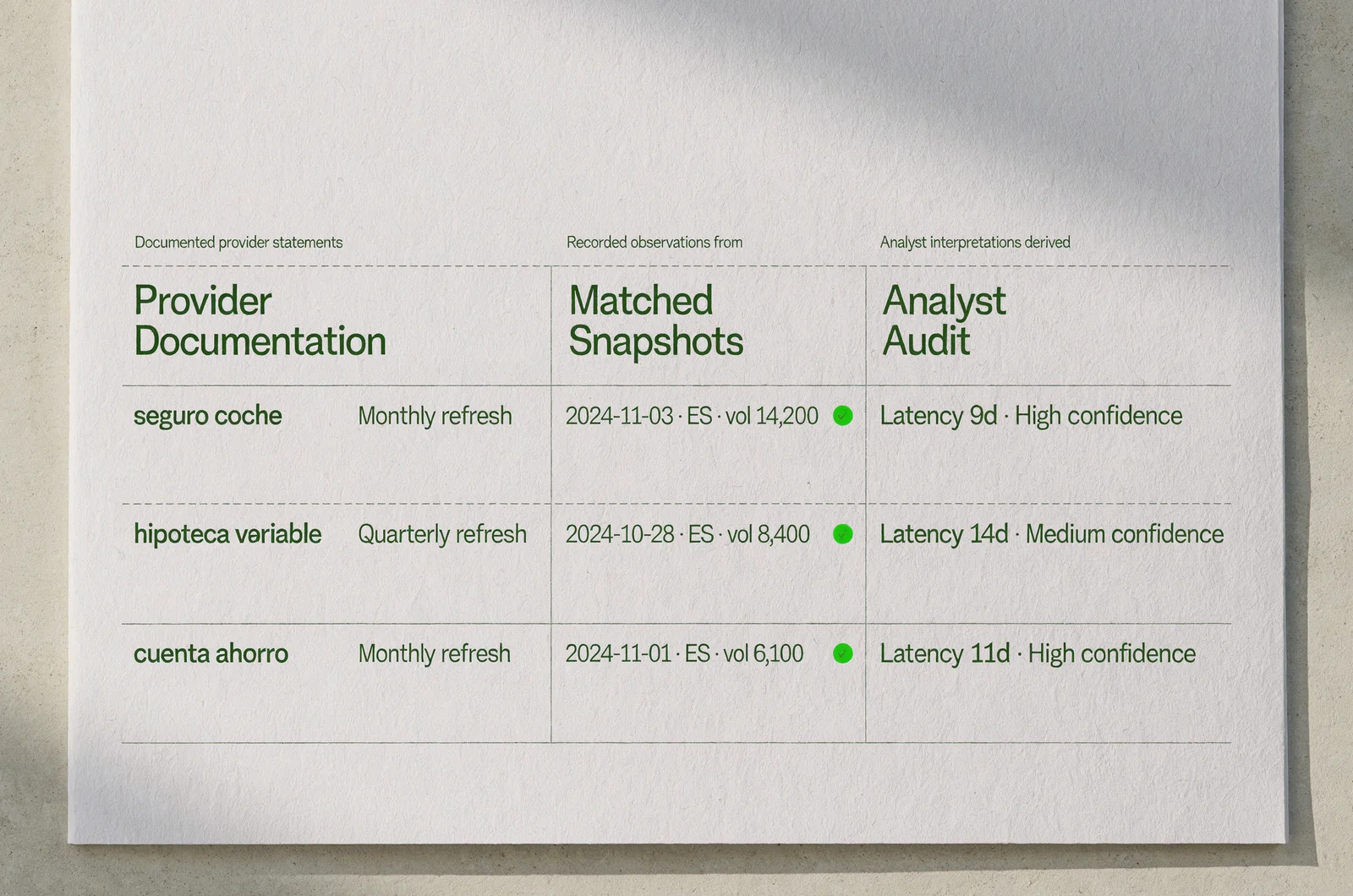
Separate three evidence categories throughout the assessment:
- Documented provider statements about collection, processing and publication.
- Recorded observations from matched exports or search-result captures.
- Analyst interpretations derived from those records.
A stated refresh schedule belongs in the first category. A changed value between two exports belongs in the second. An explanation for that change remains an interpretation until supported by documentation.
The proposed audit measures observable behaviour. It cannot recover an undisclosed collection process or establish the true number of searches from disagreement between databases.
Keep unsupported explanations in an unresolved-evidence register. Accept a freshness claim only when its timestamp, metric and geographic scope can be identified.
Separate the clocks behind keyword data
Database freshness needs a separate definition for each metric used in the purchase decision. This protocol distinguishes collection, publication and retrieval dates.
Collection and publication dates
The collection date identifies when an underlying observation occurred, where that information is available. The publication date identifies when the resulting record became accessible.
Their difference is the processing and publication delay. Calculate it only when both dates describe the same observation.
A retrieved record may also describe a reporting period, such as a calendar month. Record that period separately. An export generated today can contain values assigned to an earlier period; the export timestamp alone cannot establish their age.
Ask providers to explain whether displayed dates apply to individual queries, geographic databases, reporting periods or interface updates. Store the answer with the trial documentation.
Coverage, volume and search-result dates
Treat query discovery, volume estimates and search-result observations as separate measurements.
For discovery, record whether each requested query has a usable database entry. For volume, preserve the estimate, reporting period and any disclosed treatment of variants. For search results, retain the capture time and the location and device settings used.
These distinctions prevent a recent search-result capture from becoming evidence for the age of an unrelated volume estimate.
Use a field-specific status whenever provenance is incomplete. Suitable values include “collection date unavailable”, “reporting period supplied” and “publication date supplied”.
For every metric included in procurement scoring, retain the strongest available date and its meaning. Keep retrieval timestamps in a separate column.
Run matched observations across Spain and Portugal
A useful database trial should hold the query panel and comparison settings constant across providers. The following sampling design is proposed for an initial evaluation; it is not a validated industry benchmark.
Freeze a panel that reflects publishing decisions
Start with 120 queries divided equally across four groups:
- Established commercial topics already relevant to the business.
- Specific, low-demand queries connected to customer problems.
- Recent product terminology or emerging category language.
- Queries with a seasonal or event-related publishing window.
The equal allocation makes subgroup results visible. It does not represent their prevalence across the wider search market.
Select terms from the actual editorial backlog and commercial categories. Use the site’s long-tail keyword targeting to guide the specific-query group. Freeze the panel before reviewing provider results to reduce selection bias.
Evaluate the same 120 queries separately for Spain and Portugal. That produces 240 query-country pairs per database at each observation.
Match language settings where providers support comparable controls. For an English-language publication, retain the intended English queries. Add Spanish or Portuguese panels only when those languages belong in the publishing strategy.
Capture five matched snapshots
As an initial protocol, collect exports on days 0, 7, 14, 21 and 28. Use the same time window, location settings and export method at each checkpoint.
Record unsupported filters as exceptions. A country-level result cannot answer a city-level test question.
Keep missing rows, blank values and explicit zeros distinct. Record interface failures separately from unavailable query data.
Preserve provider identifiers and original query strings before normalisation. Document any deduplication or variant grouping applied during analysis.
This four-week design provides an initial observation window. Extend it when the provider’s documented reporting cycle falls outside that window, and record every change to the schedule.
Calculate reliability without inventing ground truth
A freshness audit should report several measurements because coverage, disagreement and observable update delay answer different purchasing questions.
Coverage and volume disagreement
Define coverage as:
Usable query-country records ÷ requested query-country records
Declare what counts as usable before the trial. A record suitable for topic discovery may lack the information required for volume-based prioritisation.
Report coverage separately for each country and query group. Keep missing records outside the volume-disagreement calculation and report their count alongside it.
For positive volume estimates, one proposed comparison is symmetric relative disagreement:
2 × |A − B| ÷ (A + B)
Here, A and B are estimates for the same query-country pair, reporting period and compatible settings. Multiply by 100 to express the result as a percentage.
Consider a hypothetical pair: Database A reports 100 monthly searches and Database B reports 300. The calculated disagreement is 100%. Estimates of 100 and 120 produce approximately 18.2%.
Neither calculation establishes which estimate is correct. Both describe the distance between the supplied values.
When both values are zero, the formula is undefined. Record that pair separately. Where one value is positive and the other zero, label the boundary case explicitly.
Observable update delay
Measure update delay only against an identifiable reference event relevant to the field under evaluation.
For example, a proposed terminology-discovery test could use a dated product announcement as its reference event. The audit would then record the last checkpoint without a matching query entry and the first checkpoint with one.
The database’s observable transition lies between those checkpoints. Preserve that interval instead of assigning a precise update time.
Without a dated reference event, report the observation as a database change. Its freshness remains unresolved.
Record persistent values with equal care. An unchanged estimate could remain valid throughout the trial. Change frequency alone cannot establish accuracy.
Effect on the publishing shortlist
Measure whether database choice changes the work approved for production.
Apply the same prioritisation rules to each provider’s data. Hold business relevance, intent fit and production constraints constant.
For a hypothetical shortlist of 20 topics, suppose two databases produce 12 shared selections. Their shortlist overlap is 60% under the definition:
Shared selections ÷ shortlist size
Inspect the eight differing selections individually. Record whether the difference came from missing coverage, volume estimates, query grouping or another documented input.
Report subgroup medians alongside the individual disagreements that changed a publishing decision. Retain the query-level records for review.
Make freshness a purchasing condition
The audit should produce explicit acceptance conditions for the intended workflow. Assign those conditions before comparing trial outcomes.
Establish minimum evidence requirements
Require sufficient support for the markets and decisions the team will serve. Proposed conditions include identifiable country settings, repeatable exports, traceable metric definitions and documented handling of missing values.
Set coverage thresholds independently for Spain and Portugal. A combined result could conceal an unacceptable gap in one market.
A provider that cannot satisfy a mandatory condition should remain unresolved until the limitation is addressed or the requirement changes.
For teams preparing SiaSEO article briefs, require enough export detail to trace an approved topic back to its query, market and observation date. Keep that requirement in the procurement specification.
Weight the remaining trade-offs
After mandatory conditions pass, an illustrative scoring model could allocate:
- 30% to usable coverage in the target markets.
- 25% to observable freshness evidence.
- 25% to stability of publishing decisions.
- 20% to auditability and export consistency.
These weights express a proposed buyer preference. They are not empirical findings.
Define the scoring scale for each measure before assigning points. Explain how missing evidence affects a score, and distinguish an observed failure from an unmeasured property.
Assess review time alongside agency pricing models, export limits and expected usage. Record trial analyst hours and use them when estimating operational cost.
Approve an annual commitment only after the acceptance record identifies the tested use cases, unresolved limitations and person responsible for reviewing them.
Preserve the audit through content production
Keyword evidence should remain attached to the publishing decision after the software purchase. The following controls are proposed for teams that move research into briefs, calendars and drafts.
Carry provenance into the brief
For each approved topic, retain the query, target country, language, source database, observation date and metric reporting period. Add a short explanation of how demand evidence influenced approval.
Separate the editorial judgement from the numeric input. A commercially relevant topic may proceed despite uncertain volume; record the reason for that decision.
When SiaSEO handles content calendars, drafting or CMS publishing, keep this evidence record alongside the editorial brief. The article reviewer should receive the same market assumptions used during topic approval.
Flag briefs for review when required provenance is absent or when the intended country differs from the research settings.
Recheck decisions at defined triggers
Specify when a topic needs another review. Proposed triggers include a changed reporting period, a product rename, a different target market or a material disagreement that alters publishing priority.
Retain the original approval record and append the new observation. This preserves the basis for each decision.
A useful interactive audit calculator would accept matched CSV exports and produce coverage, volume disagreement and shortlist overlap by country. It should preserve missing-value categories and show which records changed the shortlist.
Make its formulas visible and allow reviewers to inspect the underlying rows. Assign an owner and review date to every unresolved exception before production approval.
Resolve refresh uncertainty before an annual contract
A purchasing review should answer the following questions directly, using the trial records and documented limits.
Can current search results validate monthly volume?
A recent search-result capture establishes when those results were observed. Monthly volume requires separate evidence about its reporting period, inputs and processing.
Record freshness independently for both fields. Where volume provenance is unavailable, retain that limitation in the approval record.
What if values remain unchanged throughout the trial?
Record the observed stability. Then check whether the trial overlaps a documented update cycle and whether a relevant reference event occurred.
An unchanged value does not establish either stale data or current data. Extend the observation window when the evaluation question remains unanswered.
When is the evidence sufficient to choose a provider?
Approve the provider when it passes the predetermined market, coverage, provenance and workflow conditions for the intended use.
A four-week audit cannot establish annual seasonal behaviour or performance across untested query populations. Restrict the approval to the tested scope and schedule a review for the next relevant reporting cycle.