How the Best Content Optimization Tools Compare in 2026
We compare the best content optimization tools in 2026 — Surfer SEO, Clearscope, MarketMuse and AI-native options — scored on scoring accuracy, workflow and cost.

Choosing the best content optimization tools means deciding which part of content production needs improvement: research, editorial guidance, drafting or publishing. For SaaS marketing teams and agencies, the useful comparison is between the work a platform can take on and the review burden it leaves behind. Surfer SEO, Clearscope, MarketMuse, Copy.ai and Jasper are the five candidates considered here.
Current prices, plan limits and comparable performance results are unverified in this comparison. That prevents a defensible numerical ranking. Instead, each candidate gets a specific buying question, an acceptance test and a conditional purchase decision. Treat those assignments as evaluation priorities, rather than established product advantages.
Match the tool to the work you need done
A content optimisation purchase should start with the task that consumes your team’s time. Write that task down before comparing subscriptions.
An editorial team with strong writers might need clearer recommendations for existing drafts. A small content operation might need help producing usable first drafts. An agency might need consistent briefs and review standards across several clients. Each situation calls for different evidence.
Separate the purchase into four possible jobs:
- Improve an existing article without distorting its purpose.
- Identify coverage gaps across a collection of pages.
- Produce drafts that satisfy an approved brief.
- Move approved content into a controlled publishing workflow.
Choose one primary job and one secondary job. Otherwise, a long capability list can obscure the task you actually need to complete.
Keep keyword selection separate from draft optimisation during evaluation. Use the same approved queries across candidates. Our comparison of keyword research tools addresses that earlier purchasing decision.
For a UK and Ireland audience, include locale in the brief from the outset. Specify spelling, commercial context, currency and any geographic exclusions. Require each candidate to work from that same brief.
Compare five candidates against specific buying questions
The five tools need comparable inputs, but each also needs a buying question that can expose a useful reason to choose it. The assignments below define what to investigate; they do not certify available capabilities.
| Candidate | Evaluation priority | Evidence needed for a purchase |
|---|---|---|
| Surfer SEO | Article-level optimisation guidance | Better editorial decisions with acceptable revision time |
| Clearscope | Consistency during editorial review | Useful guidance across different writers and reviewers |
| MarketMuse | Decisions across an existing content collection | Actionable page priorities and defensible coverage recommendations |
| Copy.ai | Repeatable drafting work | Consistent brief adherence across repeated assignments |
| Jasper | Brand-sensitive content production | Accurate messaging and restrained use of approved claims |
Across every candidate, confirm the relevant functionality, usage allowance and export route in the proposed subscription before paying.
Surfer SEO: does the guidance improve the article?
For Surfer SEO, centre the evaluation on recommendations applied to an existing article. Start with a draft your editor already considers publishable, then document every suggested change.
Ask the editor to distinguish useful additions from unnecessary repetition. A recommendation earns its place when it resolves a reader question, corrects an omission or improves clarity. Record changes that would weaken the article’s focus.
Include a deliberately narrow brief. For example, ask for a comparison aimed at finance directors rather than a broad explanation for beginners. Check whether the proposed additions respect that boundary.
The limitation to investigate is over-editing. If a reviewer must repeatedly reject irrelevant additions, include that time in the purchase calculation. Any connection between a platform’s score and better editorial quality remains unproven until measured.
Keep Surfer on the shortlist if the demonstrated guidance improves approved copy within your editing budget. Save the original draft, recommendations and final version together.
Clearscope: can reviewers reach consistent decisions?
Give Clearscope an assignment focused on editorial consistency. Supply the same brief to two writers, then have reviewers assess both drafts against a written acceptance standard.
That standard should cover audience fit, factual support, scope and readability. Compare the reviewers’ decisions before and after they receive the platform’s guidance.
The buying question is whether that guidance helps explain what needs changing. Ask reviewers to record recommendations they can act on immediately and those that require interpretation.
Use a draft containing a plausible but unsupported claim. Check whether the review process catches it, and identify whether that correction came from the tool or the human reviewer.
Its fit for this workflow remains conditional on the demonstration. A useful outcome would be clearer revision requests and fewer unresolved disagreements between editors. The limitation to watch is a polished assessment that still leaves substantial checking work.
Require an annotated before-and-after draft before assigning value to the review process.
MarketMuse: can it improve decisions across several pages?
For MarketMuse, investigate a broader purchase question: can the proposed subscription help decide which existing pages deserve attention?
Provide a small content collection with overlapping subjects, different audiences and uneven depth. Ask for recommendations that distinguish updating a page, consolidating coverage and commissioning something new.
Assess the reasoning behind each recommendation. A suggestion to publish another article needs an explanation of the reader need it would address. Compare that explanation with the purpose of pages you already own.
The practical fit would be a team whose planning backlog needs clearer priorities. That fit is a hypothesis to verify, rather than a confirmed product judgement.
The limitation to examine is the distance between analysis and action. A large list of gaps has limited purchasing value if your editor must reconstruct every recommendation.
Ask for a prioritised work list containing the affected URL, proposed action, supporting rationale and estimated editorial effort. Judge the demonstration against that deliverable.
Copy.ai: can a repeated assignment stay within its brief?
Give Copy.ai a repeatable production task, subject to confirming that the proposed plan supports your intended workflow. Use several briefs with the same structure but different audiences or products.
Specify the evidence allowed in each draft. Include approved product language, prohibited claims and a clear section plan. Then assess whether those constraints survive across repeated assignments.
Measure the amount of text an editor keeps, the corrections required and the time spent checking unsupported statements. Repeat one assignment after changing a single requirement, such as geography.
The potential fit is a team seeking consistency across recurring writing tasks. Evidence of that fit requires several outputs; one polished sample cannot establish repeatability.
The limitation to investigate is how much effort moves from drafting into instruction maintenance and QA. Count the time spent repairing briefs as part of production.
Retain Copy.ai only if repeated assignments meet your acceptance standard within the total time allowance.
Jasper: does the draft preserve approved messaging?
Give Jasper a brand-sensitive assignment. Supply an approved positioning statement, product descriptions and examples of acceptable tone. Require the draft to stay within those materials.
Include a difficult distinction: two products with similar names but different intended buyers, for example. Check whether the output keeps their purposes separate.
Have an editor mark every invented promise, altered qualification and unnecessary superlative. Assess whether corrections require local edits or a substantial rewrite.
A potential fit would be a team whose main concern is consistency across writers and formats. Current suitability still needs evidence from the proposed plan and your own materials.
The limitation to watch is fluent prose that changes the meaning of approved messaging. Treat that as a substantive defect even when the draft reads smoothly.
Compare Jasper with Copy.ai on the same assignment before choosing between them. Preserve the supplied materials and marked-up outputs so the decision can be reviewed.
SiaSEO belongs in a later automation assessment
Consider SiaSEO later if the purchase brief extends to production automation. Apply the same evidence standard before giving it a place in the workflow.
Ask for a demonstration of the complete proposed process, including human review and publication controls. Assess it against the same briefs and correction budget used for the other candidates.
Test content scores against editorial judgement
Content scores become useful purchasing evidence only when you can connect recommendations to editorial decisions. Build a small, repeatable assessment before comparing numerical outputs.
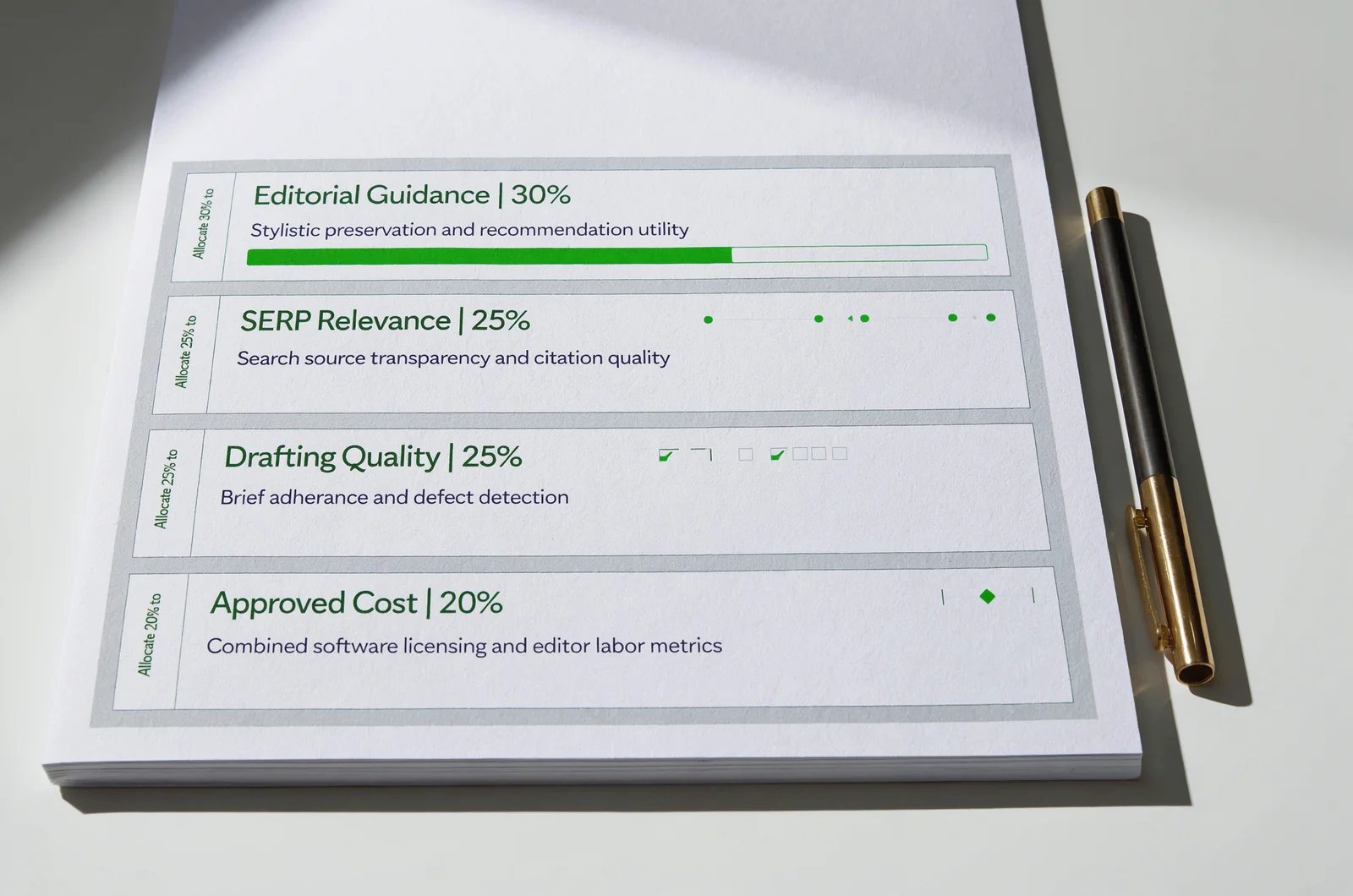
Use a proposed weighting rather than invented rankings
A practical starting rubric is:
- Allocate 30% to the editorial usefulness of optimisation guidance.
- Allocate 25% to the transparency and relevance of SERP inputs.
- Allocate 25% to drafting quality and adherence to the brief.
- Allocate 20% to cost per approved article.
These are proposed purchasing weights, rather than measured product scores. Adjust them before seeing candidate outputs.
Keep publishing controls outside the weighted score. Make essential requirements pass-or-fail: review before publication, correct CMS destination and a workable correction process. Require a demonstration for each requirement you set.
For a refresh project, reduce the weight assigned to drafting. For a production-heavy workflow, increase it and document the change.
Ask what sits behind each recommendation
For SERP-derived guidance, ask which query, country, language and retrieval date informed the recommendations. Request an explanation of any competitor-page selection.
Evaluate whether those inputs match the article’s intended reader. A comparison for UK SaaS buyers should be assessed against the audience and scope in its brief.
Use one narrow query from your actual backlog. The guide to prioritising long-tail keywords can support that selection.
Record what remains undisclosed. Avoid assigning a high transparency score where the underlying inputs cannot be explained. Keep the query settings beside the resulting recommendations.
Include defects that a polished draft could conceal
Create a clearly labelled test draft containing an unsupported statistic, a duplicated paragraph and a reference to the wrong geography. Ask each candidate to assess the same document.
Record which problems it identifies and which require human intervention. Keep factual accuracy separate from topical coverage in the results.
Then have an editor review candidate outputs without seeing their platform scores. Compare the editor’s judgement with the recommendations afterwards.
Use the findings to define ongoing QA responsibilities. Assign factual verification, audience fit and publication approval to named roles before selecting a subscription.
Calculate the cost of an approved article
Price comparison should use the complete proposed workflow. Request a dated quote or plan breakdown for every shortlisted candidate.
Include subscription fees, usage charges, additional seats, required integrations and editorial labour. Confirm how the plan counts drafts, revisions, reports and any generation allowance. Record whether quoted totals include VAT.
Use this purchasing calculation:
Cost per approved article = total allocated monthly production cost ÷ articles approved that month.
For a hypothetical example, suppose software costs £600 monthly and associated editing costs £900. If the workflow produces 30 approved articles, the combined cost is £50 per article.
A second hypothetical workflow costs £300 for software and £1,350 for editing. At the same output, its cost is £55 per approved article. The lower subscription produces the higher combined cost in this example.
Include rejected drafts and repeated generation in the numerator. Keep them outside the approved-article count. Otherwise, unusable output can make the calculation look more favourable.
A useful interactive calculator would accept subscription costs, usage fees, review hours, hourly cost and approved output. It could show the result at several publishing volumes.
Before signing, repeat the calculation with the output your team can actually review. Use that volume in the purchase decision.
Resolve the questions that change your shortlist
A final shortlist needs answers about evidence, measurement and operating requirements. Resolve these questions before comparing annual commitments.
Which candidate deserves first place?
No first-place ranking is supported here because verified comparative results and current plan details are unavailable.
Choose a provisional leader only after candidates complete the same assignment. Require evidence for the capabilities that determine your decision.
A candidate can lead on drafting and lose on editorial effort. Record those results separately before applying your chosen weights.
Can a content score establish likely search performance?
Treat the score as an input to editorial review. Assess search performance separately against the page’s purpose.
After publication, compare relevant queries, traffic quality and conversions over an agreed period. Record other changes that could affect interpretation.
Keep pre-publication quality checks and post-publication outcomes in separate records. Avoid treating a change in one as proof of a change in the other.
What should UK and Ireland teams verify?
Require a sample that follows the specified locale, audience and commercial context. Check spelling, currency, examples and any geographic assumptions.
Confirm billing currency, tax treatment and the applicable subscription terms directly in the purchase documents.
For agencies, also test whether the proposed workflow keeps client briefs, approved claims and publication destinations separate. Resolve any failure before committing multiple clients.