
Keyword Research Shifts: 5 Ways Open-Source AI Changes It
See how open-source AI models from China are altering keyword research economics and strategy, and what it means for SEO teams.

Keyword research has never been a static discipline, but the arrival of genuinely capable open-source AI models is altering its fundamentals faster than any tool update did in the last decade. Where teams once relied on closed, subscription‑gated datasets and a handful of proprietary APIs, they now have direct access to models that can generate, cluster, score, and validate thousands of queries—running on a local machine or a modest cloud instance. The five shifts that follow rearrange costs, competition, measurement, and the very boundary between research and content production. Not every team will feel every shift immediately, but all five are already visible in the repositories, tools, and tactics that SEO practitioners are deploying in 2026.
Query generation moves to near-zero marginal cost
The most obvious and immediate change is economic. Keyword research has always been bottlenecked by data access, whether through ad‑supported free tiers or enterprise‑priced API plans. An open‑source large language model, tuned on search‑oriented patterns and run on a consumer‑grade GPU, can produce hundreds of seed‑relevant phrases for roughly the price of the electricity it consumes. A small agency that would have paid several hundred dollars a month for unlimited lookups can now iterate on query ideas without thinking about per‑call charges.
Open projects illustrate the range. The Bomx/seo-keyword-research agent finds 50‑plus buying‑intent terms, clusters them, and delivers a content calendar—all from a single Claude Code prompt. scailetech/openkeyword routes company information through a five‑stage pipeline built on Google Gemini. seovimalraj/keywords-mcp wraps Google Autocomplete, Google Trends, and question extraction into a local MCP server that any compatible chat client can call, with no API keys required. None of these tools is yet a full replacement for a mature paid platform, but they sharply discount the iteration phase of research—the messy, generative work of expanding a seed list into a workable content map.
Who it fits: Technical SEO leads and data‑savvy consultants who can configure a Python environment or an MCP client. The shift is less comfortable for teams without scripting skills, though the growing collection of one‑click open‑source interfaces is shrinking that gap.
Limitation: Free generation does not equal free validation. When a model invents plausible‑sounding phrases that draw zero real searches, the cost‑savings evaporate during the quality‑assurance step. Most teams still need a way to ground the output against real search data, whether from Google’s Keyword Planner or a third‑party index.
Verdict: The cost floor for query generation is now effectively software‑only. Budgets that used to go to API credits can shift toward verification, intent mapping, and content execution instead.
Long‑tail discovery scales past human enumeration
Before large language models, finding genuinely new long‑tail keywords meant brainstorming, combing autocomplete, mining People Also Ask boxes, or paying for exhaustive lists. An open‑source model can be instructed to vary a query template across dozens of intent modifiers, regional qualifiers, and conversational phrasings—producing a combinatorial explosion that a human would never sit down to type.
The mario-montanari/keyword-intelligence skill, built for Claude, works both sides of the search divide: it explores traditional engine queries and the sorts of questions that users pose to AI summaries and chat interfaces. This dual‑lens approach surfaces phrases that are not yet visible in standard keyword databases because they belong to an interaction pattern that post‑dates the last major index update. Long‑tail discovery that once depended on intuition now leans on systematic, model‑driven divergence.
Who it fits: Content marketers fighting in saturated editorial spaces—B2B SaaS, finance, health—where the head terms are owned by legacy domains. The shift gives smaller sites a defensible corner of very specific, high‑intent queries.
Limitation: A long‑tail list is only as useful as its validation pipeline. Volume estimates from conventional tools often register “0” for truly novel phrases, even when the queries exist in conversation logs or AI‑generated session histories. Ranking for a term that attracts three clicks a month may not justify a full article, even if the cost of finding it was zero.
Verdict: Open‑source AI rewires the discovery phase from “what can I guess” to “what can the model systematically generate and variate.” The strategic consequence is a shift in content planning toward many low‑volume, high‑specificity assets instead of a handful of keyword‑stuffed head‑term pages.
‘Easy’ keywords become more crowded, faster
When any competitor can spin up a research agent that outputs a prioritized keyword list in minutes, the classic low‑difficulty, low‑volume keyword starts attracting more pages. The same economics that make generation cheap also make content cheap. A freelance SEO operator using an open‑source model to find a list of 200 underserved queries can, with a modest AI‑writing stack, target all of them within a week.
The difficulty scores provided by Ahrefs Keywords Explorer, which gauge ranking challenges based on the backlink strength of existing top pages, may lag behind this reality. A keyword with a difficulty of 5 today could become functionally harder to rank for within months as AI‑generated content piles up—not because the incumbent pages are stronger, but because the index is suddenly full of new, reasonably relevant entries. The metric hasn’t changed, but the competitive surface has.
Who it fits: Agencies that pore over keyword difficulty dashboards should pay closest attention. Teams that rely on historical difficulty as a gate for content briefs may find their “easy wins” evaporating as they execute the plan.
Limitation: This crowding effect is still sector‑specific. Niches with high domain authority requirements or heavy regulatory oversight (legal, medical) see slower encroachment because AI‑written text does not confer trustworthiness. The shift is most acute in how‑to, review, and general informational categories.
Verdict: Open‑source AI accelerates the commoditization of the long tail. The moat moves from keyword selection to site authority, original data, and genuine expertise—elements that no model can fabricate.
Search volume and intent metrics lose their anchoring
Four years ago, a monthly search volume number from a reputable database was a fairly reliable planning input. Today, the same number reflects a shrinking fraction of the informational requests that reach people. AI overviews, in‑chat answers, and multimodal queries (voice‑to‑image, camera‑search) all bypass the traditional search‑result page that SEO tools measure. When a user asks ChatGPT or Perplexity “what’s the best privacy‑first analytics tool for a SaaS homepage,” that interaction never appears in a keyword tool’s volume column.
Open‑source research tools are beginning to address this by modeling potential query patterns and analyzing autocomplete streams rather than relying on a single monthly volume snapshot. Semrush’s free keyword tool now explicitly positions itself for both SEO and AI search visibility, a recognition that the dataset must broaden. But the underlying signal remains incomplete. Open‑source approaches can supplement with prompt‑research frameworks—exploring what people type into generative interfaces—but there is no agreed‑upon metric for “generative‑response opportunity” yet.
Who it fits: SEO strategists who already treat search volume as a relative signal, not an absolute target. Those who rely on volume thresholds to justify content investment will need to adopt a portfolio view that includes zero‑volume‑today, potential‑tomorrow terms.
Limitation: The absence of a unified measurement standard means teams have to blend multiple data sources—volume indices, autocomplete frequency, customer‑service logs, and even sales‑call transcripts—to triangulate what’s worth writing. That’s analytically heavy for organizations without a dedicated data‑operations role.
Verdict: Open‑source AI exposes metric fragility, but it also provides the means to fill the gap. The future keyword research stack will likely combine a traditional index for search volume anchor points with an open‑source model’s ability to forecast query evolution from first‑party data.
Keyword research feeds the full production pipeline directly
Perhaps the most structural shift is the shrinking distance between a keyword idea and a published page. In a closed‑tool ecosystem, the researcher exported a CSV, handed it to a content manager, who briefed a writer, who produced a draft—a chain of manual handoffs. Open‑source models change this by making it practical for a single orchestration layer to consume a keyword list, cluster it by topic, score it against existing site content, and then route the best opportunities to a generation agent that drafts articles tuned to the site’s voice and metadata.
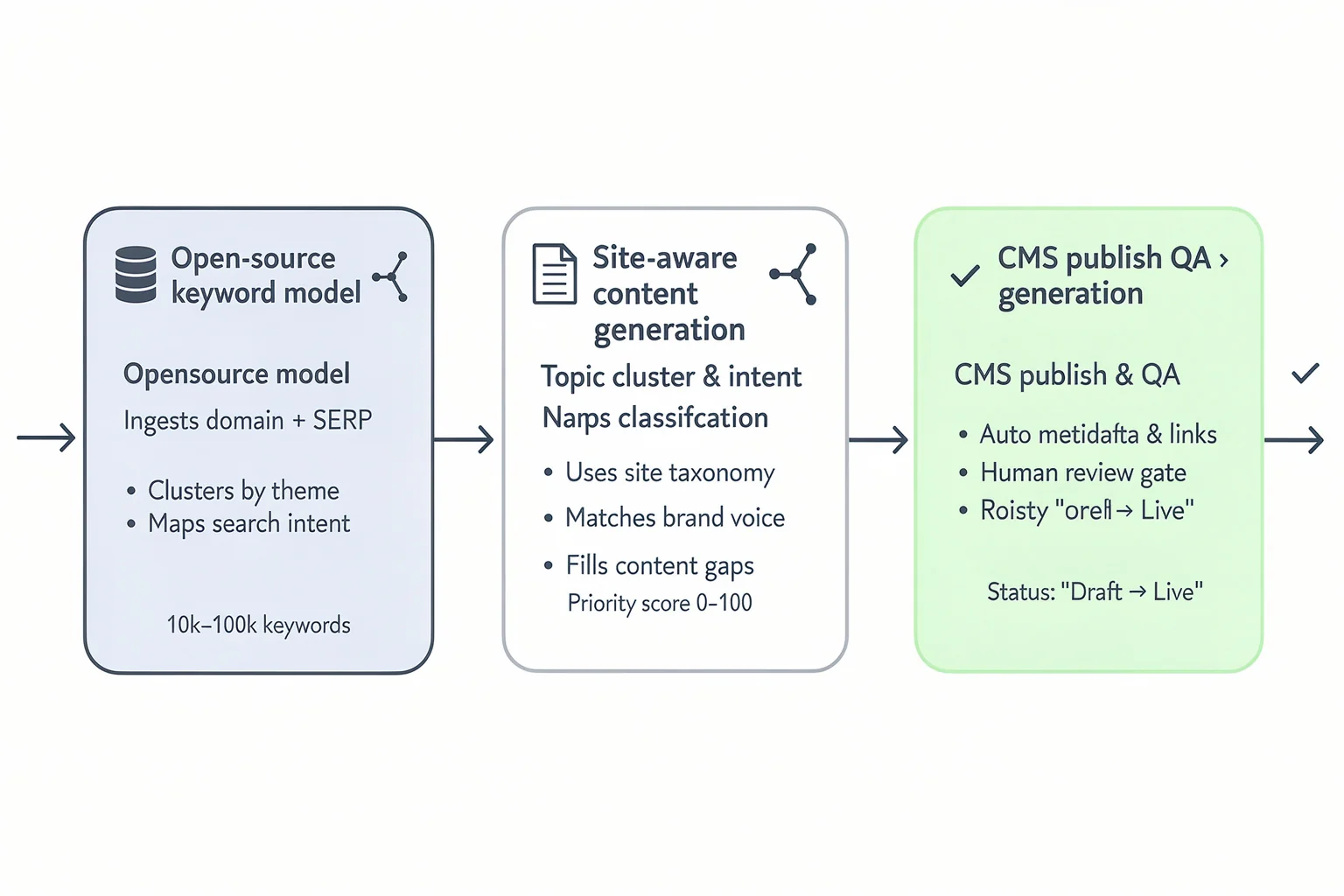
Platforms that automate site‑aware content production, from ingestion of a domain’s existing pages to final CMS push, are the logical downstream of this shift. When a system already understands a brand’s topic hierarchy and semantic fingerprints, the keyword research output slots in as a structured plan rather than a loose list of suggestions. The research step stops being a separate report and becomes a continuous input stream that a content engine can act on, review‑only, within hours.
Who it fits: B2B content operations leads who manage a multi‑domain calendar and cannot afford week‑long briefing cycles. Agency operators who serve five or ten clients with different tone‑of‑voice profiles gain the most, because the cost of repurposing an open‑source keyword pipeline across client sites is near‑zero after the initial configuration.
Limitation: End‑to‑end automation brings hallucination risk and brand‑drift that require active monitoring. A fully lights‑out pipeline that feeds from an open‑source keyword model to a publishing tool can fill a site with plausible‑sounding, statistically aligned articles that still misstate product specifications or omit a critical legal disclaimer. Quality scoring and semantic drift tracking, not just keyword coverage, become the control surfaces that matter.
Verdict: The keyword‑to‑page chain is collapsing from a fragmented workflow into a single, inspectable system. Teams that invest in the connective tissue—topic modeling, site‑aware content generation, and continuous QA—will move from research to published traffic in a fraction of the time it takes competitors who still treat research as a standalone task.
What strategists ask when the research stack goes open‑source
How do I know an open‑source model isn’t inventing keywords?
Every model can hallucinate; the safeguard is always verification against real search data. Pair generative keyword discovery with a validation step using Google Autocomplete, Google Trends, or a paid index. Many open‑source projects already bundle this verification into their pipelines—keywords-mcp, for instance, cross‑references autocomplete results by default.
Can open‑source AI replace paid tools entirely for a small agency?
For pure discovery, yes—particularly if the agency’s clients operate in well‑covered English‑language niches. For reliable training‑data scale, national‑level search volume, and competitive benchmarking, a paid index like Ahrefs or Semrush still provides a useful reality check. Most small‑agency stacks will be hybrid: an open‑source model for divergent generation and a single paid seat for validation and competitive analysis.
Does this make keyword difficulty scores obsolete?
No, but it makes them insufficient on their own. A difficulty score from a tool that counts backlinks measures one dimension of ranking probability. It does not measure how fast the index population around that keyword is growing. Teams that add a temporal dimension—watching for sudden page‑count spikes—will spot competitive pressure that a static score hides.
What’s the first experiment to run with open‑source keyword research?
Take a single content cluster your site already covers. Use an open‑source pipeline to generate 100 long‑tail variations, validate the top 20 against a paid index, and then watch the SERP for those 20 terms over 90 days. Track impressions, page‑count changes, and whether any AI‑overview answer box appears. That one cluster experiment will tell you more about the open‑source impact on your niche than any general‑market report.
Open‑source keyword research threads worth following
- AI search intent mapping in 2026
- Free keyword tools that deliver real volume data
- Your biggest questions about AI and keyword research
Review SiaSEO as the operating system for structured SEO content production. — Get started