Reality Augmented Generation vs RAG: What Actually Changes
Reality augmented generation vs RAG explained: how the two approaches differ, where each fits in AI content workflows, and what it means for factual accuracy.

Reality augmented generation needs a precise definition before a content team can compare it with retrieval-augmented generation (RAG). This article uses the former as a working label for generation with explicit claim verification. For SEO teams, the practical question is what happens after retrieval: which statements get checked, what evidence supports them, and whether unresolved claims can reach publication.
Does the label establish a distinct technique?
The name alone does not establish a distinct technique. A meaningful difference requires a documented change in evidence collection, claim assessment, or publication controls.
For this comparison, a reality-oriented workflow checks whether important statements have evidence appropriate to the task. That definition establishes an evaluation standard. It assigns no inventor, research lineage, or proprietary architecture to the phrase.
Retrieval supplies material for generation. Verification assesses statements and their supporting evidence. Both operations can belong to the same system, so the comparison depends on implementation.
A product labelled RAG could include source checks, freshness rules, and human review. Another product could use the reality-oriented label while retrieving documents and proceeding directly to drafting. The names would reveal little about that difference.
Ask which claims get checked, which evidence counts, and what happens when support is missing. A different label becomes useful when those answers identify behaviour your team needs.
If a supplier provides a formal definition, compare it with the implementation. Translate each claimed difference into something observable, such as retaining a supporting passage or holding a draft with unresolved contradictions. Record those requirements before treating the labels as separate buying categories.
What does RAG actually do?
RAG supplies retrieved information to a generative model so it can produce an answer with that material available as context.
A basic implementation has a document collection, a retrieval mechanism, and a generation step. Retrieval might select passages from product documentation, approved website pages, or another defined information collection. The model then receives the selected material alongside the task.
This creates several separate questions:
- Did the collection contain the information needed?
- Did retrieval select the relevant passage?
- Did the passage apply to the correct product, market, and date?
- Did the generated answer preserve its meaning?
Each question concerns a different part of the workflow. A correct passage can still support an incorrectly broadened statement. An accurately reproduced statement can also come from a document that has expired.
For content production, specify the retrieval boundary. Decide whether the model may use approved company documents, external material, or both. Keep evidence about the company separate from evidence about competitors or the wider subject.
Preserve the selected passages with the draft. An editor should be able to inspect the exact material supplied during generation, including its document version and retrieval date. A citation attached later cannot reconstruct that context.
What would verification add to retrieved context?
Verification would add an explicit decision about whether a generated claim has adequate support.
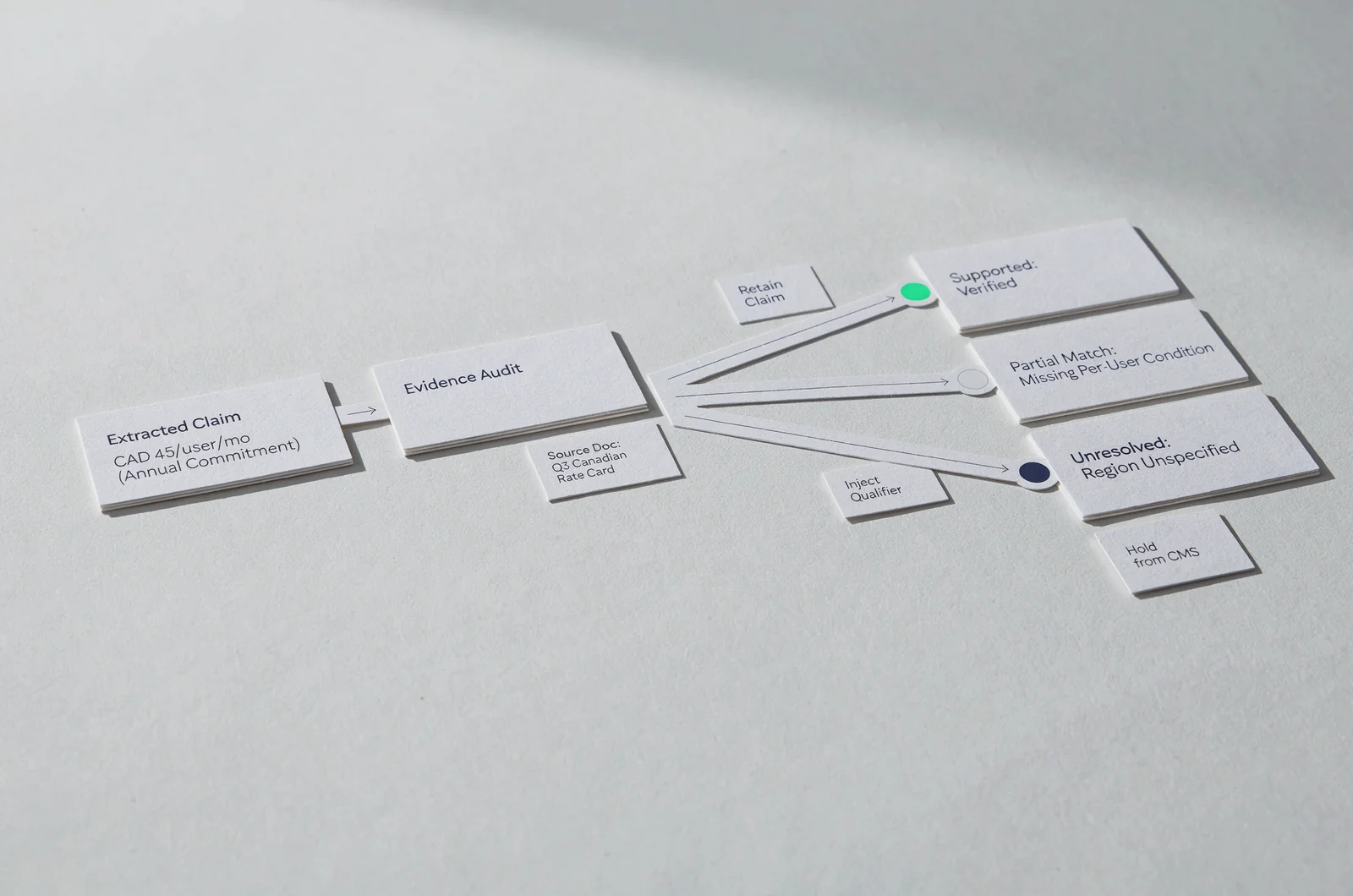
Consider the difference between selecting a relevant pricing page and approving a sentence about a subscription. Approval requires checking whether the sentence preserves the plan, currency, billing period, market, and any conditions.
A practical verification design could:
- Identify factual claims in the draft.
- Associate each claim with a supporting passage or authoritative record.
- Check whether that evidence supports the full statement.
- Flag contradictions, missing qualifiers, and unresolved details.
- Apply a defined publication rule to each result.
These are proposed controls, rather than a universal specification for the newer label.
The result should distinguish supported, contradicted, and unresolved claims. Treating every uncertain statement as false would hide an important editorial distinction. Sometimes the available evidence simply cannot settle the question.
Verification also needs a scope. A system might check whether a sentence follows from a supplied document while leaving the document’s reliability unexamined. That establishes consistency with the document.
Ask the supplier to state exactly what its check establishes. For any numerical accuracy claim, require the evaluation examples, scoring rules, and definition of an error.
Can retrieval and verification work in the same system?
Yes. Retrieval can supply evidence, while verification determines whether the resulting claims meet publication requirements.
A combined design could retrieve approved material, draft an answer, inspect its factual statements, and request additional evidence for unresolved claims. It could then revise the wording or send the draft for review.
The important boundary is between having information available and approving a statement for release. Make that boundary visible in the workflow.
For a SiaSEO content workflow, separate brand context from claim evidence. A company’s website can inform terminology and positioning. Statements about external products, changing conditions, or industry performance need evidence suited to those subjects.
The system should also distinguish authoring instructions from retrieved text. An instruction embedded in a document should remain document content rather than become authority over the writing process.
A combined workflow needs a stopping rule. Repeated retrieval without a defined endpoint can leave an article unresolved indefinitely. Specify when another attempt is justified and when an editor must decide.
For example, an unresolved product capability could trigger one request for a current authoritative document. If that document remains unavailable, remove the assertion or hold the draft according to the article’s editorial requirements.
Does current information make an answer accurate?
Current information can help assess a changing claim, but freshness alone cannot establish accuracy.
A recently retrieved page may describe an older product version. A newly updated article may repeat an unsupported statement. Retrieval time records when the system accessed material; it does not necessarily establish when every claim became valid.
Keep three dates separate where they matter:
- When the source was published or updated.
- When the system retrieved it.
- When the stated condition took effect or expired.
Geography adds another constraint. A Canadian article needs evidence that applies to Canada when discussing regional availability, currency, or service terms. Language matching alone cannot establish that scope.
Choose freshness requirements according to the claim. A definition and a current subscription price need different review rules. An evergreen paragraph can remain valid while a small factual detail requires another check.
When a claim has conflicting evidence, compare scope and authority before preferring the newer document. A current secondary summary and an older primary specification may answer different questions.
Attach relevant dates and qualifiers to the statement they support. If the effective date remains unclear, narrow the sentence or mark the claim unresolved before publication.
How would the difference appear in an SEO article?
The difference would appear in which claims the workflow permits an editor to publish.
Consider a hypothetical comparison article about software available to Canadian businesses. A retrieved document describes a plan priced per user, with annual billing and a limited set of capabilities.
A draft could reproduce the amount while dropping the per-user condition. It could describe the annual commitment as monthly billing. It could also attribute a higher-tier capability to the entry plan.
The relevant document was available in every case. The editorial failure concerns how the answer used it.
A claim check would compare each assertion with the applicable evidence:
- Does the price retain the currency and unit?
- Does the billing description retain the commitment?
- Does the capability belong to the named plan?
- Does the availability statement apply to Canada?
Search intent creates another scope boundary. Someone researching a definition needs a different answer from someone comparing purchase options. Choose article formats for intent before deciding which claims the page must resolve.
The editor’s response should match the evidence. Correct a dropped qualifier, remove an unsupported capability, or hold a purchasing recommendation that depends on unresolved availability. Keep the decision beside the affected claim so another reviewer can inspect it.
Which checks should block CMS publication?
Unresolved claims should block publication when the article’s central answer or a consequential recommendation depends on them.
Define that threshold before generating the draft. A missing source for a decorative example may justify deletion. Missing evidence for the principal comparison may require holding the whole article.
For SiaSEO drafts headed to a CMS, specify the statuses that require editorial review. Keep factual approval separate from formatting, brand voice, and structural checks. Passing one category should leave the others visible.
A practical release record should include the disputed statement, its evidence, the reason for concern, and the required resolution. Give the editor a concrete choice: approve, revise, remove, or hold.
Automated publication also needs a rule for failed checks. An unavailable checker or incomplete evidence record should produce an explicit status. Decide in advance whether that status stops release.
A compact claim-review tool could help: enter a statement, supporting passage, source URL, effective date, and market, then assign a publication decision. Keep the reasons editable and visible beside each claim.
After any factual revision, check dependent passages. A corrected plan name can affect a comparison paragraph, recommendation, and meta description. Require the final approval to apply to the exact article version sent to the CMS.
How can you measure whether verification helps?
Measure verification against a defined set of claims with reviewed evidence and expected editorial decisions.
Include straightforward examples alongside difficult cases: outdated documents, missing regional qualifiers, contradictory sources, and evidence that supports only part of a sentence. Mark these as evaluation cases rather than customer results.
Separate retrieval performance from claim approval. Otherwise, a system could appear reliable because the evaluation supplied unusually complete documents.
Record several outcomes:
- Supported claims as a share of checked factual claims.
- Factual claims that received no check.
- Unsupported claims that passed approval.
- Supported claims that were incorrectly held.
- Reviewer time and processing time per accepted article.
Keep denominators visible. A high pass rate says little if the system checks only a small subset of the draft. Report exclusions and unresolved claims alongside approved ones.
Compare alternative workflows using the same article tasks and evidence boundaries. Have reviewers inspect claims and evidence before seeing which system produced them.
A verification score also needs an interpretation. Ask whether it measures agreement with a document, source quality, contradiction detection, or something else.
Set acceptance thresholds around your publishing risks. If an unsupported central claim would require withdrawal, include that case explicitly in the release evaluation and record whether the workflow stopped it.
When is additional verification worth the effort?
Additional verification is worth considering when unsupported statements would materially affect a reader’s decision or create substantial correction work.
Prioritize claims about current capabilities, pricing, availability, comparisons, and quantitative outcomes. Identify those claim classes in the brief so review effort follows the article’s purpose.
Retrieval may provide sufficient context for an early internal draft based on approved material. Before public release, assess whether that draft contains assertions that require more evidence or narrower wording.
Scope matters as much as article length. A page built around long-tail keyword intent may answer a narrow question, yet depend on one specific product detail. Review that detail according to its consequences.
Account for the operating cost. Additional checks can require model calls, document maintenance, and editor attention. Include unnecessary holds in the assessment because they consume that attention too.
Start with the claim category responsible for your most consequential corrections. Define an approval rule, evaluate it against known cases, and inspect the remaining errors. Extend coverage when the results justify the added work.
What should you ask before buying either approach?
Ask for an inspectable evidence trail and a demonstration of failure handling before relying on either label.
Use an article task from your own publishing process. Require the supplier to show the retrieved passages, generated claims, verification decisions, and final release status.
The demonstration should answer practical questions:
- Which information collections can the system access?
- How does it preserve document versions and claim context?
- What happens when relevant evidence is absent?
- How are conflicting sources handled?
- Can an editor override a decision and record a reason?
- Which failures prevent automated publication?
- Can you export the evidence and decision history?
Request a case where the correct outcome is to withhold an assertion. That tests the publication rule directly. A polished answer with citations cannot demonstrate what happens when adequate support is unavailable.
Also establish ownership. Your team needs to know who maintains approved documents, resolves disputed claims, and reviews changes to evaluation rules.
The purchase decision should follow those requirements. Retrieval quality matters when necessary information fails to reach the draft. Claim checks matter when the draft misstates available evidence. Publication controls matter when unresolved material can still reach readers. Write each requirement into the acceptance criteria and test it before enabling automated release.