Webflow vs WordPress for SEO When Every Post Is Auto-Published
A whitepaper on how Webflow and WordPress handle SEO when articles arrive by API: indexing, schema, internal links, and structural drift.

For teams comparing Webflow vs WordPress automated publishing pipelines, the useful question is whether each approved article becomes the intended public page. That requires evidence about markup, structured data, canonical URLs, sitemap inclusion and internal links after publication. This whitepaper defines a reproducible assessment for content operations teams choosing between the two platforms. It contains no measured platform results. Its recommendations are proposed operating rules, and its conclusions concern what evidence would justify a platform decision.
The unit of comparison is the published release
A Webflow or WordPress evaluation needs a defined implementation on each side. A platform name alone leaves too much of the publishing process unspecified.
For this assessment, a release comprises an approved article, its destination configuration and the resulting public page. The comparison asks whether the complete release satisfies an agreed content and SEO contract.
Record the CMS configuration, publishing connector, templates and components responsible for SEO output. For WordPress, include the theme and any plugins involved in rendering or metadata. For Webflow, identify the collection, template and field mappings under assessment. These are inventory requirements, without assumptions about either platform’s current capabilities.
Separate three responsibilities:
- Editorial approval establishes whether the article is accurate, useful and suitable for publication.
- Delivery validation establishes whether the destination received the intended content and settings.
- Public-page validation establishes whether the released URL matches the approved specification.
A team using SiaSEO for drafting, quality scoring and CMS publishing should retain a destination-validation record alongside its content quality score. The proposed assessment treats those records as separate evidence.
For an English-language site targeting Italy, state whether the comparison covers English URLs alone or an existing multilingual deployment. Include language-variant checks only where those variants exist.
Comparable runs need a frozen publishing contract
Webflow and WordPress results become interpretable when the input requirements remain constant. Define the contract before adapting either implementation.
Hold the intended output constant
Prepare a small corpus of representative approved articles. Include a straightforward text article, an article with internal links, and an article containing the structured elements your operation actually publishes.
These are proposed test categories, without a prescribed sample size. Choose the corpus from the content formats and failure risks present in your publishing operation.
For every article, specify the intended title, URL path, headings, body content, metadata, publication state, structured data and internal destinations. Record intentional omissions too. An absent description should have a different status from a description lost during delivery.
Keep editorial requirements consistent across both destinations. Platform-specific payloads may differ; the expected reader-facing result should remain comparable.
If the content contract calls for direct answer syntax, inspect whether the published opening preserves the approved answer. That requirement belongs to the article specification.
Retain evidence at each boundary
Create an audit packet containing the approved content, outbound payload, delivery response, destination identifier, public URL, retrieved HTML and validation results.
Assign a stable release identifier before submission. Use it to connect retries and updates to the original publishing intent.
Record configuration versions and observation times. A result without its template version cannot establish whether a later template change preserves the same behaviour.
For asynchronous publication, distinguish an acknowledged request from a visible page. Define the observation window in advance and retain unresolved releases as pending until that window closes.
Five checks expose changes between payload and page
The proposed Webflow–WordPress comparison examines the public output across five areas. Each check begins with an expected result from the publishing contract.
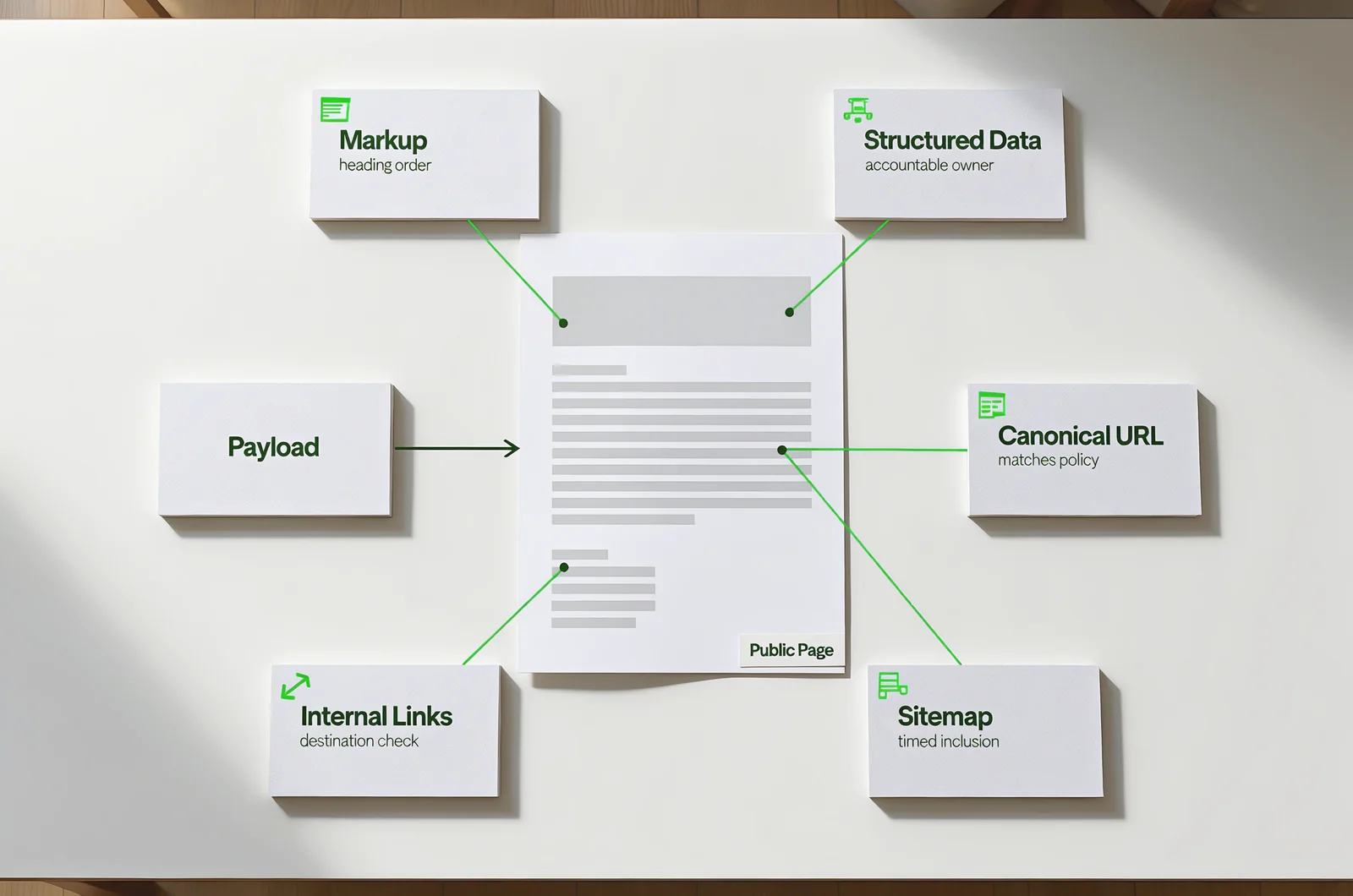
Markup must preserve the article’s structure
Compare the approved document with the delivered HTML. Inspect heading order, paragraph boundaries, lists, links, captions and any tables included in the test corpus.
Assess default template output separately from article-specific content. Record both a blank-template baseline and a populated article so that a mismatch can be traced to its origin.
For example, an article title and its body headings might be correct in the payload while the template introduces an unintended heading. Treat this as a hypothetical diagnostic case, not an observed defect in either CMS.
Define which elements require exact preservation and which permit equivalent rendering. Compare meaningful document structure separately from decorative wrappers or irrelevant whitespace.
Structured data needs an accountable owner
Specify which component is responsible for each intended structured-data object. The responsible component might be a template, an integration or another configured mechanism.
The test should establish whether the public page contains the intended objects, whether they parse, and whether their values agree with the visible article. Record duplicate or conflicting declarations as separate issues.
Do not infer successful delivery from a field labelled “schema” in the publishing payload. Inspect the actual output.
A proposed gate should reject fabricated authorship, unsupported dates and structured-data values that contradict the approved content. Passing that gate establishes compliance with the local specification; it makes no claim about search-result presentation.
Canonical URLs must match the declared policy
Define the intended canonical destination for each test article before publication. Include any deliberate exceptions to a self-referencing canonical policy.
Compare that destination with the canonical emitted by the public page. Inspect the article URL’s response and any redirects separately.
Include update and retry scenarios. The assessment should detect whether a repeated submission creates an additional public route or changes the intended destination.
Treat canonical agreement, route uniqueness and redirect behaviour as distinct results. A single combined pass would conceal which requirement failed.
Sitemap checks need explicit timing
For each release, state whether the intended public URL should appear in the sitemap and when the assessment should check it.
Record the observed URL, its inclusion status and any relevant timestamps actually present. If the intended sitemap cannot be inspected, label the result unverified.
Test both a new article and a subsequent update. Where the operating contract includes withdrawal, also inspect the expected sitemap state after withdrawal.
Sitemap acceptance in this framework means agreement with the declared publication policy. Keep search-engine discovery and index inclusion outside that acceptance result.
Internal links need destination-level inspection
Compare each approved internal link with the delivered anchor and destination. Inspect links in the public HTML as well as those visible in the content record.
Include a destination that already exists, an intentionally excluded destination and an article update that changes a link. These proposed cases test selection and preservation.
A publisher that inserts links should retain the chosen destination set for each release. Otherwise, later differences become difficult to reproduce.
Define acceptable destination states in advance. Record broken destinations, unintended redirects and prohibited targets against individual links, with enough context for an editor to repair them.
Measure publication separately from search visibility
The measurement model should distinguish CMS delivery, public-page acceptance and subsequent search observations. This prevents an ambiguous “published successfully” status from carrying several meanings.
Define release outcomes and denominators
Use a compact outcome model: pending, accepted, failed and withdrawn. Give every failed release a reason tied to a specific acceptance check.
A proposed release pass rate is the number of accepted releases divided by the number of releases with completed evaluations. Report pending releases separately.
Count retries as delivery attempts associated with the same release. Also report attempts per release, because a final success can conceal repeated intervention.
Measure elapsed time between defined events: approval, first submission, delivery acknowledgement and public-page acceptance. Avoid a single duration labelled “publishing time” unless its start and end are explicit.
Report the corpus size beside every aggregate. Preserve failures by category so that a favourable average cannot hide a recurring canonical or link defect.
Keep search observations outside the release gate
If the evaluation includes search visibility, record the observation source, date and URL. Keep index status, impressions and rankings as separate observations.
Those observations cannot isolate a CMS effect within this proposed design. Content differences, site history, publication timing and configuration changes remain possible explanations.
A stronger assessment would use comparable content groups, stable observation periods and a written account of remaining differences. Even then, report associations with their limitations.
Describe an unobserved search outcome as unknown. Do not convert a technically accepted release into a claim that the article has been indexed.
Release gates turn the comparison into operating rules
The practical value of a Webflow–WordPress assessment is a release policy that an operations team can enforce.
Specify the checks that stop publication
Classify requirements as mandatory gates or advisory observations before running the comparison.
Proposed mandatory gates could cover missing approved content, an unintended canonical destination, an inaccessible public route or a link to a prohibited destination. Advisory observations might cover optional metadata or a presentation difference that preserves the intended structure.
The classification is a local policy decision. Document its rationale and owner.
Where a defect can only be detected after public release, define the response in advance. The chosen action might be withdrawal, correction or a pause on subsequent releases.
For a team publishing articles through SiaSEO, assign ownership of content approval, destination mapping and public-page verification. Keep those responsibilities visible even when one person holds several roles.
Test recovery alongside initial publication
Include a deliberately interrupted delivery, a retry, an update and a withdrawal scenario in the assessment.
The proposed recovery requirement is that each release remains identifiable and its final public state remains explainable. Inspect for duplicate routes, partial content and stale metadata after recovery.
Record the human work required to restore the intended state. Count diagnosis, repair, verification and any repeat approval.
Include that labour when assessing content production costs. Subscription cost alone is insufficient for the operating-cost model defined here.
A useful internal selector would accept evidence for mapping, validation, ownership and recovery, then show which requirements remain unverified for each CMS. It should display the missing evidence behind every unresolved result.
Platform selection depends on verified control
This framework supports a conditional choice between configured implementations. It provides no evidence for a universal SEO ranking of Webflow and WordPress.
What would justify choosing Webflow?
Choose the assessed Webflow configuration if it passes the mandatory release gates and meets the team’s requirements for change control, recovery and operating effort.
Require evidence that the intended content and SEO settings reach the public page. Confirm that the people responsible for templates and mappings can diagnose a failed release.
An unresolved requirement should remain visible in the decision record. Resolve it through a configuration change, a documented operating restriction or a further test before approving unattended publication.
What would justify choosing WordPress?
Apply the same standard to the assessed WordPress configuration. Require passing release evidence and an accountable owner for every component involved in the output.
Record which requirements depend on configuration, extensions or custom implementation. Apply that inventory discipline to both platforms.
Where both implementations pass, compare measured repair effort, release delay and maintenance obligations under the same workload assumptions. Where neither passes, repair the release process before increasing volume.
These are analytical implications of the proposed model. A claim that either platform has cleaner default markup, stronger schema handling or better automated SEO output would require additional evidence.
Approval boundaries and migration questions
Unattended publishing also needs rules for exceptions and platform changes. Two questions belong in the operating decision.
When should human review return?
Under the proposed policy, restore human approval when a release fails a mandatory gate, requires an undocumented exception or produces conflicting evidence.
Template and connector changes should trigger renewed validation of the representative corpus. Content approval may remain valid while delivery approval requires another check.
Assign an owner and an expiry condition to every temporary exception. Keep publication paused where the intended public state cannot be established.
Does a passing assessment justify migration?
A passing assessment establishes that the tested configuration met its declared requirements under the recorded conditions.
Migration needs a separate business case covering existing URLs, redirects, archives, integrations and operating costs. This paper contains no migration measurements and no comparative traffic results.
Record the current implementation’s performance before approving a replacement. Run both configurations against the same approved corpus, then compare the documented results and unresolved requirements.