When Automated Content Scheduling Beats a Manual Editorial Queue
Automated content scheduling vs manual editorial queues: where each model wins on velocity, review depth, consistency and control for B2B SEO teams.

For B2B content teams comparing automated content scheduling vs manual editorial queues, the deciding question is where articles get stuck. Automation makes sense when approved work waits for someone to assign dates, transfer content or trigger publication. A manual queue earns its place when each article still needs editorial judgement before release. A hybrid fits teams with both conditions. Choose between them by separating review capacity from publishing administration, then examining the work each article requires. The practical goal is a dependable flow of useful, approved content with clear ownership when something fails.
Three ways to move an article from draft to live
Compare scheduling models by who controls the release decision, what must happen before publication and how exceptions reach an editor.
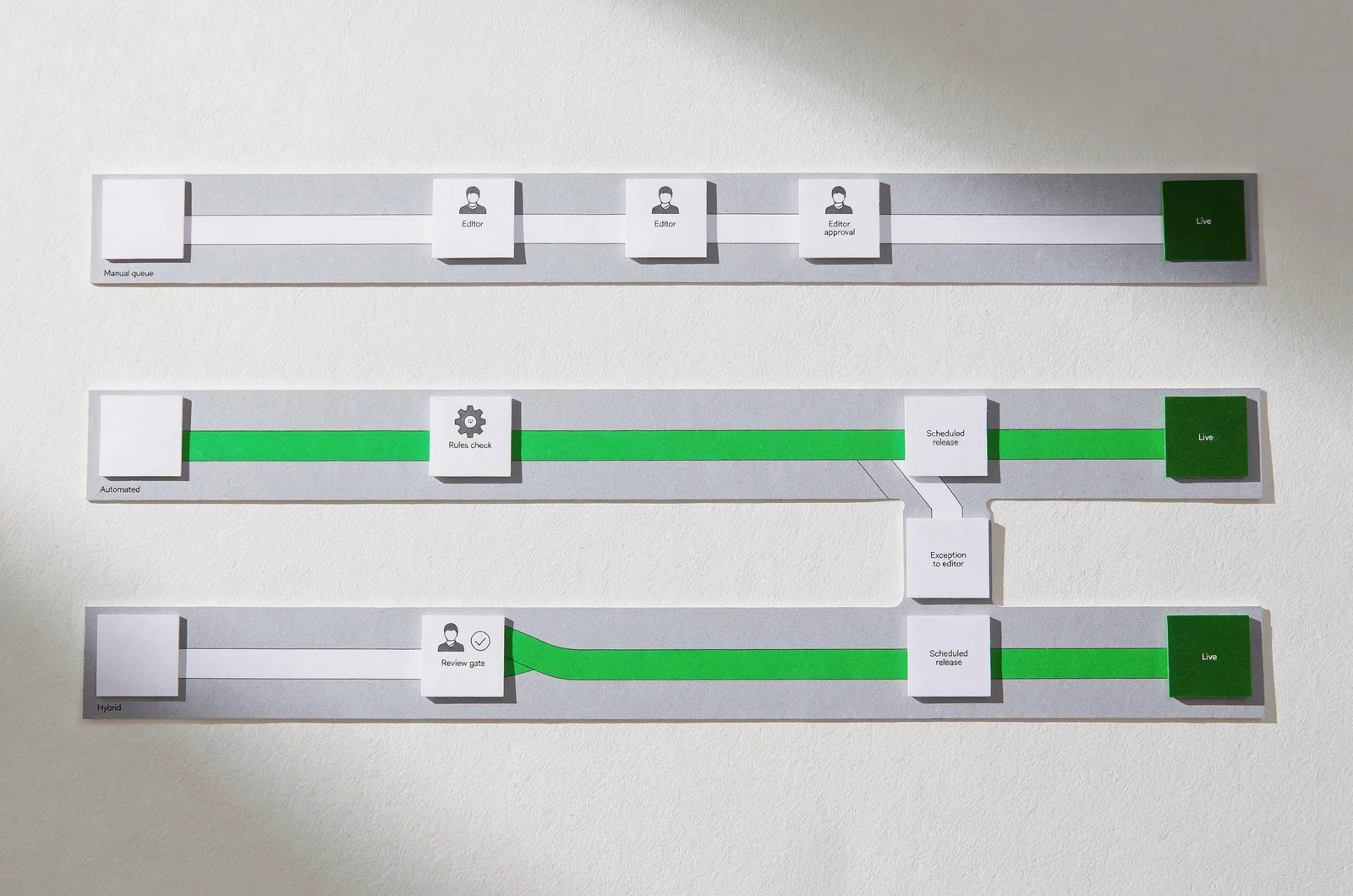
For this comparison, automated scheduling means rules move eligible articles towards a publishing date. It does not require automated writing. A manually written article can enter an automated schedule, just as an AI-generated draft can remain in a manual editorial queue.
A manual queue requires a person to advance articles through the relevant stages. A hybrid uses explicit review gates, followed by automated scheduling or release.
| Operating model | Release decision | Suitable workload | Control to establish |
|---|---|---|---|
| Automated scheduling | Eligibility rules permit release | Repeatable articles with settled briefs and completed checks | Define what blocks publication and who handles failures |
| Manual editorial queue | A person authorises each release | Articles whose claims, timing or positioning need individual judgement | Assign an approver and a review deadline |
| Hybrid with review gates | Human approval makes an article eligible for automation | Mixed portfolios with routine content and sensitive exceptions | Record approval against the specific article version |
These are workflow designs, rather than promises about a particular platform. Before choosing one, inspect the point where your current queue accumulates work. Separate articles awaiting a decision from articles already cleared for publication.
Automation wins when approved work waits for release
Automated scheduling is a stronger fit when publication delays come from repeated administrative steps after editorial decisions are complete.
Identify work that needs execution
Look at articles that missed their planned dates. Was the remaining task a substantive review, or did someone need to upload images, confirm a date or move an approved page into the CMS?
For the latter group, define a repeatable release path. Specify the required article status, destination, owner and publication window. An article should become eligible only after those fields and its editorial checks are complete.
Use a separate status for a failed publishing attempt. Otherwise, an item marked scheduled can obscure whether anything actually reached the website. Assign someone to inspect that status and resolve the failure.
Keep calendar stability separate from editorial readiness
A calendar slot should express an intended release date. It should not substitute for approval.
Suppose an approved article loses its supporting evidence during a revision. The original date is still on the calendar, but its readiness has changed. Require renewed approval for changes to material claims, product positioning or the article’s central recommendation.
Automation is a reasonable choice when your team can describe eligibility precisely and maintain an exception queue. If those rules remain vague, first document several recent release decisions and the conditions behind them.
The practical test is whether an editor can explain why a specific version was eligible to publish. Keep that explanation attached to the article record.
Manual queues earn their place when judgement changes the article
A manual editorial queue fits work where the remaining decisions concern substance, audience or timing.
Reserve human review for consequential decisions
Use individual approval for articles that introduce a new positioning argument, discuss sensitive customer situations or make claims that require specialist verification.
An editor may also need to decide whether a proposed page belongs on the site at all. A technically complete draft can still duplicate an existing argument or address an audience outside the content strategy.
Give that reviewer a concrete decision to make. Replace a broad request to check quality with questions about the claim, evidence, audience and publication purpose. Name the person authorised to resolve disagreements.
Make manual approval visible and bounded
Treat a manual queue as a defined process with an owner, status and expected response date.
Separate substantive review from formatting corrections. If an editor approves the argument but returns a broken table, record the required repair without implying that every editorial decision remains open.
Plan an escalation route for absent reviewers. Decide whether another person can approve, whether publication moves or whether the article waits.
Manual control is justified when the reviewer’s decision can materially change what readers see. To assess its value, record the changes reviewers request and distinguish substantive corrections from routine release administration.
Match the workflow to review capacity and content volume
Team size and article volume help frame the scheduling decision, but review workload determines what the queue can actually support.
The following scenarios are hypothetical planning cases. Adjust their volumes and review assumptions to match your content.
A small team publishing four articles a month
Consider a founder and one content lead producing four substantial articles monthly. Each piece needs a distinct argument and close review.
A manual queue is a reasonable starting point. Assign dates, reviewers and release ownership, then identify any administrative steps worth automating. At this volume, first establish whether publication handling creates enough work to justify another process.
Keep a record of time spent on review separately from time spent preparing approved articles for release.
Two editors coordinating 24 articles a month
Suppose two editors share a monthly workload of 24 articles. Assume each article needs 30 minutes of review.
That plan requires 12 editor-hours. If the editors can allocate only six hours between them, the proposed workload exceeds review capacity by six hours.
Automating publication leaves that review requirement intact. A hybrid is worth considering if some articles can follow established briefs while others need specialist attention. Any reduction in review time should come from a deliberate change in review scope, supported by checks of the resulting work.
A useful planning calculator would accept monthly article volume, review minutes per article and available editor-hours. It should show the capacity shortfall before suggesting a higher publishing cadence.
An agency coordinating 80 articles across clients
Imagine an agency with six people sharing production and review responsibilities across 80 monthly articles.
Evaluate automation by client and content category. A settled educational series might qualify for automated release after approval. A new client’s first articles might require individual sign-off.
Keep client permissions, destinations and approval records distinct. Before expanding automated release, confirm that each publishing task carries the correct client, article version and CMS destination.
Build a hybrid queue around evidence and release gates
A hybrid model fits teams that want automated release while retaining human decisions at defined points.
Approve the brief before filling the calendar
Start with the article’s intended audience, search intent, central question and relationship to existing pages.
Record which topic the article owns and what falls outside its scope. Keep the long-tail keyword strategy attached to the brief so reviewers can assess whether the draft still addresses the intended problem.
For English content serving France and Benelux, specify the intended readership and geographic scope. Ask reviewers to check whether examples, terminology and market assumptions fit that audience.
A populated calendar should remain editable when a brief fails this review. Return the brief for revision before assigning production work.
Give each review gate an observable pass condition
Define checks that a reviewer or system can record consistently:
- Confirm that the draft answers the approved reader question and stays within the agreed scope.
- Verify material claims against the evidence retained for the article.
- Review terminology, product descriptions and recommendations for brand consistency.
- Inspect links, metadata, formatting and the intended CMS destination.
- Record approval against the version eligible for release.
Include AI search visibility in the content review. Ask whether the page states its claims clearly and makes their supporting evidence identifiable.
Keep mechanical checks separate from editorial approval. A complete metadata field establishes that the field has content; a reviewer must still assess whether it accurately describes the article.
Test failure handling alongside successful release
Before relying on an automated schedule, walk through a rejected article, a publishing failure and a substantive edit after approval.
Specify what happens in each case. A failed check should produce a visible blocked state. A publishing error should reach an owner. A changed article should return to the appropriate review stage.
If SiaSEO is among the platforms you evaluate, apply these same acceptance tests to its fit within your workflow. Assess the controls required by your process without assuming that a scheduling feature establishes editorial readiness.
After release, verify the public page’s title, body, links and publication status. Record who handles discrepancies and how the corrected page returns to approval.
Measure publishing speed alongside corrections and topic drift
Compare the three models against the same operational measures so that a fuller calendar does not become the sole measure of success.
Track where time and rework accumulate
Record timestamps for draft submission, review start, approval and publication. Use them to distinguish waiting for review from waiting for release.
Track corrections after publication, with a short description of what changed. Separate formatting repairs from unsupported claims, misleading recommendations and audience mismatches. The categories should help you decide which checks need attention.
For a pilot, define these measures in advance:
- Approval-to-publication time, measured from recorded approval to confirmed release.
- Review time per article, using editor effort rather than elapsed calendar time.
- Articles returned for substantive revision, divided by articles reviewed during the period.
- Post-publication corrections, grouped by the consequence of the error.
Compare similar content categories. An original research article and a routine educational page should not share an unexplained review-time target.
Check whether the queue still serves the topic plan
Review a sample of published articles against their approved briefs. Check the intended audience, question and page purpose.
Repeated movement away from those briefs should trigger an investigation into briefing, drafting or approval. Changing the publication schedule alone would leave those decisions unresolved.
Set the pilot’s acceptance conditions before launch. Decide what correction pattern requires a pause, who can stop automated release and which articles return to manual review. Review the results after a complete publishing cycle before increasing volume.
What changes when you automate the queue?
The remaining decisions concern the scope of approval, the handling of stale drafts and the outcome your team expects from publication.
Can automated scheduling replace final editorial approval?
Choose that only for a clearly defined content category with an agreed review policy. Specify which evidence, content and release checks must pass. Retain individual approval for material claims or recommendations that require judgement. Assign an owner who can suspend release when the policy produces unacceptable results.
Should an approved article be checked again before publication?
Use a freshness rule tied to the content. Require renewed review when an article changes materially, its supporting evidence changes or its approval expires under your policy. Record that rule with the article category. Avoid treating an approval from an unspecified date as permanent permission to publish.
Does a higher publishing cadence establish better SEO performance?
Treat cadence as an operational measure. Evaluate search performance separately against the article’s purpose, with attention to visibility, relevant visits and desired reader actions. Keep the pilot’s workflow decision grounded in release time, review effort, corrections and topical fit. Choose automated release when approved work waits; retain manual decisions where editorial judgement remains unresolved.