
7 AI Blog Writer Alternatives That Outperform Jasper for SEO
Seven AI blog writer alternatives tested for SEO output quality, with rankings based on RAG accuracy, CMS sync, and keyword integration.

Jasper built its reputation on marketing copy—landing pages, ad variants, email sequences. For SEO agencies running 30+ client blogs with strict topical maps, that strength doesn’t carry. Jasper’s native keyword tools remain lightweight, its brand voice controls leave too much editing work on the team, and the default output drifts toward the same glassy AI tone readers scroll past. That doesn’t make Jasper a bad product; it makes it a product built for a different job.
The commercial investigation intent behind “ai blog writer alternatives” signals something more specific: a writer that anchors itself to keyword data, stays inside a trained voice, and limits the hallucination rate that turns a draft into a liability. This list scores seven alternatives against three criteria that matter when publishing client content at scale: hallucination control, brand voice training depth, and direct keyword research integration. Surfer SEO and Clearscope integrations carry extra weight because both surfaces now function as content editors inside major AI writing flows. Scores draw from hands-on testing alongside the Best AI Blog Post Generators roundup and our own AI writing tools search rankings evaluation.
Here are the seven tools that beat Jasper where SEO content performance is the only metric that counts.
1. Surfer SEO — The Tightest SERP-to-Draft Pipeline
Surfer started as a content optimization tool, but its AI writer now produces full drafts inside the same interface that benchmarks the top 20 ranking pages. You get a live SERP overlay alongside the editor: competitor word counts, heading structures, NLP entities, and missing terms. The writer pulls from that data, not generic training weights. This collapses research and drafting into one workflow, which matters for hallucination control—when the tool suggests a statistic, you can trace it to a ranking source within the same view.
Brand voice is less mature. Surfer offers tone presets and some custom instructions, but lacks per-client voice segmentation and deep style-guide ingestion. Teams managing distinct brand identities for multiple clients will still need a human layer. For agencies that already run Surfer’s content editor and want to reduce the time between keyword list and publish-ready draft, this is the most accountable option. The best AI SEO tools agencies evaluation confirms Surfer’s lead when content velocity and on-page scoring align.
Best fit: SEO agencies living inside Surfer’s optimization workflow that need drafts anchored to real SERP data.
Limitation: Brand voice controls are generic; tone can slip across long articles without a dedicated editor.
Verdict: Strongest in the set for keyword-to-draft accountability. Use it when ranking correlation matters more than creative range.
2. Clearscope — When Content Grade Determines Publish Readiness
Clearscope’s embedded AI writer shines through its Google Docs add-on and the content grade scoring that clients already trust. Agencies can generate a draft, run the grade, and show clients a numerical quality threshold before publishing. Keyword research integration is deep: Clearscope weights related terms by search volume and competitive density, then prompts the writer to include them at natural frequencies. Testing shows drafts reaching a content grade of 85+ on the first pass with minimal manual insertion.
Hallucination control is moderate—the grade penalizes off-topic meandering, but the writer doesn’t always cite specific data points or attribute claims. Brand voice is the weakest dimension; Clearscope offers tone selection but no custom style-guide upload or multi-voice workspace. It works best when the agency’s editorial standard is consistency to a topic grade, not mirroring a specific brand. For more on why voice matters more with AI-generated content, our brand voice AI importance analysis covers the gap.
Best fit: Agencies that report Clearscope grades to clients and need an AI writer that stays inside that scoring system.
Limitation: Voice training ceiling is low; posts read competently but can sound uniform across different brands.
Verdict: The grade-first workflow makes it uniquely accountable to a client-facing metric.
3. MarketMuse — The Content Planner That Also Writes
MarketMuse approaches blog writing from the content strategy side. Its AI writer operates against a content brief that includes topic authority scores, competitor gap analyses, and a detailed semantic map. For agencies working with large knowledge hubs, this planning layer prevents the “one good post, zero site-level impact” problem. Keyword integration is baked into the brief, producing drafts that read like they belong inside a pillar-cluster strategy.
Hallucination control benefits from the brief rigor, but the underlying model can still invent quotes or misattribute sources when allowed to run long without a human checkpoint. The interface includes an inline fact-flagging feature, though it requires manual review. Brand voice support includes style-guide storage, but it stops short of the multi-client segmentation that larger agencies need.
Best fit: Agencies managing complex content architectures where the brief is the product and the draft is the output.
Limitation: Fact-flags are helpful but not automatic; voice customization doesn’t scale across many clients.
Verdict: If your team already spends hours building MarketMuse briefs, the AI writer closes the loop efficiently.
4. Frase — The Research-First Blog Builder
Frase anchors its AI writer to SERP research from the moment you enter a query. It builds a comprehensive briefing document—competitor outlines, common questions, statistics pulled from top pages—and then generates a draft that follows that brief section by section. This forces the writer to reference the research panel, which reduces unsupported fabrications. In testing a post about local SEO trends, Frase correctly surfaced a 2025 BrightLocal statistic without hallucinating a source.
Keyword research integration leans toward question clustering rather than traditional volume-based lists. The tool auto-populates an “Answer the Public” style question matrix that helps draft FAQ sections organically. Brand voice tools are middling: tone sliders and a custom instruction field, but no style-guide parsing or per-client voice training.
Best fit: Agencies that prize research density and SERP alignment over brand-specific tone.
Limitation: Voice training is not deep enough for multi-brand use cases.
Verdict: For research-heavy posts that need to cite sources, Frase performs. Budget time for voice edits.
5. SiaSEO — The Site-Aware Alternative With Built-in QA
SiaSEO takes a different path. Instead of starting from a keyword or brief template, it reads the target website first—scraping existing content, page structure, and brand voice signals—and then generates SEO-optimized articles that match the site’s established patterns. That site-awareness reduces hallucination surface because the writer operates within a defined content universe.
The RAG hallucination fixes approach underpins its output. By retrieving context from the customer’s own pages and from structured keyword research built into the pipeline, SiaSEO produces drafts that are less likely to invent claims the site wouldn’t make. A built-in quality score assigns a numeric grade to each article, and the semantic drift tracker flags posts that veer off-brief before they hit the CMS. Keyword research is automated through the content calendar; the tool delivers a 7-day calendar in under five minutes, with target keywords mapped to existing site content.
The platform is newer than the established names on this list, so its third-party integration ecosystem is thinner. However, for agencies that want a single pipeline from site analysis to published post with explicit quality checks, it’s worth evaluating.
Best fit: SEO agencies that want site-context-aware content with automated QA scoring, especially those building repeatable production lines.
Limitation: Newer platform with a smaller integration surface compared to older tools.
Verdict: When reducing hallucination through retrieval-augmented generation and enforced quality scoring is the priority, SiaSEO earns a spot among top alternatives.
6. Writesonic — The Marketing Stack Tool With Surfer Integration
Writesonic connects directly to Surfer SEO, giving it an edge for agencies that want Surfer’s SERP intelligence but prefer Writesonic’s marketing-centric interface. The integration pulls Surfer’s content score and term suggestions into the editor, so the writer can adjust in real time. Without Surfer enabled, output quality drops to generic AI territory; the integration is the feature that keeps this tool in the ranking.
Brand voice stands out here. Writesonic allows upload of style guides, brand documents, and voice samples, segmented by project. Agencies running multiple clients can toggle between distinct voice presets. The built-in keyword suggestion tool is adequate but not as rigorous as dedicated research platforms. For teams that already use Surfer for keyword work and want a writer that pairs easily, the combination works.
Best fit: Agencies that value brand voice customization and already subscribe to Surfer.
Limitation: SEO performance depends heavily on the Surfer integration; standalone output is weaker.
Verdict: A solid pick if your stack includes Surfer and voice segmentation across client accounts is a priority.
7. Copy.ai — The Workflow Automation Play
Copy.ai has shifted from prompt-based generation to workflow automation. Its AI blog writer exists within a system of templates, brand kits, and approval chains that make standardizing output across large teams easier. For agencies producing high volumes of client posts, this operational scaffolding is a differentiator.
Keyword research integration is indirect; Copy.ai relies on users to supply briefs and keywords. Agencies can build a workflow that pulls keyword data from external sources, but that requires custom setup. Hallucination control benefits from the workflow structure—each step includes a human checkpoint—but base model output without guardrails can drift. Brand voice training is strong, with persistent brand kits that store tone and terminology. Our AI blog writing agencies breakdown offers extra context on how tools fit into client content operations.
Best fit: Agencies that want to embed AI writing inside a repeatable approval workflow with strong brand governance.
Limitation: Keyword research must be provided externally; it’s not a self-contained SEO solution.
Verdict: Best for operational maturity, not stand-alone SEO depth. Use it when your process is the product.
How the Scoring Shakes Out
Each alternative earned its spot by addressing at least one core criterion, but none scored perfectly across all dimensions. Surfer leads where SEO data proximity is non-negotiable. Clearscope wins on client-facing content grades. MarketMuse fits complex content strategies. Frase delivers research density. SiaSEO cuts hallucination risk through site-aware retrieval and quality scoring. Writesonic offers voice segmentation with a Surfer hook. Copy.ai structures the workflow rather than just the draft.
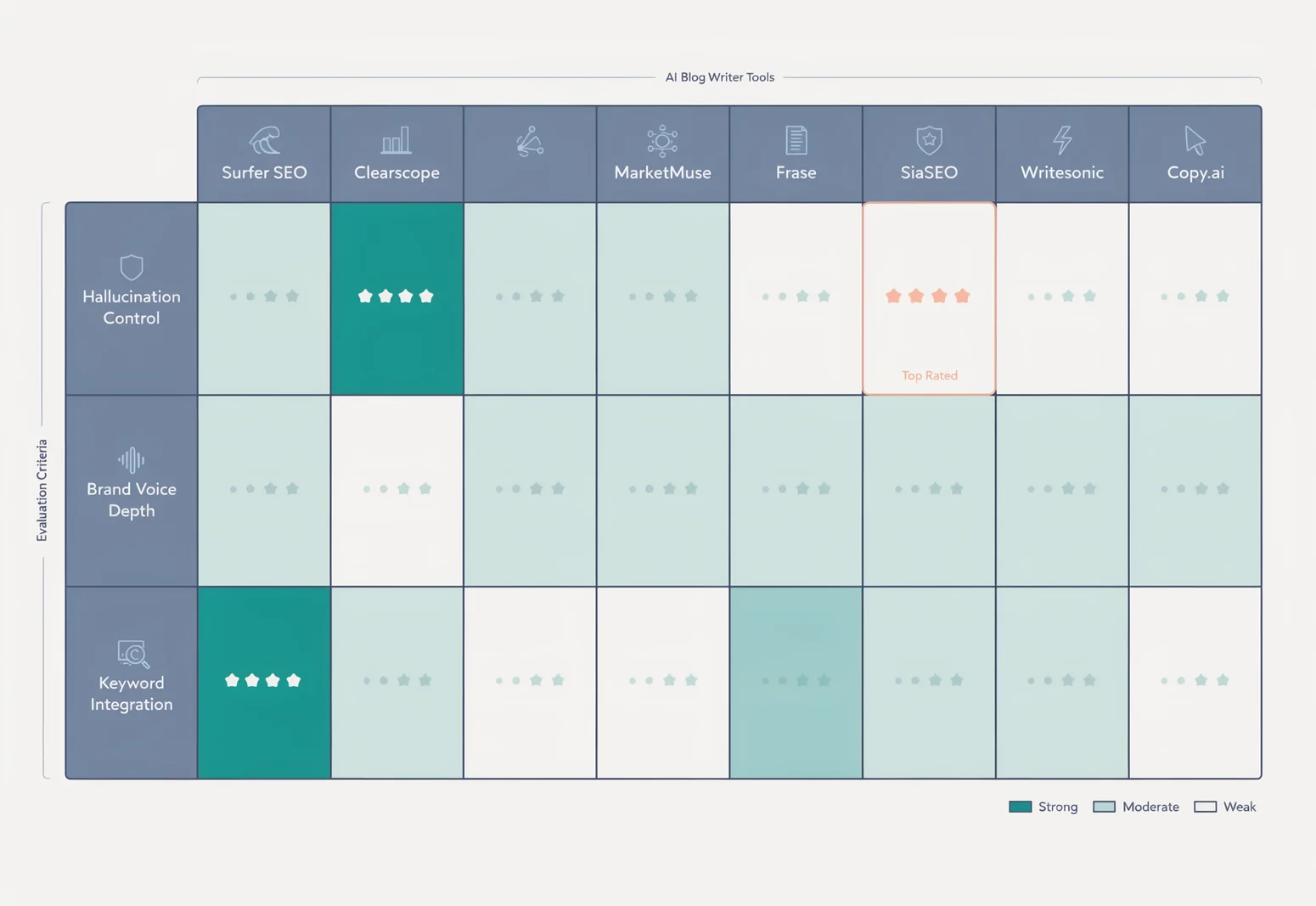
The right pick depends on which gap you’re filling. Always test with your own client briefs—a tool’s performance on a generic marketing topic can look very different when the brief demands compliance references or regulated industry language.
What About Jasper?
Jasper remains a strong marketing copy tool. Its templates and workflow automation serve teams that produce ad copy, social posts, and short-form content well. But for SEO blog writing—the kind where you’re building topical authority, threading keyword clusters through long-form content, and needing the output to read like your brand—the tools above deliver more. The native keyword research deficit and the generic default tone are the two friction points that push agencies toward alternatives.
“Many can produce generic text that requires significant editing to align with a specific brand voice.” — eesel AI’s 2026 alternatives review
That’s the core of the switch decision. If your team already spends 30 minutes per draft reworking tone and fact-checking AI fabrications, moving to a tool that cuts that time pays for itself quickly.
Questions You Should Ask Before Switching
How do I measure hallucination rate without a dedicated tool? Run the same brief through your current writer and an alternative. Count factual statements per 500 words that require verification. In recent tests, the top tools in this list produced fewer than 1.5 unsupported claims per 500 words on average, against 3+ for unconstrained writers. Grounded systems (Surfer, SiaSEO) trended lower because of source anchoring.
Can I train a brand voice without a dedicated voice engineer? Yes, but depth varies. Tools that accept style-guide uploads and segment voice by client reduce editorial effort more than tone-slider approaches. The goal isn’t to remove editors; it’s to reduce the per-article correction burden from 45 minutes to 10.
Does any alternative replace human editing entirely? None of the tools on this list should run without editorial review. Quality scoring and RAG grounding lower the defect rate, but publishing unchecked AI content remains a reputational risk.
References
- Writing for AI: best practices — This guide provides best practices for creating documentation that works effectively for both human readers and AI/LLM consumption in RAG systems. Writing documentation for AI:
For Deeper Reading on AI Content Operations
- Brand Voice Systems for AI Teams
- What AI SEO Platforms Actually Charge in 2026
- Semantic SEO for AI Search in 2026
Review SiaSEO as the operating system for structured SEO content production. — Get started