How to Choose an AI Blog Generator That Scales Without Quality Drift
Learn how to evaluate AI blog generators for scale, quality control, and site-aware output. A practical framework for marketing teams and agencies.

Most teams discover quality drift only after it has cost them traffic. One month your AI-generated posts rank; three months later, thin structure, repetitive angles, and off-brand phrasing start cannibalizing your own URLs. The tool still works, but the output has slipped. This is the central risk when you choose a blog generator for volume: scale and quality are not automatic partners.
This guide gives you a decision framework built around three operational tests—site-awareness, quality scoring, and CMS integration—that separate tools that maintain standards from tools that merely accelerate output. It is written for marketing directors, agency operators, and content leads who need to evaluate software before committing a content calendar to it.
What Site-Awareness Actually Means
A blog generator that lacks site-awareness writes in a vacuum. It infers your industry from a prompt, guesses your audience, and produces generic authority signals that readers and search engines recognize as pattern-matching rather than expertise. Site-awareness means the tool reads your existing content, understands your positioning, and carries that context into every new draft.
Start your evaluation with a simple test. Submit your homepage URL and a target keyword. Does the output reference your product categories, your documented methodology, or your existing content pillars? Or does it invent a company profile that sounds plausible but misrepresents what you do?
The distinction matters because search engines now weight entity consistency heavily. Google's systems cross-reference what you claim across pages. An AI tool that generates posts without grounding in your actual site structure introduces contradictions that dilute topical authority. As one operator framework puts it, "If a tool writes well but fails SERP intent, it bleeds impressions to competitors with tighter briefs and stronger on-page structure" Best AI SEO Blog Generator:.
Look for these specific capabilities:
- URL ingestion with semantic parsing, not just keyword extraction
- Brand voice calibration from existing posts, not template selection
- Internal link awareness that suggests connections to your published pages
- Content pillar tracking so new posts extend clusters rather than repeating them
A tool that cannot demonstrate these functions from a live URL is not site-aware. It is prompt-aware, which is a much lower bar.
Building a Quality Scoring System You Can Trust
Quality drift hides in plausible-sounding output. The grammar is correct, the structure follows templates, the keyword density looks reasonable—but the claims are unsupported, the examples are generic, and the angle duplicates something you published six weeks ago. Without explicit scoring, you will not catch this until analytics shows the damage.
The critical question for any blog generator is whether it gates publication on quality metrics, or merely reports them after the fact. As noted in recent analysis of AI writing platforms, "Does the tool have a mechanism to score content before it publishes—or does it just ship whatever the model outputs? This is the single biggest differentiator between tools that survive algorithm updates and tools that don't" Best AI Blog Writer for.
Demand scoring dimensions that map to search quality frameworks, not just readability. The minimum viable set includes:
| Dimension | What to Verify | Red Flag |
|---|---|---|
| E-E-A-T signal density | First-person expertise, cited sources, dated claims | Generic "experts say" without attribution |
| Semantic originality | Novel angle relative to your existing posts | Near-duplicate of published content |
| Structural completeness | Logical H2/H3 flow, answer-targeted sections | Template-heavy organization without query matching |
| Factual grounding | Verifiable claims, accurate product references | Hallucinated statistics or invented case studies |
| Helpful content alignment | Reader task completion, not keyword satisfaction | High keyword density, low practical value |
Run a controlled test. Generate five posts on related topics from the same keyword cluster. Score them yourself against these dimensions, then compare your scores to the tool's internal ratings. If the tool consistently overstates quality—marking near-duplicates as original, or generic advice as expert—its scoring system is cosmetic.
Some platforms now use multi-model routing for this: one model generates, another evaluates, and a threshold gates publication. The specific architecture matters less than the outcome. What percentage of drafts fail the gate? If the answer is near zero, the gate is not functioning.
CMS Integration as a Quality Control Layer
Publishing friction creates a hidden cost that compounds with scale. Every manual export, format fix, image resize, and meta-description rewrite adds time and introduces inconsistency. But the deeper problem is that disconnected workflows separate content creation from content governance. When generation and publication live in different systems, quality checks fall through the gap.
Evaluate integration on three levels:
Data flow. Does the tool push clean HTML with proper heading hierarchy, alt text, and schema markup? Or does it dump markdown that your CMS reformats unpredictably? Test with a single post and inspect the rendered output. Check heading levels, list formatting, and image handling under your theme.
Workflow state. Can you hold posts in review, schedule publication, and track versions? Or does the tool treat "generate" and "publish" as the same button? The ability to stage content for editorial review is non-negotiable for teams managing multiple writers or client accounts.
Feedback loop. Does publication data—indexing status, ranking position, click-through rate—return to the generation system? Without this, the tool cannot learn from performance. You are flying blind on whether your content strategy is working.
Modern platforms are moving toward direct API publishing with agent-ready protocols. One recent platform release enabled "autonomous software agents through a public API and a Model Context Protocol server" so that "an assistant connected to it can now draft a post, organise it, publish it, and confirm the change is live on the customer's own domain, without a human touching the interface at any point." This direction—machine-readable publishing infrastructure—matters because it enables the closed-loop systems that prevent drift.
The Publish-Readiness Ladder: A Practical Grading Method
Even with good tooling, you need a manual verification framework for spot-checking output. Adapt a five-rung ladder from operator practice:
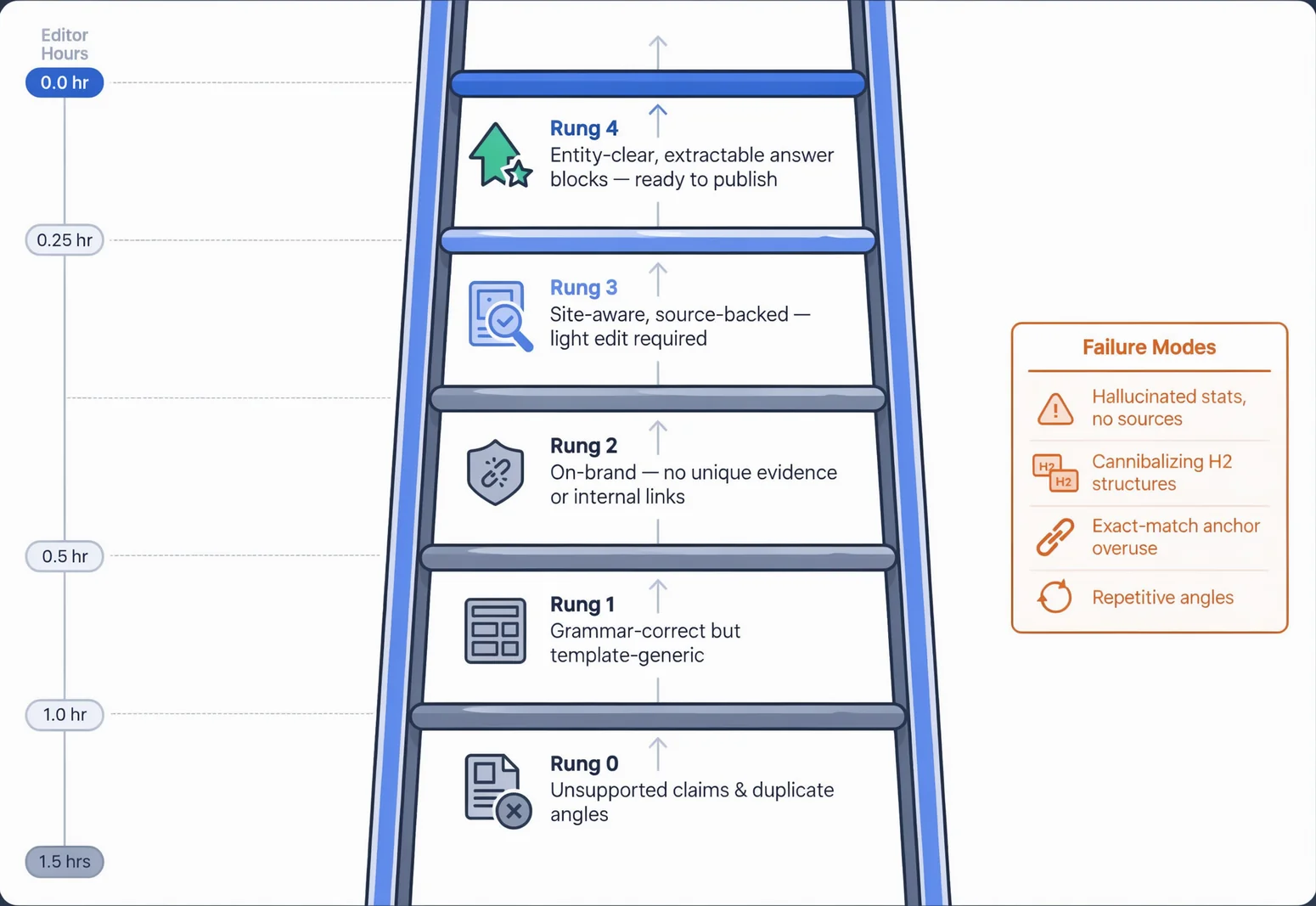
- Rung 0: Unusable. Factual errors, off-brand voice, or structural failure.
- Rung 1: Heavy editing required. Core argument salvageable, but most sentences need rewriting.
- Rung 2: Moderate editing. Paragraph-level fixes, some claim verification, heading adjustments.
- Rung 3: Light editing. Line-level polish, link insertion, image addition.
- Rung 4: Near-publishable. Minor tweaks only; suitable for time-sensitive or high-volume pipelines.
Apply this during trial periods by sampling three outputs per keyword family. If your median rung is below 3, the tool adds editor overhead that negates its speed advantage. Track this metric weekly after adoption; drift often appears first as a slow decline in rung scores, not as dramatic failure.
Watch for specific failure modes that indicate systemic problems: hallucinated statistics without sources, excessive exact-match anchor text in suggested links, and redundant H2 structures that cannibalize sibling posts. These patterns suggest the tool is optimizing for surface signals rather than genuine topical development.
Evaluating Indexing Velocity and Search Performance
Quality that search engines cannot discover is not quality. A common operational blind spot is measuring output volume while ignoring indexing speed. Use Google Search Console's Index Coverage report and URL Inspection tool to track crawl-to-index time for AI-generated posts. If your output sits unindexed for ten or more days on low-competition keywords, you have a pipeline problem, not a content problem.
The root cause is usually technical: uncrawlable JavaScript rendering, missing internal links, or thin pages that Google deprioritizes. But the generator itself shares responsibility. It should produce "cleanly crawlable, interlinked, and built for speed" output Best AI SEO Blog Generator:. Verify this by checking:
- Whether generated posts include logical internal link suggestions
- If image alt text and structured data are present in the raw output
- Whether the tool warns about cannibalization before publishing
Some teams now track a separate metric: LLM visibility, or how often their content appears in AI search answers. This requires different optimization—structured extraction, clear entity relationships, explicit E-E-A-T signals—than traditional keyword targeting. If your strategy includes appearing in ChatGPT answers or Perplexity citations, your quality framework must explicitly measure these dimensions.
Scaling Without Losing Editorial Control
The tension between volume and control intensifies as teams grow. A solo operator can review every post; a ten-person content operation with fifty client accounts cannot. The solution is not to eliminate review but to shift where it happens.
Front-load editorial decisions into the tool configuration. Define your voice parameters, content pillars, and prohibited phrases before generation begins. Build approval workflows for sensitive topics—pricing, competitive comparisons, regulatory claims—while allowing routine posts to flow through automatically.
Monitor for semantic drift quarterly. Compare a sample of recent posts against your earliest AI-generated content. Has the vocabulary shifted? Have the examples become more generic? Has the angle on recurring topics flattened into repetition? These are early warning signs that your tool is recycling patterns rather than developing your topical authority.
Blog standards from established editorial programs emphasize this discipline: "University bloggers must make a commitment to regular posting" with clear voice guidelines, and content should be drafted in external tools for spell and grammar review before CMS entry Blog Standards. The same rigor applies to automated generation. The machine does not remove the need for standards; it makes standards more important because the volume of application is higher.
What to Demand During Vendor Evaluation
When you demo a blog generator, structure your evaluation around observable behavior, not feature lists. Request these specific demonstrations:
- Live URL analysis. Provide your own homepage, not a demo site. Evaluate the output for accurate brand representation.
- Controlled quality test. Generate three posts on the same keyword cluster. Score them for originality and factual accuracy.
- Publishing workflow walkthrough. Move a post from generation to scheduled publication. Count the manual steps.
- Performance data review. Ask for anonymized indexing speed and ranking trajectory data from existing customers.
- Failure mode exposure. Ask what happens when output fails the quality gate. Is it blocked, flagged, or merely noted?
Be skeptical of tools that cannot demonstrate quality gating with specific thresholds. A "confidence score" without defined dimensions is not a score; it is a decoration. Similarly, be wary of platforms that emphasize speed metrics without corresponding accuracy benchmarks.
When AI Search Visibility Changes the Stakes
Traditional SEO optimization targets ranking position. Emerging AI search optimization targets citation and extraction—whether your content appears in synthesized answers. This shifts quality requirements.
Content that ranks well may still fail to be cited by LLMs if it lacks clear entity structure, explicit expertise signals, and concise answer passages. Your blog generator should help with this, not hinder it. Look for tools that:
- Structure content with extractable answer blocks
- Surface entity relationships explicitly
- Track LLM citation rates as a performance metric
One analysis of AI writing platforms notes that "if success is AI search visibility—appearing in ChatGPT answers, getting cited by Perplexity, surfacing in Google AI Overviews—you need a different stack entirely. You need content structured for LLM extraction, a quality gate that enforces E-E-A-T signals before anything publishes, and a measurement loop that closes the system" Best AI Blog Writer for.
This is not future-proofing. AI overviews already appear for significant query volumes, and the trend is toward more synthesis, less traditional ranking.
Tool Idea: A Publish-Readiness Calculator
For teams managing multiple keyword clusters or client accounts, consider building a lightweight calculator that inputs your monthly post target, editor capacity, and observed rung distribution, then outputs the maximum sustainable volume before quality drops below your threshold. The formula is simple:
Sustainable volume = (Editor hours per month × Average posts per hour at target rung) / Review coverage percentage
Where review coverage is the fraction of posts you spot-check rather than fully edit. If your tool's median rung is 2.5 and your editors can process two posts per hour at that level, but you can only review 20% of output, your sustainable volume is lower than raw capacity suggests. This calculator exposes the real constraint in your system.
Questions Operators Ask Before Committing
How do I prevent my AI tool from cannibalizing my own content?
Require the tool to check existing URL inventory before generating. It should flag when a target keyword overlaps with published posts and suggest differentiation angles or cluster extensions rather than repetition.
What is the minimum viable quality gate?
At minimum, automated checks for factual consistency against your site, originality against your archive, and structural completeness against the target query. Human review should focus on strategic fit and expert judgment, not basic error catching.
How quickly should I expect indexing?
For established sites with regular publishing cadence, three to seven days for low-competition keywords. Beyond ten days indicates technical or quality issues. Track this per content source to isolate generator-specific problems.
Can one tool handle both traditional SEO and AI search optimization?
The capability is emerging but not universal. Evaluate whether the tool explicitly structures for extraction and tracks LLM citation metrics. If it only reports traditional ranking data, it is not optimizing for the full search landscape.