Reality Augmented Generation Across 9 Research Sources
Explore nine sources that define reality augmented generation, from core terminology to applications in SEO content workflows.

For content operations teams researching reality augmented generation, the first decision is what the phrase means and which evidence supports it. Before it becomes a content strategy or software requirement, its relationship to retrieval-augmented generation needs a traceable explanation.
Nine verified publications cannot be identified from the evidence available for this article. The roundup therefore covers nine source categories to assess, with the evidence each would need to contribute. Publication identities, exact-phrase usage and access costs remain unverified. These are research priorities, rather than endorsements of particular papers.
For a marketing director, agency owner or content lead, the practical question is concrete: what information should enter a generation workflow, and what checks should govern the resulting article?
What would make a source credible here?
A source earns a place in this research map by resolving a specific uncertainty about terminology, mechanisms or publishing decisions. Require an identifiable author or organisation, an inspectable document and a clear connection between its evidence and the claim you intend to make.
Keep three decisions separate:
- Whether a document uses and defines the exact search phrase.
- Whether it explains a relevant generation mechanism.
- Whether its findings support a proposed content workflow.
Use retrieval-augmented generation for the mechanism of retrieving external material and supplying it to a generator. Leave the meaning of the queried phrase unresolved until an identifiable source defines it.
A document about retrieval can inform the second decision while leaving the first unanswered. Similarly, a proposed architecture needs evaluation before you attribute performance benefits to it.
Assess research cost as access fees, technical review time and reproduction effort. No monetary estimates are available here. For every candidate, record its publication date, version, source type and the precise claim it can support.
Three sources for terminology and generation mechanics
These first three categories address the central ambiguity: whether the proposed label describes a defined concept, and how a corresponding system would work.
1. An original publication defining the phrase
Start here if your article, proposal or procurement brief depends on the exact terminology. The strongest candidate would be an identifiable publication whose authors explicitly introduce or define the phrase.
Inspect the full passage around the definition. Record whether the authors describe a retrieval system, a connection to physical observations, a multimodal process or something else. Preserve their stated scope and any conditions attached to the definition.
Budget review time for context, terminology and the publication’s supporting references. A passing mention in a headline would provide less useful evidence than a definition connected to a method.
Its limitation is scope: one author’s definition would establish that author’s usage. Assess wider adoption separately. Accept this source for terminology only when you can point to the relevant passage; otherwise, keep the phrase’s meaning marked as unresolved.
2. An original retrieval architecture paper
Choose this category when the practical question concerns document-grounded drafting. A suitable paper should make the information flow inspectable: what enters the retrieval stage, what it returns and what the generator receives.
Look for details about the document collection, retrieval method, context selection and generation procedure. Ask whether the reported system retrieves passages, complete documents or another representation. Those distinctions belong in any explanation of its mechanism.
The review burden depends on how much technical reconstruction the paper requires. Include supplementary material or code in the assessment only when an identifiable candidate provides them.
A retrieval architecture cannot, by itself, establish the meaning of a different phrase. Use it to explain the documented mechanism. With no specific paper verified here, implementation recommendations should remain conditional on the architecture eventually selected.
3. A controlled study of factual support
Prioritise this source when the intended benefit is fewer unsupported statements. Require an evaluation that defines what counts as a supported claim and explains how judgements were made.
Inspect the comparison conditions. Which inputs changed? Did the generator, instructions or document collection also change? Record the evaluation task, assessors and treatment of partially supported statements. Keep the denominator visible whenever results are reported.
Expect the review effort to centre on methodology. A headline result gives too little information for deciding whether a study applies to your publishing work.
Its limitation is transferability. Assess whether the evaluated questions, documents and outputs resemble your own. Accept performance claims only within the study’s stated conditions, then define a separate evaluation for your articles. No benchmark result or improvement percentage is established in this guide.
Three sources for grounding claims in a business context
The next categories examine what should count as evidence when generation involves business entities, changing information or observations beyond text.
4. Research on structured knowledge and entity relationships
This category fits teams whose drafts depend on relationships between products, capabilities, markets and audiences. Seek research that explains how those relationships are represented and how the generator uses them.
A candidate might describe records, a knowledge graph or another explicit structure. Inspect how it handles missing values, conflicting relationships and changes to an entity. Require enough detail to distinguish the stored evidence from the model’s generated interpretation.
Budget time to map the proposed representation against your own content. For a hypothetical Munich SaaS team, that could mean connecting each product claim to its language version and intended market.
The limitation is the underlying record quality. Structure alone provides no basis for declaring a claim current or correct. Accept a candidate when its representation and evaluation address the relationships your content needs; require separate evidence for the business facts themselves.
5. Research on time-sensitive retrieval and conflicting evidence
Use this category when an article depends on information that can change. Seek a method that makes dates, versions or competing records part of the evidence assessment.
Inspect what a timestamp means. It could identify publication, revision, observation or a period of validity. Require the source to explain how its method handles an older authoritative record alongside a newer document with a different scope.
Review costs should include an audit of your own records. Ask which documents retain revision history and who can resolve contradictions between them.
A later date alone should not determine your editorial decision. Require authority, subject match and validity conditions alongside recency. Accept this source for a freshness policy only if its method addresses the conflicts you expect. Keep any claimed benefit tied to the evaluated task and its documented time window.
6. Research on multimodal or physical-world grounding
Consider this category if the intended meaning includes images, audio, sensor readings or observations of a physical environment. Establish that scope before assigning it a place in a text-content workflow.
Require a candidate to identify its inputs and explain how each contributes to the generated output. For a visual claim, inspect the connection between the observation, its interpretation and the final statement.
Budget technical review for data collection, annotation and evaluation. Assess those requirements against the actual material your team plans to publish. Keep deployment costs marked as unknown until a specific method and operating context are documented.
The limitation is relevance. Evidence from a visual or sensor-based task needs a reasoned connection to editorial work. Include this category only when the proposed use requires those inputs; otherwise, spend the research effort on textual evidence and claim support.
Three sources for controlling the published article
These categories connect the generation mechanism to editorial decisions. They cover operational evidence, so distinguish internal specifications and reports from research publications.
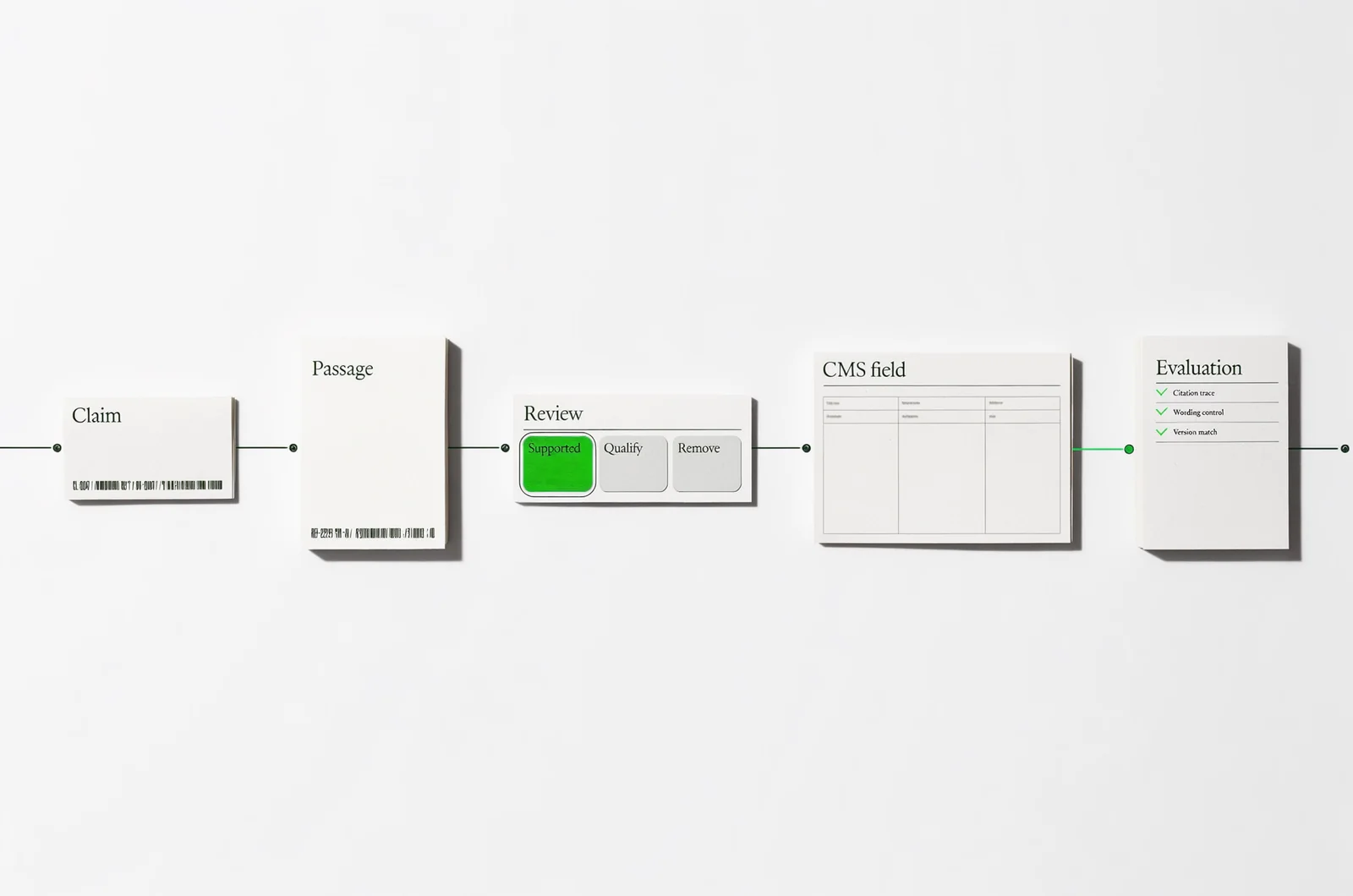
7. A documented claim-to-evidence workflow
Choose this source when reviewers need to inspect why a draft contains a particular factual statement. The useful document would specify how claims connect to supporting passages and how uncertainty reaches the editor.
Require an example record with the claim, source identifier, relevant passage and review decision. Include a route for statements that are unsupported, ambiguous or dependent on another document. Specify who can approve a qualification or remove a claim.
The main cost signal is reviewer effort. Ask for evidence of how much inspection the proposed process requires before deciding whether it fits your publishing volume.
Its limitation is coverage: a workflow specification describes intended behaviour. Require sample outputs and an evaluation before treating that behaviour as demonstrated. Accept the document as an operating procedure once its responsibilities and failure handling are explicit.
8. A versioned publishing interface specification
This source fits teams that need approved content to reach a CMS with its structure intact. Assess the interface specification against the article fields and review states your team uses.
Require documented handling for headings, links, metadata and publication status. Add source identifiers or review records to that assessment when the proposed workflow depends on them. Inspect how revisions and failed submissions should be handled.
Budget for field mapping and representative examples. The specification should provide enough detail to compare the intended content with the stored result.
Its limitation is evidential scope. Successful delivery establishes no conclusion about factual support. Use a separate content approval decision. When planning automated publishing workflows, define which records must survive the transfer and require a check of the resulting CMS entry before release.
9. An evaluation report from the intended publishing workflow
Prioritise this category when moving from a proposed method to an operational decision. Require a report about the kinds of articles, sources and review conditions your team actually intends to use.
Ask for a documented sample, evaluation criteria and unresolved failures. Useful measures to request include unsupported claims, citation mismatches, editorial corrections and review time. Each measure needs a definition and a stated denominator.
Budget for both assessment and adjudication. If reviewers disagree about support, record how those disagreements are resolved. Keep generation settings and source versions attached to the evaluated outputs.
The limitation is generalisation beyond the sample. A report about one article family leaves other formats unevaluated. Accept it as evidence for the tested scope, and identify which additional article types or source conditions need assessment before expanding publication.
Use the evidence to set a publishing threshold
The nine categories become useful when each one answers a defined decision about the proposed generation workflow. Assign every accepted source a role: terminology, mechanism, factual support, operational control or evaluation.
Separate the research decision from the release decision
Build a claim register before approving an article premise. For each substantial assertion, record the supporting document, passage, version and permitted wording. Treat missing evidence as an editorial task: remove the assertion, qualify it or commission the required research.
Then set a publication threshold. Specify which unresolved issues block release and who can resolve them. A terminology gap may require rewriting the premise; an unsupported product statement may require a current primary record.
For a team evaluating SiaSEO, apply these requirements to the proposed workflow. Ask whether source records, qualifications and editorial decisions can remain inspectable through drafting and publication.
Make the evidence check inspectable
A useful internal checklist could accept a draft and its source register, then flag claims without supporting passages. It could also show source dates and unresolved review decisions beside each claim.
Keep the release decision with the designated reviewer. A match between words in a claim and words in a document still requires a judgement about meaning.
For a hypothetical English article based on German business documentation, retain the original passage beside its translation. Require the reviewer to check that the translated wording preserves the original scope, conditions and degree of certainty.
Questions that change the research brief
Resolve these questions before using the ambiguous term to commission content or compare systems. Each answer determines which of the nine source categories deserves attention.
Is the phrase interchangeable with retrieval-augmented generation?
That equivalence remains unverified here. Require an identifiable author’s definition before treating the terms as interchangeable.
Where the intended mechanism is retrieval followed by generation, describe those operations directly. If the intended scope includes physical observations or multimodal inputs, state those requirements separately. Keep the terminology decision attached to its supporting document.
Can retrieval alone justify publishing an article?
Require evidence at the claim level before approval. Inspect whether the retrieved passages address the right entity, conditions and time period, then assess whether the draft preserves those limits.
For release, request the draft, its claim register and unresolved review decisions together. Approve or revise the statements that materially affect the reader’s understanding.
Does this establish an advantage in AI search?
No AI-search performance conclusion is established by the evidence in this guide. Treat factual support and search visibility as separate evaluation questions.
For work on generative engine optimisation, define the visibility outcome before assessing it. Record the relevant queries, observation dates and comparison conditions. Keep claims about visibility outside the source-grounding evaluation until supporting evidence exists.
The present decision is narrower: establish the terminology, identify the relevant mechanism and require inspectable evidence for the article’s claims. Commission the missing sources before presenting a nine-publication research roundup.