Search Engine Optimization Answers for B2B Growth Leaders
Get answers to core search engine optimization questions. Learn about organic indexing timelines, content velocity, and technical site health benchmarks.

For B2B teams, search engine optimization is the work of making relevant pages discoverable through unpaid search results. The management challenge is deciding which pages deserve investment, what must pass review and how to connect visibility with qualified demand. These answers explain how to diagnose discovery problems, choose topics, control publishing volume and measure commercial outcomes.
What should SEO achieve for a B2B business?
SEO should help relevant buyers discover information that supports a purchase decision, with qualified demand as the commercial objective.
Start by identifying the decisions your website needs to support. A prospect might need to understand a problem, compare approaches, assess implementation requirements or validate a supplier. Each task deserves an appropriate destination.
Keep the relationship between content and revenue explicit. For each proposed page, record its intended reader, the question it answers and the commercially relevant action that could follow. That action might be viewing implementation documentation, exploring a product page or submitting a qualified enquiry.
Separate branded demand from discovery demand in reporting. Someone searching your company name has a different starting point from someone researching an unfamiliar solution category. Combining those journeys makes it harder to assess where organic acquisition contributes.
A practical brief should explain why the business needs the page before specifying its length. If nobody can identify the buyer decision it supports, return the topic for clarification before commissioning a draft.
Why can a published page remain invisible in search?
A published page can remain invisible because discovery, crawling, indexing and ranking are separate stages.
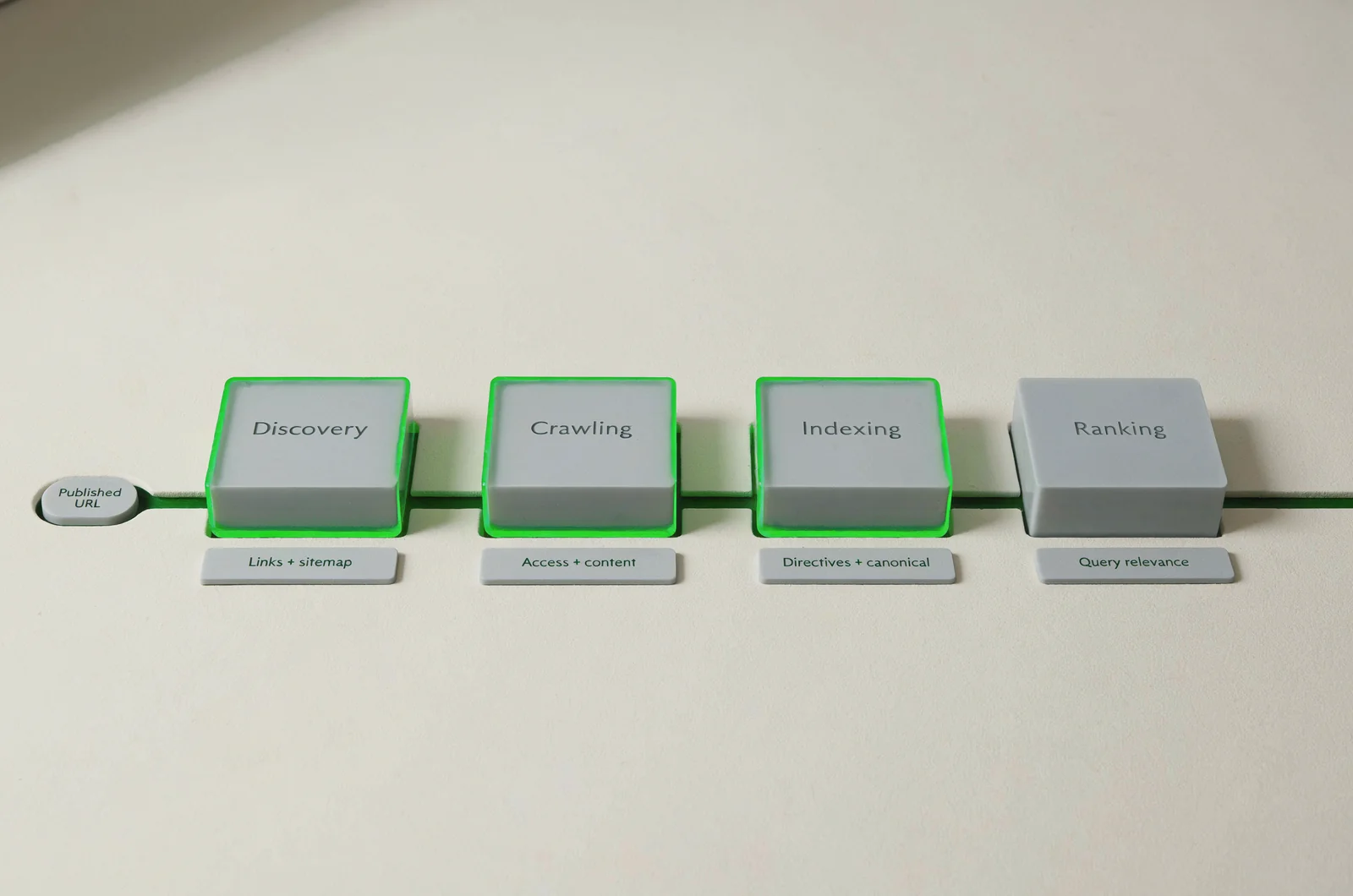
Publication establishes that a URL exists on your website. It does not establish that a search engine has fetched it, included it in its index or selected it for a relevant query.
Diagnose the stages in order:
- Check whether the page has crawlable internal links and appears in the intended sitemap.
- Confirm that the URL returns the expected content and that crawler access is permitted.
- Inspect indexing directives and canonical signals for unintended exclusions or conflicting destinations.
- Check whether the indexed page answers the queries you expect it to attract.
Use URL-level evidence rather than inferring the cause from an empty traffic chart. An access problem needs a different response from an indexed page with weak relevance.
Also inspect the published output. A CMS preview can look correct while the live page has missing text, broken navigation or an unexpected directive. Include the final URL in the publishing handover, and assign someone to verify its rendered content and indexing eligibility.
How long should you allow for SEO results?
Allow separate review periods for technical processing, search visibility and commercial outcomes; one deadline cannot explain all three.
Track publication, observed crawling, indexing status, relevant impressions and qualified actions as distinct events. This creates a diagnostic record instead of a single countdown from launch.
If a page has not been crawled, investigate discovery and access. If it is indexed but attracts irrelevant impressions, review intent and page scope. If relevant visitors arrive without progressing, examine the answer, proposition and onward journey.
Set review windows using your own publishing history and sales cycle. A familiar topic on an established site and a new product category need different planning assumptions.
Compare similar page cohorts. Group pages by purpose, publication period and intended audience before judging performance. Mixing established commercial pages with newly published educational articles obscures useful differences.
Keep a change log alongside the results. Record substantial revisions, redirects and template changes so reviewers can distinguish the original page’s performance from later interventions. Set the next review date when you publish.
Which technical problems deserve attention first?
Prioritise technical problems that prevent valuable pages from being accessed, understood or used.
Start with the pages that support commercial journeys. Check product destinations, substantial educational resources and the navigation connecting them. A site-wide issue affecting those paths deserves attention before cosmetic changes to low-priority archives.
Use a consistent inspection sequence: response status, rendered content, indexing directives, canonical destination, internal links and visitor usability. This keeps the investigation tied to observable behaviour.
A successful response code alone does not prove that the expected page was delivered. Verify that the principal answer and navigation are present in the rendered output.
For performance work, inspect actual page behaviour across relevant devices. Record the affected template, the user task interrupted and the likely scope. Avoid treating an isolated synthetic score as the whole diagnosis.
Treat technical health benchmarks as diagnostic inputs rather than universal pass marks. A useful issue record names the URL pattern, describes the failure and gives a verification condition. For example: the intended article text appears on the live URL, its links work and its indexing directive matches the publishing decision.
Which keywords deserve their own pages?
Give a keyword its own page when it represents a distinct reader task that warrants a distinct answer.
Small wording differences rarely justify separate production briefs. Start with the question behind the query, then decide whether an existing page can answer it completely.
Suppose a SaaS buyer searches for exporting audit logs and another searches for audit-log retention requirements. The first task concerns an operational procedure; the second concerns evaluating how records should be managed. Different pages may make sense because the required evidence and reader actions differ.
For each candidate, assess business relevance, available expertise, likely page format and overlap with existing coverage. Use long-tail keyword prioritisation to develop the shortlist beyond broad category terms.
Keep geography purposeful. A UK-specific page needs a substantive reason, such as different terminology or service availability. A place name added to otherwise identical copy provides little editorial justification.
Assign an intended destination before drafting. Record whether the topic belongs on an existing article, a new resource or a commercial page, and explain the distinction in the brief.
How many articles should your team publish?
Publish at the rate your team can research, review, release and maintain without accumulating unresolved quality problems.
Content velocity is an operating decision. Set it from the work required to produce useful coverage and the people available to approve it. Draft generation is only one part of that capacity.
Account for research, subject review, editing, CMS checks and later maintenance. Count returned drafts and substantial corrections as production work. Otherwise, the calendar can appear healthy while the review queue grows.
When SiaSEO supports calendar creation and article drafting, keep generated drafts and approved releases as separate totals. Give every scheduled article an owner who can resolve factual questions and approve publication.
A useful capacity estimator would take available editorial hours, typical review time and expected revision effort, then estimate a sustainable release volume. Base its assumptions on completed work.
Review the cadence when the queue changes. If reviewers repeatedly return drafts for missing evidence, improve the briefs before increasing output. Measure overdue reviews and correction work alongside the number of published pages.
What makes a B2B answer credible enough to publish?
A credible B2B answer makes its claims checkable, states its limits and gives the reader enough detail to act.
Specificity should come from evidence. Explain the operating conditions behind a recommendation: the intended user, relevant constraints and situations where another approach may fit.
For a procedural answer, check the steps against the current product or process. For an evaluative answer, make the comparison criteria explicit. For a numerical claim, retain the original source and the context needed to interpret it.
Distinguish documented facts from editorial judgement. A recommendation can be useful without pretending to be a measured industry benchmark. State the reasoning and identify the assumptions.
Treat content optimisation tools as review aids. Keep an editorial decision record alongside any score, especially when the proposed change affects accuracy or scope.
Before approval, ask whether a knowledgeable buyer could use the page to complete the stated task. Remove unsupported superlatives, replace vague instructions with concrete actions and resolve factual objections before sending the article to the CMS.
Where should AI automation stop for human review?
Require human review wherever an unresolved error could materially change a buyer’s understanding or decision.
Define those boundaries before enabling automated publication. Product capabilities, customer examples, numerical claims and comparative assertions deserve an explicit verification route.
Separate factual checks from style checks. A fluent paragraph can still contain an unsupported statement. An article can follow the brand voice while answering the wrong question.
For SiaSEO’s site-aware drafts, verify that the underlying website context is current and appropriate for the article. A claim copied from an outdated product page still needs correction. Keep the person responsible for product truth involved in approval.
Use automated quality scoring to organise review work, while retaining an independent publication decision. Any threshold you adopt should be tested against examples your editors have assessed.
Maintain a short exception log. Record what was wrong, what evidence resolved it and whether the same failure could affect other drafts. Use that record to improve briefing and review rules. Release the article only after its material factual questions have an accountable resolution.
When should you update, merge or retire existing content?
Update a page when its purpose remains useful, merge pages when their purposes overlap, and consider retirement when there is no clear reader need.
Start with the reader task. A weak result can reflect an incomplete answer, outdated information, technical restrictions or a mismatch between the page and its intended queries.
For an update, preserve the useful material and identify the exact gap. That might be a missing procedure, an obsolete product reference or a comparison that lacks decision criteria.
For a merger, choose the destination that best supports the combined purpose. Move useful material deliberately, revise internal links and plan the treatment of superseded URLs. Check the destination after release.
Retirement needs a reason beyond age. Review the page’s current usefulness, links, enquiries and relationship to other resources before deciding its future.
Maintain a content register with one named owner per important page. Record the intended question, current evidence, last substantive review and next review trigger. Use those records to identify duplicate briefs before they become duplicate articles.
How should B2B teams measure organic performance?
Measure organic performance through a chain of discovery, relevant visits and qualified commercial actions.
Choose measures that correspond to the page’s purpose. An implementation resource and a supplier-evaluation page support different tasks, so judge each against its intended role.
Use search reporting to inspect query relevance, impressions and clicks. Use on-site analytics to examine the journeys that follow. Connect enquiries to qualification and opportunity records where your measurement setup supports that connection.
Agree on definitions with sales. Specify what counts as a qualified enquiry, how duplicate contacts are handled and which period the report covers. Keep those definitions stable enough for comparisons.
Report branded and non-branded demand separately where possible. Also distinguish new content from established pages and separate material revisions from routine edits.
Treat attribution as a model with limitations. Record missing data and explain whether a reported outcome is directly observed or assigned by the model.
Finish each review with an operational decision: continue observing, investigate a technical issue, revise the answer or reconsider the topic. Give that decision an owner and a review date.
Does visibility in AI answers need a separate strategy?
Use the same evidence and editorial discipline, then assess AI-answer visibility through a separate measurement plan.
Do not assume that an organic ranking report describes how a brand appears in generated answers. Define the questions, systems, locales and observation dates you intend to monitor.
Record the response, any displayed citations and whether the brand or page appears. Preserve enough context to repeat the observation. Treat a single appearance as an observation rather than a dependable acquisition forecast.
For content production, make answers understandable within their stated scope. Keep definitions, conditions and supporting evidence close together. Ensure that someone arriving at an individual section can identify what the answer applies to.
Avoid publishing multiple shallow variations solely to pursue different answer surfaces. Return to the buyer’s task and decide whether another page contributes useful information.
Keep AI visibility and business outcomes in separate reporting fields. Compare them over time, but require evidence before attributing a change in enquiries to a change in generated-answer exposure.
Who should own SEO execution and publishing decisions?
Assign one accountable owner for organic performance, with named specialists responsible for technical work, factual accuracy and publication approval.
The owner needs authority to resolve priorities across teams. Otherwise, content production, engineering and commercial reporting can each progress without addressing the same business problem.
Define responsibilities at the handovers. A writer needs an approved brief; a reviewer needs the evidence behind material claims; a publisher needs a clear release decision. After publication, someone must own corrections and maintenance.
If an agency participates, specify deliverables in terms of inspectable work. Request page-level recommendations, implementation records, evidence for claims and reporting definitions. Clarify who can change live pages and who approves substantial revisions.
Keep production access aligned with those responsibilities. Document how a scheduled release can be paused and how an incorrect article is corrected.
Use a shared register for briefs, approvals, live URLs and review dates. At each performance review, connect the proposed work to a reader task, an observed problem and a person responsible for completion.