The Best SEO Agency in Canada for Scaling B2B Companies
Review the best SEO agency options across Canada. Compare verified technical deliverables, contract scopes, and monthly retainers for growing B2B teams.

Choosing a Canadian partner for search engine optimization starts with a practical question: which part of your growth program needs outside ownership? A SaaS company facing a site migration needs different support from a marketing team struggling to publish credible product content. Your shortlist should reflect that difference.
The recommendations below compare five agency engagement models against technical delivery, content workflows, cost structure and client responsibilities. Provider-specific capabilities, current retainers and comparative results remain unverified for this guide, so naming a national winner would overstate the evidence. Use these models to define the agency you need, then assess named firms against documented work and current proposals.
Set selection criteria around your delivery bottleneck
A Canadian B2B agency shortlist should begin with the work your team cannot currently complete. Write that constraint into the brief before requesting proposals.
For example, consider a hypothetical software company with capable writers and a growing backlog of unresolved indexing problems. Hiring more editorial capacity would leave its technical constraint untouched. Its brief should prioritise diagnosis, developer coordination and validation.
Evaluate prospective partners against these criteria:
- Match the proposed work to a defined commercial audience, product line and target market.
- Require technical findings to include affected URLs, supporting evidence, priority and an implementation owner.
- Ask for a content workflow that covers briefing, source checks, subject expert review and publication.
- Specify how reporting will connect search activity with agreed conversion events and opportunity records.
- Establish ownership of accounts, content, documentation and publishing permissions.
Treat a sample deliverable as evidence of how an agency documents work. Assess a performance claim separately: request its baseline, measurement period, scope and relevant client context.
For a Canadian mandate, also specify billing currency, required language coverage and working-hour overlap. Request those details in writing before comparing fees.
Five agency models for a Canadian B2B shortlist
These models earn a place on the shortlist according to the work they would own. They are purchasing options, with evidence requirements attached to each recommendation.
Technical SEO agency for implementation-heavy work
Put a technical specialist on your shortlist when the immediate brief involves migrations, crawling, indexation, rendering or shared page templates. This model fits a team that can produce content but needs help diagnosing and resolving site-level problems.
Ask for an issue register that connects each finding to affected pages, a proposed change and a validation method. The distinctive deliverable should be an executable backlog with clear acceptance criteria.
For cost comparison, request separate scopes for diagnosis, implementation support and post-release checks. If your developers will make the changes, specify the agency time available for tickets and review.
The limitation is the implementation boundary. An audit engagement may leave coding and deployment with your team; confirm that responsibility before signing.
Require a redacted issue example that shows evidence, prioritisation and resolution checks. Shortlist this model when engineering work is the constraint and your internal team can commit development capacity.
B2B content agency for subject expertise and editorial throughput
Consider a content specialist when your team needs a repeatable process for turning product knowledge into useful pages. Make access to subject experts part of the engagement.
The requested workflow should move from audience and intent to brief, draft, factual review, revision and publication. Ask the agency to explain its long-tail keyword strategy using topics relevant to your buying audience.
For cost comparison, separate research, interviews, drafting, revisions and CMS work. Clarify what happens when a draft needs substantial technical correction.
The limitation is coverage outside editorial production. Technical implementation, conversion tracking and distribution require explicit owners.
Request a redacted brief and its finished article. Use search intent article templates to assess whether the format fits the reader’s task. Shortlist this model when your team can supply expertise and approvals but needs editorial execution.
Integrated agency for coordinated delivery across disciplines
An integrated engagement belongs on the shortlist when you want one partner accountable for technical planning, content production and measurement. Define the responsibilities across all three areas.
Ask for a shared backlog that connects technical dependencies with content priorities. A proposed landing page, for example, should have an owner for the brief, design requirements, implementation and conversion tracking.
Request a retainer breakdown by workstream and named role. Establish what capacity is reserved, how priorities change and which requests trigger additional fees.
The limitation is scope clarity. A broad service description can leave important work undefined. Require the agency to show the expected outputs for a representative month.
Evidence should include a sample delivery plan and reporting document with responsibilities attached. Choose this model when your internal team can direct priorities and approve work, while the agency supplies the agreed execution capacity.
Fractional SEO lead with specialist execution
A fractional lead is worth considering when your company already has writers, developers or an incumbent agency but needs someone to set priorities. Define this engagement around decisions and coordination.
The distinctive deliverable should be a maintained roadmap with documented trade-offs. Request a clear process for assigning work, resolving dependencies and checking completion across contributors.
For cost comparison, separate leadership time from specialist execution. Include your own team’s expected coordination time in the budget assessment.
The limitation is delivery authority. A fractional lead cannot complete every task through planning alone. Establish who can commit developer capacity, approve content and resolve disagreements.
Ask for a redacted roadmap and an example decision record. Shortlist this model when execution resources already exist and fragmented ownership is the problem. Give the lead a named internal sponsor and written decision boundaries.
Bilingual or international SEO agency for defined market expansion
Include a language or international specialist when your brief requires distinct English and French experiences, or expansion into additional countries. Specify the audiences and markets that each page must serve.
Request a workflow covering locale-specific intent, terminology, page relationships and language review. Require the agency to explain which decisions will be shared across markets and which need separate approval.
For cost comparison, ask how research, adaptation, technical setup and review are charged for each locale. Confirm who handles revisions when a shared product claim changes.
The limitation is coordination across language and technical work. Assign an owner to each localized page and its review cycle.
Evidence should include a redacted locale brief and a sample approval process. Shortlist this model when multiple markets are funded parts of the plan, with internal reviewers available for each required language.
Compare retainers through the work they include
Agency fees become useful comparisons once the proposals describe comparable responsibilities. Request a common scope before evaluating the monthly totals.
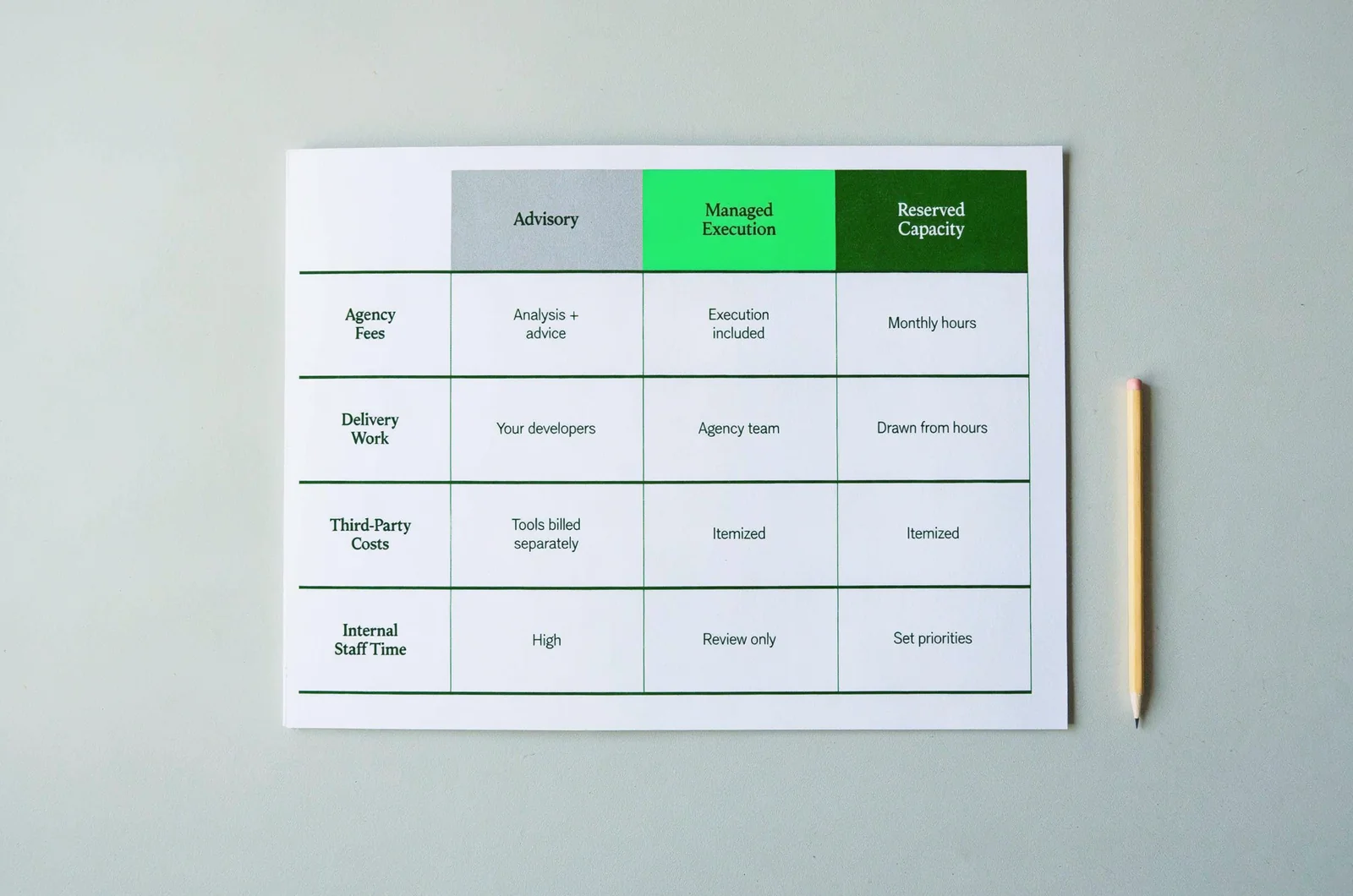
Separate advice, managed execution and reserved capacity
Use three scope bands to organise proposals.
An advisory scope should specify analysis, recommendations and consultation. Your team must then assign implementation.
A managed execution scope should name the work the agency will complete, such as approved content revisions, CMS preparation or defined technical changes.
A reserved-capacity scope should identify the people or time committed to your account, along with the rules for allocating that capacity.
These are proposed procurement categories. Current Canadian market price bands are unverified here. Ask each agency to explain where its proposal fits and which responsibilities remain with you.
Request quotes in Canadian dollars. Have the proposal itemise taxes, software, subcontracting, travel and other charges where applicable.
Compare the full delivery commitment
Build the budget comparison around your intended scope:
Planned spend = agency fees + separate delivery costs + approved third-party expenses + internal staff allocation.
Avoid counting work twice when implementation or production is already included. Make any estimate of internal time visible so finance can review the assumptions.
Clarify revision allowances, approval deadlines, unused capacity and change requests. A proposal selector could collect these inputs and display responsibility gaps alongside the proposed spend.
Before signing, attach a representative month of work to the agreement. Ask the agency to identify what would change if your company delayed approvals or development access.
Keep content approval and publishing ownership explicit
Your agency agreement should explain how a draft becomes an approved page. This deserves attention when content production involves automation, several contributors or direct CMS access.
Request a workflow with a named owner at each stage:
- Approve the audience, intent and brief.
- Record the evidence behind product and factual claims.
- Assign subject expert review.
- Resolve factual and editorial revisions.
- Approve publication and check the live page.
Ask how the agency handles an unsupported claim, an outdated source or a draft that diverges from your positioning. Require a documented escalation path.
If SiaSEO is part of the content workflow under consideration, assign responsibility for briefs, source checks, approvals and updates in the agency agreement. Apply the same ownership questions to every platform involved.
For work described as retrieval-augmented generation, ask how retrieved material is selected and checked against the draft’s claims. Request an example that your subject expert can inspect.
Specify publishing permissions, scheduling authority and the process for correcting or withdrawing an approved page.
Give the agency a 90-day acceptance plan
A proposed 90-day plan gives your team a concrete way to assess delivery. Set milestones around work the agency can control, with business results reviewed against the agreed measurement approach.
Establish the baseline and owners in the first month
Request an inventory of agreed pages, measurement access, existing content and unresolved technical issues. The agency should document assumptions and identify gaps that affect its recommendations.
Approve a prioritised backlog with owners and acceptance criteria. Record which dependencies belong to your developers, product experts and marketing team.
End the first review with a written delivery plan and an agreed reporting schedule.
Inspect completed work during the second month
Choose a bounded set of deliverables to review. For example, a hypothetical pilot could cover one page template or one content cluster.
Check whether technical changes meet their acceptance criteria. Review content against the approved brief, evidence and product claims.
Record blocked tasks separately from completed work. Assign each blocker an owner and a resolution date.
Review scope and measurement in the third month
Compare the agreed outputs with accepted work. Examine revisions, missed dependencies and any gap between promised and available capacity.
Review search and conversion observations within the limits of the measurement period. Keep forecasts distinct from observed results.
Renew against a revised backlog, named responsibilities and an updated capacity commitment. Put any scope changes into the agreement.
Questions to settle before signing a Canadian agency
The final agency discussion should resolve uncertainties that could change your budget, workload or choice of partner.
What should a scaling B2B company budget?
Request current written quotes for the same defined scope. Without verified proposals, a national retainer range would create a false reference point.
State the budget available for agency work, implementation and internal participation. Ask each candidate to identify what it can complete within that boundary and which work it would defer.
How much weight should location carry?
Specify the operational requirements behind your location preference: meeting overlap, language review, on-site work or knowledge of a target market.
Then request evidence relevant to those requirements. If a provider’s location, staffing or service coverage matters to the engagement, confirm it directly in the proposal.
What should happen when the engagement ends?
Require an exit plan covering account access, editable files, work in progress, documentation and unresolved tasks. Identify which materials belong to your company and any contractual restrictions.
Make handover responsibilities part of the agreement.
Choose the agency model that matches your delivery constraint. Award the work once a named provider has supplied relevant evidence, a workable scope and clear ownership.