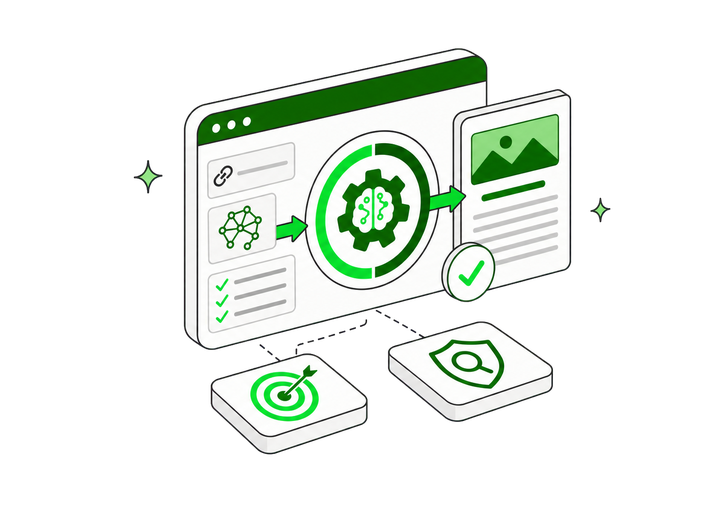
Webflow vs WordPress Programmatic SEO Pipeline Architecture
Compare Webflow and WordPress programmatic SEO pipelines. Understand CMS collection caps, REST API endpoints, database indexing, and automated publishing.

For teams evaluating Webflow vs WordPress automated publishing pipelines, the architectural question is where publishing control should live. Webflow’s managed CMS and a self-hosted WordPress installation create different operational boundaries. Both require a workflow that connects approved content to a verified public page.
The useful comparison spans content modelling, API delivery, recovery, caching and search discovery. Treat those as separate layers. Choose the CMS against the controls your team needs, then prove that the complete publication path behaves as intended.
Treat publication as a sequence of states
An automated publishing architecture needs an explicit definition of completion. A successful content write is one checkpoint; the public page requires its own verification.
Model the workflow around observable states:
- The content passes editorial and structural validation.
- The destination accepts the intended revision.
- Publication makes that revision publicly available.
- A public request returns the expected page.
- Search monitoring records discovery and indexing separately.
Store evidence for each transition. Useful records include the article identity, approved revision, destination identifier, attempt timestamp and verification result. A dashboard should distinguish an accepted draft from a verified live page.
SiaSEO’s site-aware drafting and semantic QA can sit within content preparation. Keep the approval decision attached to the exact revision sent downstream. Otherwise, an approved draft and a later generated revision could share a misleading approval status.
Programmatic SEO also needs an eligibility decision before generation. Use long-tail keyword prioritisation to establish which page families deserve production capacity. Require a distinct reader need and sufficient underlying information before a record enters the publishing queue.
Where Webflow and WordPress put the control boundary
The architectural distinction between Webflow and self-hosted WordPress concerns which parts of delivery your team designs and operates.

Webflow centres the adapter on the managed CMS
For Webflow, model the CMS as an external service with a defined content structure and supported publishing interfaces. The adapter translates an approved article into the destination’s collection fields and relationships.
Separate content preparation from destination operations. Resolve required references, prepare assets, validate field mappings and determine the intended publication action before sending writes.
Record the applicable collection capacity, write quota, batch size and request-body ceiling for the selected environment. Store a verification date alongside these configuration values. Capacity planning should use the limits that apply to the actual site and operations.
Self-hosted WordPress brings more layers into scope
For self-hosted WordPress, include the application, database, hosting and cache configuration in the architecture review. Decide who owns each layer and who responds when publication slows or public pages become stale.
Use application interfaces for routine publishing. Test the expected validation, relationships and downstream behaviour around each write. Treat database maintenance as a separate operational responsibility with its own recovery procedure.
Define the article’s destination model before implementing the connector: content type, taxonomy relationships, custom fields, media and publication status. Record any dependencies on extensions or custom application code.
Assign an owner to every component between the publishing worker and the public response.
Make the content model independent of the CMS
A comparison of publishing stacks becomes clearer when both adapters receive the same approved content model. Keep destination-specific field names inside the adapter.
Preserve identity, meaning and approval
An illustrative internal record might contain:
{ "content_id": "integration-alpha-guide", "locale": "en-GB", "revision": 7, "approval_state": "approved", "title": "Integration alpha deployment guide", "slug": "integration-alpha-deployment", "body_html": "
Approved deployment guidance.
" }This is an internal contract, rather than a platform API payload. Extend it with the information your workflow needs: descriptions, asset references, taxonomy identities and approval evidence.
Keep the stable identity separate from the slug. Define whether a locale represents a separate publication target or an attribute of the same record. Make that choice explicit before updates begin.
Use keyword research tools to inform page selection upstream. Keep keyword datasets separate from destination field mappings.
Test what survives serialisation
Choose the body representation deliberately. HTML, structured rich text and block-based content require different conversion rules.
Measure the serialised request body after conversion and escaping. Character count alone is an insufficient payload budget. Include metadata and asset references in the measurement.
Create representative fixtures with nested lists, tables, quotations, links, accented characters and image captions. Compare the stored result with the public rendering.
Treat conversion losses as validation failures. Record which elements were removed or changed, and block publication when those changes alter meaning.
Budget API work in bytes and requests
For either CMS, publishing capacity should describe the entire workload. Count asset operations, reference lookups, writes, publication actions and verification requests separately.
Estimate the lower bound before adding concurrency
Consider a hypothetical batch of 600 articles. Assume each article requires three requests, and the configured allowance is 60 requests per minute. These are illustrative inputs, not platform quotas.
The request budget alone produces a lower bound:
600 articles × 3 requests ÷ 60 requests per minute = 30 minutes.
That estimate excludes retries, asset transfers, processing delays and verification. Use it to expose assumptions, then replace them with measurements from the intended environment.
Keep independent budgets for operations with different constraints. A worker pool should respect the applicable allowance for each operation and destination.
A useful internal capacity estimator would accept article count, requests per article, asset volume, concurrency and configured limits. It should return a lower-bound duration and identify the constraint that determines it.
Make payload rejection recoverable
Classify failures by the action they require. A field validation error needs a content or mapping correction. A request-size rejection needs a smaller supported payload or a revised content representation.
Transient failures may justify delayed retries. Authentication failures need operational attention. Avoid sending every error through the same retry policy.
Define a maximum attempt count and a quarantine queue for unresolved records. Preserve a redacted error response, content identity and attempted revision.
For batches, track outcomes at item level wherever the interface permits. Reconcile uncertain items before resending them, and retain successful item mappings.
Design retries around a stable article identity
Retries need a reliable relationship between an internal article and its destination record. Put that relationship in a durable publishing ledger.
Reconcile ambiguous writes
Suppose a write reaches the CMS, but the response never reaches the worker. The worker needs a way to determine whether the intended change exists.
Store the internal identity, destination record identifier, approved revision and last confirmed operation. Where supported, attach a stable external identity to the destination record as an additional reconciliation aid.
After an ambiguous result, inspect the destination through a supported interface. Compare the intended revision or content fingerprint before deciding whether to retry.
Keep slugs out of the role of sole identity. Define how redirects and URL changes interact with the publishing ledger.
Prevent stale jobs from replacing approved revisions
Define concurrency rules for updates. A delayed job should pass a revision check before it can publish over newer approved content.
Set a policy for editorial changes made directly in the CMS. Possible approaches include pausing automation, importing the edit for review, or protecting designated fields from automated updates.
If SiaSEO supplies a revised draft, apply the same approval and revision rules used for any other content producer. Record the draft’s quality result alongside the approved content fingerprint.
Retain a recoverable copy of the previous approved revision. Test restoration across content, metadata and publication status; document which elements require separate recovery.
Verify the public page, database queries and search discovery
The Webflow or WordPress publishing response should lead to a public-page check. Database performance and search indexing then need their own evidence.
Follow the cache chain
Document every delivery layer in the selected architecture. For a self-hosted WordPress deployment, inspect the configured application cache, page cache, reverse proxy and CDN. For Webflow, identify the available publication and delivery controls.
Define invalidation behaviour for article pages and any affected archives, navigation or feeds. Include updates and withdrawals in this review.
Verification should request the public URL through the normal delivery path. Check for an expected content fingerprint or a distinctive approved passage.
Allow for the delivery behaviour established during testing. Use bounded retries and record how long the expected public result takes to appear. Mark unresolved results as unverified.
Separate query performance from search indexing
For a self-hosted WordPress installation, profile the queries behind article pages, archives, related-content blocks and filters. Use representative data volumes before deciding whether database indexes or query changes are appropriate.
Evaluate any proposed index against both query benefit and write cost. Keep the evidence with the change.
Search-engine discovery requires a different set of checks. Verify the intended status code, canonical URL, robots directives, rendered body text and internal links. Check sitemap membership where the site’s publication design requires it.
Content QA belongs before publication and in periodic reviews afterwards. A comparison of content optimisation tools can help define that review stage, while technical verification confirms what the public page contains.
Record publication, crawlability and observed indexing as separate statuses. Give each failure an owner and a documented investigation path.
Choose the architecture your team can operate
Choose between Webflow and self-hosted WordPress against a workload and an ownership model.
Consider Webflow when the proposed content structure fits the managed CMS and the team wants to work within supported platform interfaces. Demonstrate the required references, updates, publication actions and withdrawal behaviour before committing the full content inventory.
Consider self-hosted WordPress when the project needs application extensions, database tuning or delivery controls that the team is prepared to maintain. Include infrastructure ownership, extension dependencies and recovery work in the evaluation.
Use the same acceptance exercise for both designs. Include a representative article, an asset-heavy article, an update, a withdrawal and an ambiguous write result. Test at a meaningful content volume and concurrency level.
Measure:
- Time from approval to verified public content.
- Requests and transferred bytes per verified article.
- Recovery effort after an interrupted publication.
- Behaviour when editors change destination content.
- Restore time for the previous approved revision.
Review access boundaries during the exercise. Separate production credentials from development credentials, restrict access to the intended publishing scope, and keep secrets out of logs.
Choose the design whose operational responsibilities have named owners. Record unresolved dependencies before scheduling unattended publication.
Questions that affect the publishing design
Both CMS choices raise practical questions about portability, approval and failure containment.
Can one publishing service support both CMSs?
Design a shared orchestration layer for content validation, approval, scheduling and observability. Put destination-specific operations in separate adapters.
Each adapter should declare the operations it supports, its field mappings and its completion checks. Run the same acceptance fixtures against both, then document differences in behaviour.
Should every approved article publish automatically?
Set automation eligibility by page family and change type. A revision within an established template can follow a different approval path from a new template or a large structural change.
Define which changes require editorial review. Keep publication blocked when mandatory evidence, mappings or validation results are missing.
How should an agency contain failures across clients?
Give each client a separate destination configuration, credential boundary, publishing ledger and operational budget.
Test whether a failed destination can occupy all available workers or exhaust shared capacity. Set queue limits and recovery ownership so other clients retain their scheduled publishing capacity.
What should happen when the CMS structure changes?
Version the adapter mapping and validate it against the destination before releasing queued work.
Quarantine records that no longer satisfy the expected structure. Update the mapping, rerun representative fixtures and resume only the affected workload after verification.