7 AI Ranking Signals That Decide Which Pages Get Cited
Seven AI ranking signals ranked by impact, from entity clarity to source freshness, with a practical way to test each one on your own pages.

AI ranking raises a practical question for B2B content teams: which page improvements deserve attention when the goal is a citation? These seven signals give you an audit order for pages you want ChatGPT, Perplexity, Gemini or Google AI Overviews to reference. Track source citations, brand mentions and website visits as separate outcomes.
The ranking follows operational dependencies. Check access first, then examine subject clarity, supporting evidence and answer structure. Review topical coverage, independent corroboration and maintenance after those foundations. A confirmed retrieval failure deserves attention before a wording adjustment.
These positions express editorial judgement. They make no claim about proprietary algorithm weights, measured uplift or uniform behaviour across platforms. Each evidence note identifies an observation your team can collect to evaluate the recommendation.
Keep the work at page and query level. A broader programme for generative engine optimisation can set direction; this list gives technical owners and editors specific checks to assign. For each page, record the suspected weakness, the supporting observation and the change you intend to evaluate.
1. Crawl access to the actual answer
Put access first because a failed retrieval needs investigation before you can assess the answer itself. This check best fits technical teams managing pages with complex rendering, consent controls or security rules.
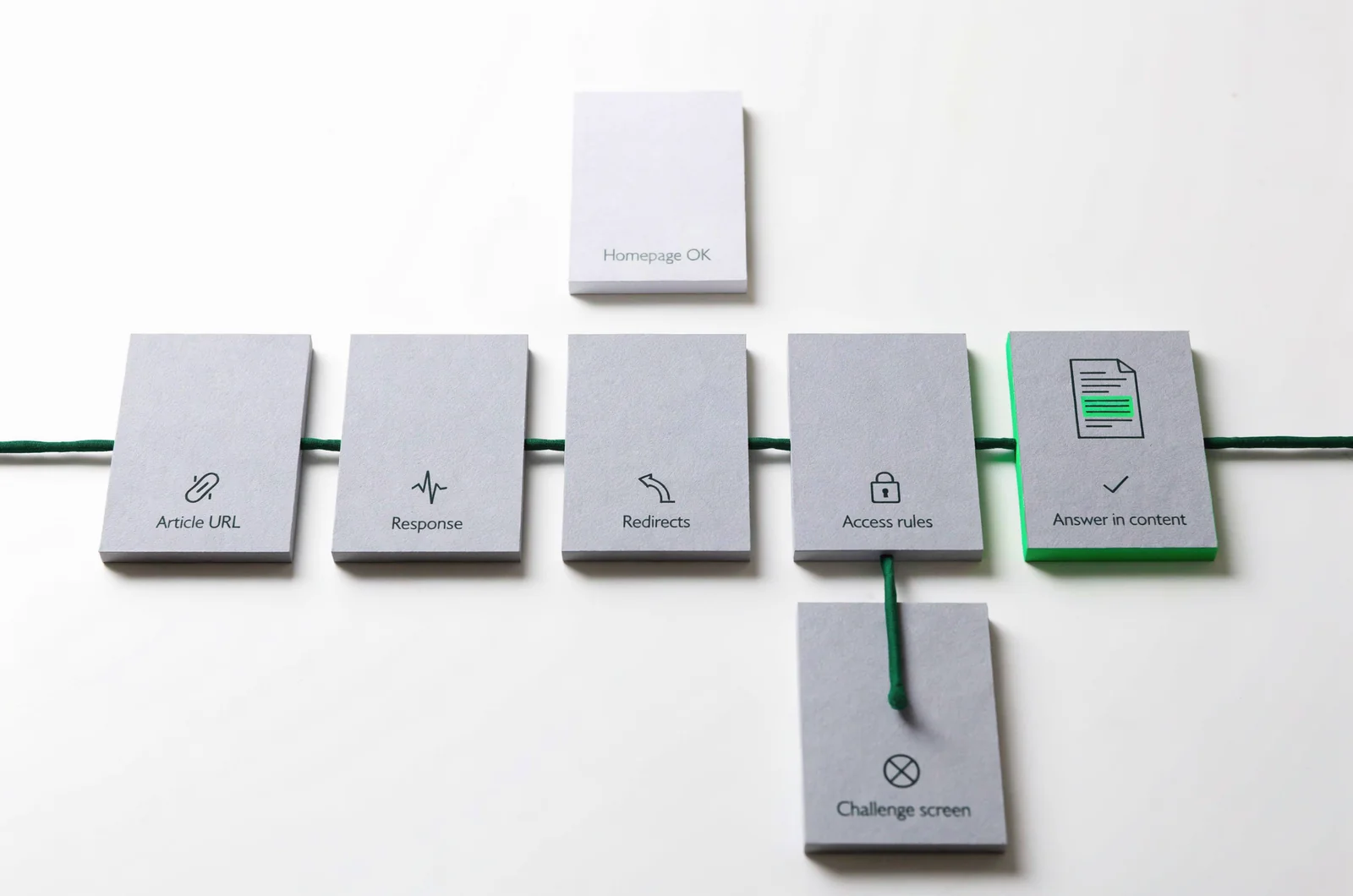
Inspect the exact URL you want cited. Check the response, redirects, access restrictions and whether the intended answer appears in the returned content. A successful homepage request tells you little about a blocked article. Likewise, a successful request that returns a challenge screen leaves the answer unavailable through that request.
Review agent permissions against the relevant service’s documented identity and purpose before changing rules. Keep search retrieval and model-training permissions as separate decisions in that review.
Evidence note: retain the requested URL, request conditions, response status and returned content. Where available, compare these with relevant server logs. This evidence supports a narrow conclusion about access under those conditions.
For a short verification, retrieve the priority page through the access path under investigation and locate its central answer in the response. Record any difference from the browser-visible page.
Successful access establishes only the result of that check. It does not establish indexing, source selection or future citations. Resolve a reproducible access failure first, then pass the page to editorial review with the response evidence attached.
2. Entity clarity and explicit scope
Entity clarity comes second because your citation audit needs an unambiguous account of what the page describes. Prioritise it when several products, organisations, markets or meanings share similar names.
State the subject near the beginning. Identify the relevant organisation, product category, audience and geographic scope where those details affect the answer. Keep qualifications beside the claims they constrain.
For an English-language SaaS guide aimed at Munich buyers, specify whether a recommendation concerns Germany or the wider DACH market. Add geography where it changes the advice. Avoid inserting location names into unrelated technical explanations.
Evidence note: look for conflicting product names, undefined abbreviations and scope changes between the title, opening and main answer. These are observable editorial problems. Their presence alone does not establish why a platform omitted the page.
Verify clarity by giving the opening and central answer to a colleague without the navigation or surrounding website. Ask them to identify the subject, intended reader and applicable market. Record disagreements before revising.
This signal best fits multi-product businesses, agencies handling several client brands and multilingual publishing teams. Its limitation is that accurate identification leaves the substance of the answer untested.
Fix ambiguity before expanding coverage. End the review with one consistent subject description and visible qualifiers for every market-dependent recommendation.
3. Evidence another page can reference
Supporting evidence ranks third because it gives your team something concrete to assess beyond presentation. Start here when a page makes strong recommendations but leaves readers unable to inspect their basis.
Choose a claim that matters to the reader’s decision. Support it with a documented calculation, reproducible procedure, original dataset or attributable primary material. Explain how the evidence connects to the recommendation.
For a proposed software comparison, publish the conditions under which each option was assessed. For an original benchmark, explain the sample, collection period and exclusions. Use those formats only when the underlying work exists.
Evidence note: inspect whether a reader could trace a material claim to its supporting material and understand the limits. A statistic without provenance should remain an unresolved editorial issue until someone verifies or removes it.
A short check is to select the page’s strongest claim and follow its evidence chain. Can another person inspect the material, understand the method and reproduce any calculation? Record the first missing step.
This priority best fits subject specialists and SaaS teams with useful operational knowledge. Its limitation is the effort required: obtaining evidence may require research beyond a copy edit.
Avoid manufacturing a study to fill the gap. Narrow the claim when the evidence supports less. Publish the strongest defensible version with its method and limitations beside it.
4. Answer blocks with their conditions attached
Answer structure ranks fourth because it gives editors a bounded passage to inspect and test. Prioritise it when a page contains a useful answer scattered across several sections.
Choose the passage that most directly addresses the target question. Give it a descriptive heading, a direct opening and the conditions needed to interpret it. Keep exceptions close enough that the passage remains accurate when read alone.
A procedural answer should include its dependency and stopping condition. A recommendation should identify the circumstances in which it applies. Avoid separating a broad promise from the qualification that materially changes it.
Evidence note: examine the passage outside its original layout. Look for missing subjects, unexplained pronouns and references to distant caveats. This check evaluates self-contained meaning; it does not prove that any platform favours a particular paragraph length.
Verify the block by copying it into a plain document with its heading. Ask a reviewer to explain the advice and identify its limits without consulting the rest of the page.
This check best fits editors refining existing content. Its limitation is substantive: a concise passage can still contain a weak or unsupported answer.
Preserve explanation where the subject needs it. Use the answer block to orient the reader, then retain the reasoning below. Approve the passage only when its recommendation and conditions remain intact together.
5. Depth that resolves the whole query
Topical depth ranks fifth because coverage should follow a defined reader task. Prioritise it when a page addresses a broad topic while leaving the intended decision unresolved.
Write down what the reader needs to do after reading. Then identify the questions required to complete that task: constraints, alternatives, implementation details or failure conditions. Include the ones that change the decision.
For query selection, use long-tail keyword research to develop a more specific set of reader questions. Treat those questions as candidates for editorial judgement. Avoid expanding the page solely to accommodate a larger keyword list.
Evidence note: map each section to a reader question and identify the supporting answer. Mark omissions, repetition and passages that introduce a different intent. This produces an inspectable coverage map without inventing a completeness score.
To verify the page, ask a reviewer to complete the intended task using its contents. Record where they need clarification or outside information. Decide whether each gap belongs on this page or a separate one.
This signal best fits content leads managing overlapping articles and broad guides. Its limitation is scope: adding every adjacent question can obscure the original task.
Keep depth proportional to the decision. Add a section only when you can name the uncertainty it resolves and the evidence needed to answer it.
6. Third-party corroboration of specific claims
Independent corroboration ranks sixth as an audit priority for claims about identity, capability or reputation. Give it attention when those claims depend mainly on your own website.
Choose a concrete statement that warrants outside confirmation. Check whether an independent publication, recognised directory, customer account or other attributable record supports that statement. Examine the substance of the reference before counting the mention.
For example, a directory entry may help confirm an organisation’s identity while leaving its performance claims untested. Evaluate the relationship between the record and the claim you want to support.
Evidence note: record who made the statement, when it appeared, what it confirms and whether the publisher is independent of your organisation. Several copies of the same announcement should remain identifiable as one underlying statement in your audit.
A short verification is to inspect one material claim against an independent record. Check names, dates and scope. Preserve any disagreement for review instead of choosing whichever version sounds more favourable.
This priority best fits newer organisations, renamed products and businesses with inconsistent public descriptions. Its limitation is control: you cannot edit independent coverage as you edit an owned page.
Do not assign a universal citation value to a mention count. Correct inaccurate owned descriptions, document genuine corroboration and keep unsupported reputation claims out of the answer.
7. Freshness tied to claim validity
Freshness ranks seventh in the general audit order, but move it forward whenever time determines whether the answer remains valid. Prioritise pages about changing product capabilities, integrations, prices or procedures.
Separate the date of an editorial review from the validity of individual claims. Check what changed, which passages depend on it and whether screenshots or instructions still match the described conditions.
For a conceptual explanation, a date change may provide little substance to review. For a version-dependent procedure, an outdated step deserves direct attention. Let the claim’s exposure to change determine the review effort.
Evidence note: retain the material consulted, its applicable date or version, and the passages changed after review. A modified timestamp alone does not document that work.
Verify freshness by selecting the page’s most time-sensitive statement. Compare it with the underlying primary material available to your team. Update or qualify the statement if its conditions have changed.
This signal best fits content operations teams maintaining large inventories. Its limitation is prioritisation: a routine update schedule can consume effort on stable explanations while vulnerable claims wait.
Assign a review trigger to each sensitive claim. That trigger might be a product release, a changed document or a scheduled check. Record an owner and the evidence required to close the review.
Test changes against a repeatable query set
Turn the seven priorities into a page-level evaluation rather than a single visibility score. Choose a small, stable query set that reflects the audience and market you intend to serve. Keep English and German queries distinguishable when both matter to the business.
For each observation, record the platform, query wording, date, available account conditions and cited URL. Preserve the response or screenshot where permitted. State the citation measure explicitly: any owned-page citation, a particular URL, or support for a specific claim.
Change one meaningful element where practical. If you repair access, rewrite the opening and replace the evidence together, report the result as a combined intervention. Keep the original page version available for comparison.
Useful observation fields include:
- Whether the target URL appeared as a citation.
- Which passage or claim the response associated with it.
- Whether the citation supported the response’s statement.
- Whether the result recurred in later observations.
An interactive checklist could accept a page URL and query set, then display seven evidence fields. Require an attachment or explanation for each pass, fail or unknown status. Keep access failures visible individually.
If SiaSEO forms part of your publishing workflow, keep this audit alongside editorial approval and CMS checks. Document ownership through CMS publishing workflows, so someone remains responsible for reviewing the published page.
Report the observed result with its dates, query conditions and remaining uncertainty.
Questions to settle before reporting citation gains
Does one citation establish a stable position?
Treat one citation as one recorded observation. Preserve the response, query, platform and date before drawing a broader conclusion. Use repeated observations to describe consistency, and keep the reporting window visible beside the result.
Which signal should a small team address first?
Start with the clearest documented failure. Follow the ranked order when several weaknesses compete for attention. Bring time-sensitive inaccuracies forward if they compromise the answer. Assign one owner and one verifiable completion condition to the selected change.
Should every page receive all seven checks?
Apply a brief initial review, then concentrate effort where the page’s purpose creates exposure. A product procedure warrants version checks; an original analysis warrants method checks. Record why a check received less attention so another reviewer can revisit that judgement.
What would justify a claim of improvement?
Define the measure before editing, retain the baseline and collect comparable observations afterwards. Describe the difference you observed. Keep causal claims proportionate to the evaluation design, and disclose simultaneous changes that prevent you from attributing the result to one signal.