9 Article Templates by Search Intent, Ranked by Where They Win
Nine article templates mapped to search intent, from how-to to comparison, each ranked by the query types and SERP layouts where it earns clicks.

The practical question behind 9 article templates search intent is which structure will help your reader complete a task. For SaaS marketing teams and agencies, that choice determines what a writer must produce and what an editor should approve. Put a troubleshooting query into a broad explainer, and the reader must assemble the fix themselves.
The ranking below favours precise tasks, observable outcomes and clear editorial acceptance tests. It is an editorial judgement about fit. A lower-ranked format becomes the right choice when the reader’s task calls for it.
Start by identifying the reader’s verb: perform, repair, compare, shortlist, confirm, inspect, understand, assess or define. Use long-tail keyword targeting to separate modifiers that share a task from those that deserve different pages.
The query examples below are hypothetical. Treat the suggested search engine results page (SERP) features as things to check for the target language and market. Record the formats present, the evidence they contain and the unanswered task your article could complete.
1. How-to articles win when the reader needs a finished result
The how-to takes first place because its editorial test is concrete: can the intended reader complete the procedure? Choose it for practitioners who know their goal and need a reliable sequence.
Illustrative modifiers include how to, set up, configure, implement and migrate. A query such as how to map blog categories to a content calendar calls for actions in dependency order.
Build the article around the starting state, required inputs, ordered steps, expected outputs and a final verification. Put warnings beside the step they affect. If a step changes a setting, show how the reader can confirm the resulting state.
For SERP fit, check numbered snippets, video results and procedural pages. If the task depends on seeing an interface interaction, decide where screenshots or a demonstration are necessary.
This format fails when the proposed steps conceal unresolved choices. How to choose a content strategy may need a decision framework before any procedure.
Commission a how-to when the result can be demonstrated and checked. Reject an outline whose steps are merely headings such as research, execute and optimise without specified inputs or outputs.
2. Troubleshooting articles win when something has already failed
Troubleshooting ranks second because it starts with an observable symptom and can end with a verified repair. It fits operators facing an error, unexpected behaviour or a broken workflow.
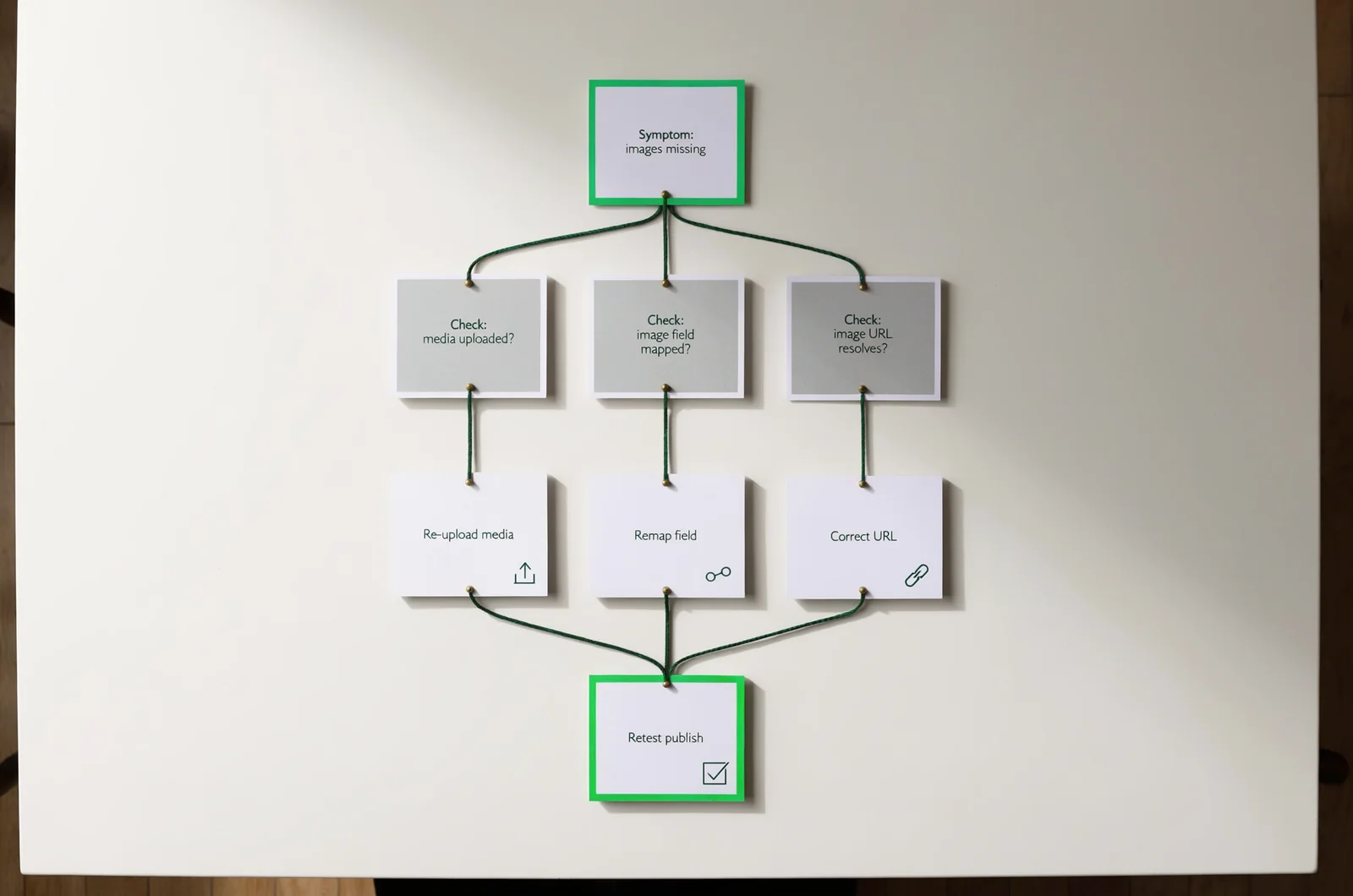
Look for modifiers such as not working, failed, missing, error and why does. An illustrative query is CMS article published without images. The reader needs help isolating the cause before changing settings.
Structure the article as symptom confirmation, diagnostic checks, conditional fixes and retesting. Separate possible causes. Tell readers what each check establishes and which result sends them to the next branch.
Inspect the results for support pages, discussion threads, short answer panels and demonstration videos. Use that review to identify whether the article needs diagnostic depth, visual evidence or both.
The failure mode is a collection of speculative fixes without a decision sequence. Recommending several changes together also makes the repair harder to verify.
For an existing underperforming article, consider stalled organic page fixes alongside the format assessment.
Choose troubleshooting when readers can identify their symptom. Require every proposed fix to include the condition that justifies it and a check that confirms success.
3. Comparison articles win when the shortlist already exists
A comparison earns third place because it can organise a bounded decision around explicit criteria. It fits buyers or technical evaluators who have already named the alternatives.
Signals include versus, vs, difference between and which is better for. An illustrative query is manual review vs automated publishing for multilingual articles. The useful answer depends on the operating conditions.
Open with the decision boundary: who is choosing, what constraints apply and which criteria could change the recommendation. Then compare the alternatives against the same criteria. Close with conditional recommendations for distinct circumstances.
Check for comparison tables, product pages and video comparisons in the results. Record which dimensions those pages address before deciding what your article must substantiate.
This template fails when the author scores alternatives using uneven evidence or invents distinctions to create a winner. Unknown information should remain visibly unknown.
It also needs discipline around scope. A two-option comparison should resolve that choice; a long catalogue of additional products can obscure it.
Use this format when the alternatives are defined and evidence exists for the deciding criteria. Approve the verdict only if a reader can trace it back to those criteria.
4. Roundups win when the reader needs to build a shortlist
A roundup comes fourth because it helps readers discover candidates before they can compare them closely. It fits a marketing lead or agency operator who knows the problem but has not selected the options.
Illustrative modifiers include best, top, tools for, platforms for and alternatives to. Specify the selection boundary before collecting entries: intended user, required capabilities, exclusions and available evidence.
Each entry needs a reason for inclusion, a suitable use case, a meaningful limitation and a clear distinction from neighbouring entries. Keep the evidence standard consistent.
A keyword research tool comparison provides a useful setting for this discipline: require documentation for claims about database freshness or geographic coverage.
Inspect list results, product pages and comparison videos to assess how readers are being helped to discover options.
The format fails when every entry receives interchangeable praise. A ranked list also becomes misleading if the publisher cannot explain the ordering.
Choose a roundup for discovery. If the evidence supports inclusion but cannot support a defensible ranking, group candidates by use case and explain the grouping.
5. Q&A articles win when one bounded question controls the decision
A focused Q&A ranks fifth because it can resolve a narrow uncertainty without expanding into a general guide. It fits readers who need an answer before continuing another task.
Signals include can, does, should, is it possible and what happens if. An illustrative question is should translated articles share the same editorial template? The answer needs conditions, consequences and exceptions.
Start with a direct answer. Explain the conditions that change it, give a worked hypothetical example and identify the action each condition implies. Keep supporting questions subordinate to the main question.
For SERP fit, examine answer panels, related-question boxes and pages that address the same uncertainty. Assess whether the reader needs a short resolution or a more involved decision.
This format fails when the headline is narrow but the response becomes a broad essay. It also fails when a conditional answer is compressed into an unjustified yes or no.
Use Q&A when the question can be resolved within a defined scope. Require the opening answer to state its scope, and remove sections that do not affect the reader’s decision.
6. Checklists win when the reader needs to verify readiness
A checklist ranks sixth because it supports inspection against a defined standard. It fits editors, content operations leads and agency reviewers who already understand the work.
Illustrative modifiers include checklist, audit, requirements, before publishing and review. A query such as multilingual article publishing checklist asks what must be checked before approval.
Organise checks by the object being inspected: brief, draft, evidence, localisation and publication settings. Write each item so a reviewer can mark it complete using observable evidence.
For example, replace check links with an instruction to open each destination and confirm that the anchor describes the linked page. Replace check intent with a requirement to compare the opening answer against the brief’s reader task.
Inspect downloadable resources, list snippets and checklist pages in the results. Decide whether readers need an explanation, a reusable document or both.
The limitation is assumed competence. A checklist cannot replace procedural guidance for someone who does not know how to perform its checks.
Choose this template for repeatable review. Require an acceptance condition for each item and name who can resolve a failed check.
7. Deep dives win when the reader needs to understand a mechanism
A deep dive ranks seventh because its value depends on explaining relationships in enough detail to support judgement. It fits experienced readers who need to understand why a system behaves as it does.
Signals include how it works, architecture, mechanism, technical guide and trade-offs. An illustrative topic is how semantic drift checks work in an article review process.
Build the structure around a model: components, inputs, transformations, outputs, assumptions and failure conditions. Use one worked hypothetical example throughout so readers can follow the mechanism without repeatedly changing context.
Inspect technical documentation, diagrams, explanatory videos and long-form articles in the results. Identify which parts of the mechanism need visual explanation and which need evidence.
The format fails when depth means adding terminology. A long article can still leave its central causal relationship unexplained. Unsupported technical detail should be removed or clearly bounded.
Choose a deep dive when understanding the mechanism changes an implementation or evaluation decision. Require the outline to name that decision and explain how each section contributes to it.
8. Case studies win when the reader needs evidence from a comparable situation
A case study ranks eighth because it requires documented material before drafting can begin. It fits evaluators asking whether an approach could work under conditions resembling their own.
Illustrative signals include case study, implementation example, results and before and after. The editorial task is to establish what happened, under which conditions and with what limits.
Use a structure covering context, baseline, constraints, decisions, implementation, outcomes and unresolved questions. Keep measured results separate from interpretation. Any numerical outcome needs a source, a measurement window and a clear definition.
For SERP fit, inspect customer stories, implementation reports and project presentations. Assess whether their circumstances are sufficiently specific for a reader to judge comparability.
This format fails when a success narrative omits the baseline or attributes every change to one intervention. A hypothetical example cannot substitute for a documented case.
Choose a case study only when the source material supports the account. If reliable outcome data is unavailable, narrow the article to documented implementation decisions and make that narrower promise in the headline.
9. Explainers win when the reader needs a shared definition
An explainer ranks ninth because its task is broad and must be deliberately bounded. It fits readers who need enough conceptual grounding to understand a discussion or make an initial decision.
Signals include what is, meaning, definition and examples. An illustrative query is what is content intent mapping. Start with a direct definition, then show its boundaries.
A useful structure covers the concept, its components, one hypothetical example, nearby concepts and the decision it helps a reader make. Define terms only as far as the promised outcome requires.
Inspect definition panels, short snippets and introductory guides in the results. Consider what would justify reading beyond a compact definition: a distinction, worked example or practical application.
The failure mode is scope expansion. A definition article can accumulate strategy, implementation and product selection sections until its original purpose disappears.
Choose an explainer when the reader needs conceptual orientation. Keep the opening definition self-contained, and require every later section to clarify the concept or demonstrate its use in a named decision.
Make template fit an editorial approval gate
The template choice becomes operational when it changes the brief and the acceptance test. Record the reader’s task, chosen format, required evidence and observable completion condition before commissioning the draft.
A comparison brief should specify the criteria that could change the recommendation. A troubleshooting brief should require diagnostic branches. A case study brief should identify the records needed to support its outcomes.
At review, ask an editor to point to the passage that completes the promised task. If they cannot locate it, revise the substance before adjusting heading counts or keyword placement. Apply the same test to an existing article before replacing its format.
For teams considering SiaSEO, include template fit in the review criteria alongside factual accuracy and brand fit. Keep approval responsibility explicit.
A useful interactive selector could ask for the reader’s task, named alternatives, available evidence and completion condition. Its output would be a proposed template plus missing brief inputs. Require an editor to approve that recommendation before adding the article to the publishing calendar.
Questions that can change your format choice
Can one article combine two templates?
Yes. Choose one primary task and use the second format to support it. A how-to can include troubleshooting after a difficult step. A comparison can include a short definition of an unfamiliar criterion. Keep the title, opening and largest sections aligned with the primary task.
What if the search results contain several formats?
Treat the mixed results as a reason to investigate the query’s possible meanings. Examine the reader task each format addresses and choose the one your page can complete with available evidence. Record that choice in the brief. Avoid combining every format into one oversized article.
Should a buying query become an article?
Choose the destination according to the action the reader needs. A reader ready to buy, request a quote or check a specific service may need a commercial page. Use an article when explanation or evaluation must precede that action. Specify the intended destination before commissioning the draft.