Webflow vs WordPress Automated Publishing in 5 Technical Tests
Evaluate Webflow and WordPress across 5 automated publishing benchmarks, covering API throughput, item limits, and live CMS schema synchronization.

For teams evaluating Webflow vs WordPress automated publishing pipelines, the practical question is whether an approved article reaches the correct public page, with its structure intact and its publication recorded. The decision needs evidence about the full publishing path: validation, references, event recovery, public delivery and throughput.
The five tests below are ranked by the operational cost of failure. Content correctness comes first because an incorrectly published article should block release. Throughput comes last because queue speed matters after the publication controls work. This is an acceptance protocol: neither platform receives a performance score without measurements from a defined configuration.
Compare a specific Webflow site with a specific WordPress deployment. Record the connector version, authentication scope, field configuration and delivery architecture for each.
Use one shared, illustrative fixture throughout: an English article for a Spanish business, with an author, topic references and a relationship to a Portuguese version. Run valid publication, invalid input, updates and recovery against that fixture. Keep the expected result beside every test case.
1. Schema validation: stop invalid articles before publication
Start the Webflow and WordPress evaluation with the boundary between approved content and writable CMS data. This test ranks first because every later result depends on the article having the intended structure.
Reject malformed content before a write
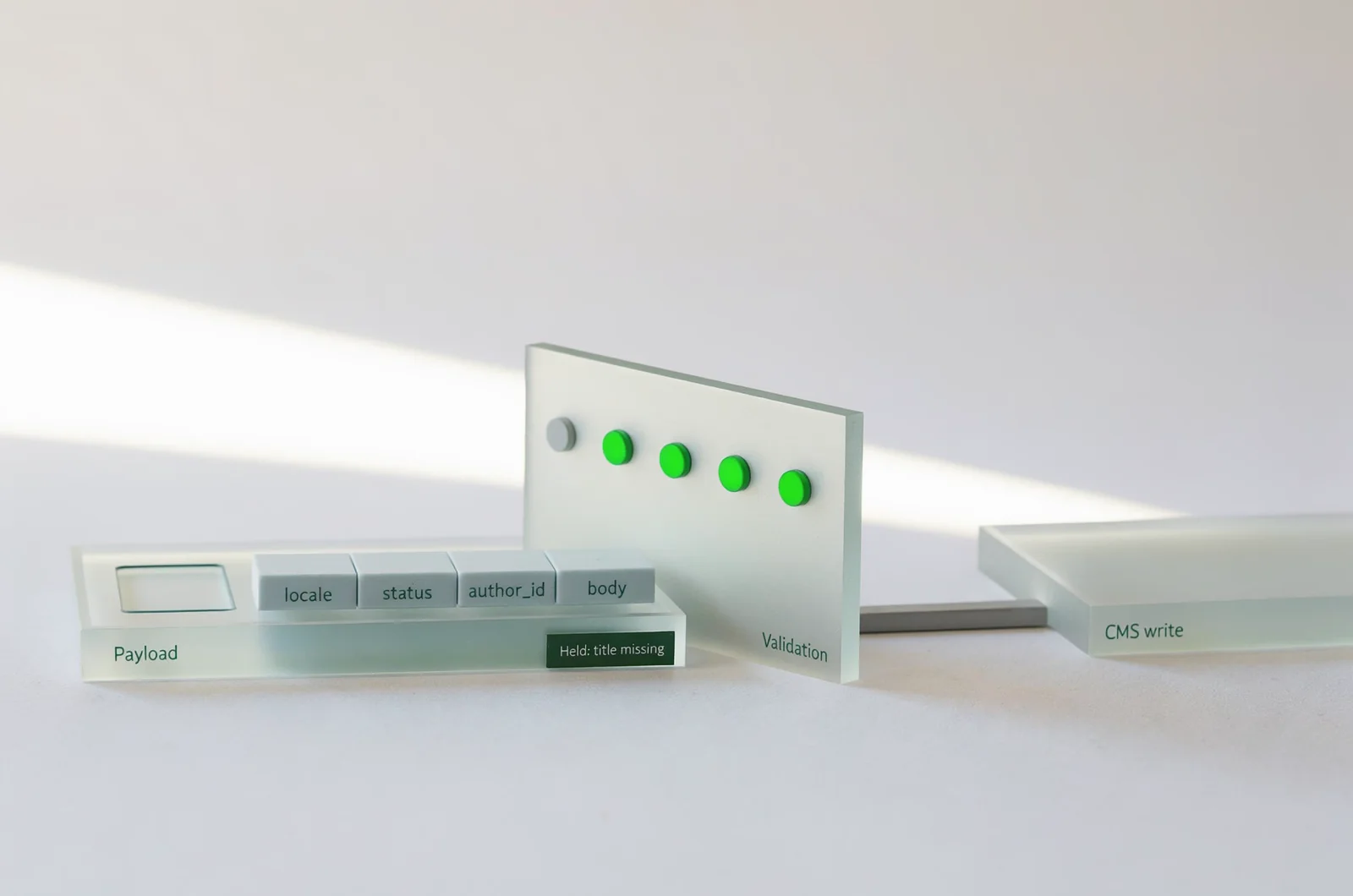
Build a contract for the article payload. Include required fields, permitted values, field types, locale, publication status and any editorial constraints.
Submit a valid fixture, then change one property at a time. Remove the title. Supply an unsupported locale. Replace a reference identifier with free text. Send a field that the destination no longer recognises.
For each case, specify whether the connector should reject the job, hold it for review or apply an explicitly approved transformation. Silent field removal should fail whenever it changes the approved article.
When assessing AI SEO content tools, keep generation quality and delivery validity as separate acceptance checks. A readable draft still needs a valid destination payload.
Make the failure report usable
Request the same evidence from both implementations: submitted payload, validation result, destination response and resulting publication state.
For Webflow, require a field map tied to the collection configuration under evaluation. For WordPress, require an equivalent map that identifies any component responsible for additional fields.
This test best fits teams with several article types, multiple locales or frequent editorial changes. Its limitation is coverage: passing the selected invalid inputs proves only those cases.
Prefer the implementation that rejects malformed jobs before publication and identifies the exact field requiring repair. Add every production validation incident to the fixture set.
2. Reference mapping: keep authors, topics and locales attached
The second test asks whether Webflow and WordPress preserve the relationships surrounding an article. A successful body-field write should leave no uncertainty about the intended author, topics or language relationships.
Resolve dependencies before releasing the article
Use the shared fixture to test an existing author, a missing author and several topic references. Include two entities with similar display names.
Give each source entity a durable identifier. Define how the connector translates that identifier into a destination reference. Treat display names as presentation values unless your contract explicitly requires otherwise.
Exercise the dependency sequence. Attempt publication before the author exists, then create the author and retry. Specify whether the connector may create dependencies or must hold the article for review.
Inspect the resulting records and rendered page. Verify the intended entity, locale and relationship direction.
Change relationships without creating duplicates
Update the article’s author and replace a topic reference. Replay the same approved update. The expected result should remain one article with the revised relationships.
For each candidate, document where relationship rules live: connector configuration, application code or destination-specific components. Ask how those rules change when an editor renames a field or replaces a content type.
This test deserves extra weight for agencies publishing across client sites and teams managing related content in several languages. Its limitation is model coverage; a successful author relationship does not establish that every other relationship works.
Select the implementation whose mappings your team can inspect and repair within its support capacity. Keep unresolved references in a visible queue with an assigned owner.
3. Webhook recovery: prove the queue survives missing events
Rank event recovery third in the Webflow and WordPress assessment. Where the connector uses webhooks, test the complete path from event receipt to recorded publication. For polling designs, apply the same recovery expectations to reconciliation.
Replay events and interrupt delivery
Send the same event more than once. Deliver an older update after a newer one. Interrupt the receiver, restore it and inspect the queue.
Define the expected result before each run. An approved version should produce the intended destination state, with repeated delivery accounted for in the job record.
Ask each implementation to demonstrate its event identity, content version and duplicate handling. A callback acknowledgement should be followed through to the completed job and destination record.
For Webflow and WordPress alike, establish which component owns retries. If several components can retry a write, document how they coordinate.
Recover the article when the event never arrives
Hold back a test event entirely. Require the workflow to identify the missing change through reconciliation or an operator-visible recovery process.
Record how the discrepancy is detected, who receives it and how publication resumes. Measure the recovery interval against a target selected before the run.
This test is particularly useful for unattended publishing and agencies responsible for several independent queues. Its limitation is deliberate fault coverage: the simulated failures cannot represent every possible outage.
Prefer the connector that restores the correct article version and produces a traceable job history. Record the remaining manual steps and assign an owner to each one.
4. Publication latency: measure the public page and its caches
The fourth test compares how long each Webflow or WordPress configuration takes to deliver the approved version publicly. Include regeneration, cache invalidation and separate frontend builds wherever the tested architecture requires them.
Follow the article beyond the API response
Record three checkpoints: job acceptance, confirmation of the destination write and verification of the expected public page.
Use a recognisable content revision in the fixture so the final check can distinguish the new article from a previous version. Verify the intended URL, locale, title and body.
Measure new publication and updates separately. An update test should include a correction to an existing article, because the public delivery path may differ from the initial release path.
If your team is investigating stalled organic pages, verify the public content before attributing the problem to keyword selection or editorial quality.
Attribute regeneration work to the tested architecture
List the stages between the CMS write and the public response. Identify which stage requests regeneration, invalidates caches or waits for a build.
When either candidate uses a separate frontend, include that frontend in the result. Keep CMS write latency as its own measurement so the team can locate delays.
This test best fits teams publishing scheduled campaigns, corrections or content with strict release windows. Its limitation is architectural dependence: results from one delivery configuration cannot establish a platform-wide timing claim.
Choose the configuration that meets your publication target across the tested workload. Record the sample size, observation period, slowest result and any publications that failed to become visible.
5. API throughput: drain the queue without duplicate writes
API capacity ranks fifth because speed should be assessed after correctness and recovery. The Webflow and WordPress trials need an equivalent editorial workload and explicit limits for the configurations under review.
Count the work behind each article
Record the requests needed for one complete publication, including reference resolution, media handling, article creation and publication checks where applicable.
Define the relevant quota boundary before testing: token, account, site, endpoint or another documented scope. Include any constraints imposed by hosting, security middleware or the connector itself.
An absent quota entry should remain unknown until the permitted operating range has been established. Avoid deriving capacity from article count alone.
Run the representative workload at increasing concurrency. Record completed jobs, rejected requests, retry volume and the remaining backlog.
Test pressure and recovery together
Introduce a temporary failure during the burst. Stop new submissions, restore the dependency and measure how long the queue takes to drain.
Require explicit handling for responses where the write outcome is uncertain. The recovery procedure should establish whether the destination already contains the intended version before another write occurs.
This test best fits bulk imports, backfills and agencies sharing publishing infrastructure across clients. Its limitation is workload specificity: a text-only batch does not establish capacity for articles with media and relationship updates.
Prefer the candidate that completes the expected workload within its operating limits and preserves publication correctness during retries. For agencies, include failed-job investigation in content production costs.
Turn the five results into a CMS decision
The useful Webflow or WordPress recommendation comes from the tested configuration and the team expected to maintain it. Keep failed correctness checks visible when comparing results.
Score evidence and apply release gates
Use this proposed editorial rubric for each test:
- Give 0 when the required behaviour fails or remains untested.
- Give 1 when the workflow succeeds through undocumented manual repair.
- Give 2 when the documented recovery process succeeds under the tested failure.
- Give 3 when normal operation and the agreed failure cases pass with retained evidence.
Keep the score beside the configuration, workload, observed result and support effort. These grades describe the evaluation method; they are not measured platform ratings.
Treat invalid publication, incorrect references and duplicate writes as release blockers. Require repair and a repeat of the affected test before approving unattended publication.
Choose a configuration your team can maintain
Choose Webflow when its demonstrated field mapping, release process and operating capacity meet the requirements without unresolved workarounds. Choose WordPress when its tested configuration meets those requirements and the team accepts responsibility for the components involved.
For stable article schemas, give substantial weight to connector simplicity and predictable changes. For complex relationships or approval rules, require evidence that the chosen implementation can express and maintain them.
If SiaSEO is part of the content workflow, assess its CMS handoff against the same release gates. Assign validation, reference resolution, retries and public-page verification to named components.
An interactive acceptance checklist could record each result and block approval whenever a correctness test fails. Keep untested behaviour visibly distinct from a passing result.
Questions to settle before choosing a publishing connector
Resolve these operational questions for both candidates before approving the publishing workflow. Put the answers in the acceptance record so editorial and engineering teams use the same release criteria.
Can an API response count as publication?
Define completion as verification of the intended public article version. Record API acceptance as an earlier checkpoint.
Specify how the final check handles protected previews, locale routes and cached responses where those apply. A job should retain enough evidence to identify the exact destination version that passed.
Should every approved draft publish automatically?
Set automation permissions by content class and failure consequence. Define which changes may proceed unattended and which require review.
Keep the approved draft version attached to the publication job. If the draft changes after approval, require a documented rule for renewed approval rather than leaving the connector to infer intent.
What should happen when the CMS schema changes?
Run the fixture set against the revised schema before releasing the corresponding connector change. Define who updates the field map and who approves the result.
Hold jobs whose required fields or references no longer match the contract. Resume them after the mapping passes the affected tests, then verify the public page.