API-Driven Content Publishing Moves Workflow Bottlenecks Downstream
Trace where API-driven publishing workflows slow down, from content handoffs and validation failures to review queues, retries, and indexing.

API driven content publishing workflow bottlenecks become clearer when you trace the work from approved draft to indexed URL. For marketing directors and agency operators, the practical question is which constraint to remove next: validation failures, unresolved assets, reviewer capacity, delivery errors, or problems on the live page. Each requires a different response.
Treat publishing as a sequence of explicit states, each with an owner and evidence of completion. The framework below is a proposed operating model. Its examples illustrate workflow decisions rather than measured performance or a particular CMS implementation.
Define completion beyond the publish request
Start the publishing workflow by deciding what each completion state means. An approved document, a stored CMS record, a public page, and an indexed URL need separate acceptance criteria.
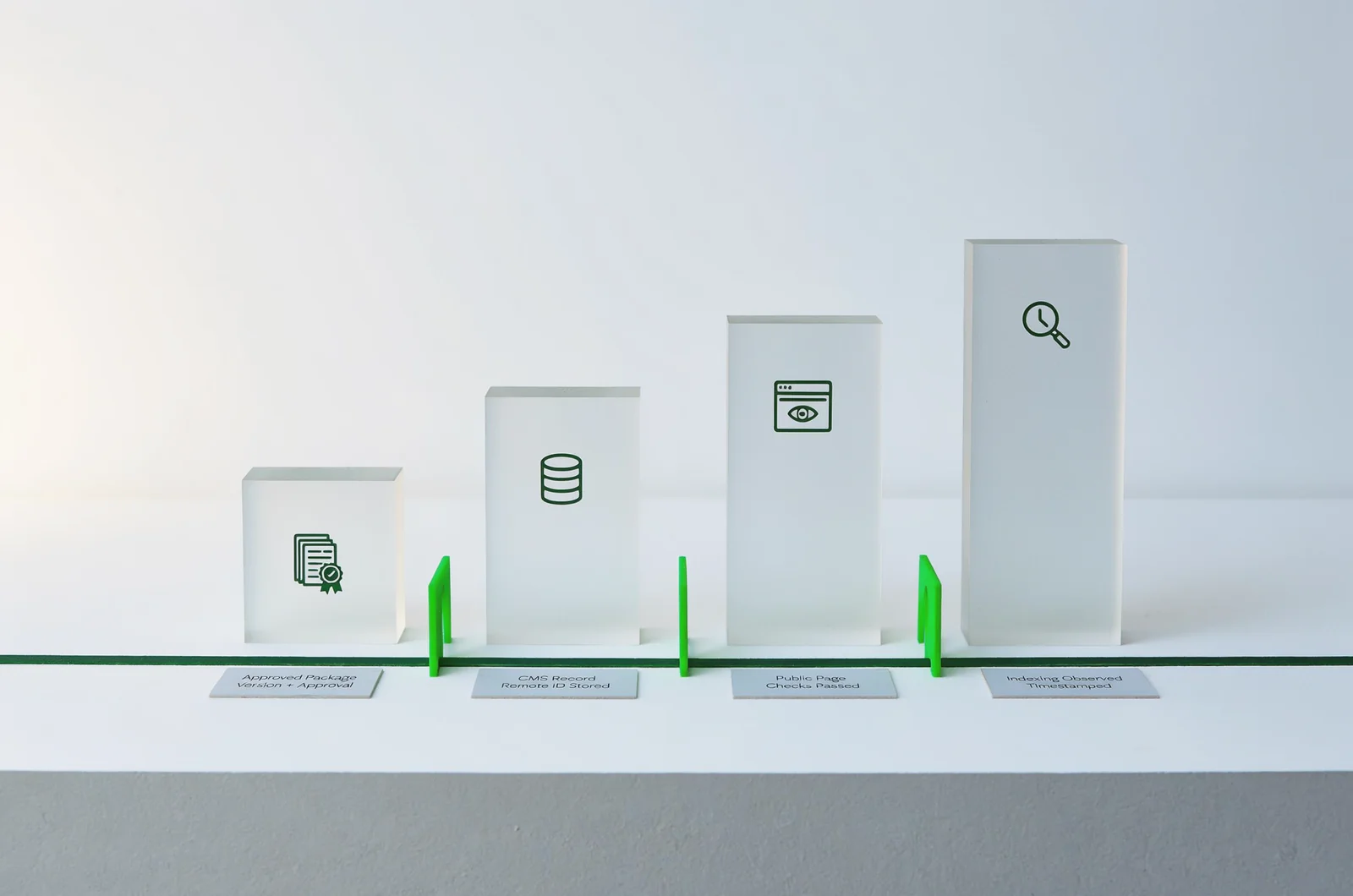
A useful model distinguishes these boundaries:
- An approved package contains a specific content version, publication destination, supporting assets, and recorded approval.
- An accepted CMS record has a remote identifier and the intended fields, relationships, and publication state.
- A verified public page passes the checks your team requires for readers and search accessibility.
- An observed indexing outcome records search evidence separately, with the time of observation.
Keep the publication action distinct from its downstream outcomes. Otherwise, a dashboard can report success while nobody owns a missing image or an unexpected redirect.
Work backward from the evidence each state requires. If public verification needs a canonical URL, the delivery stage must retain that URL or provide a reliable way to resolve it. If approval covers an image, the approved package must identify that asset.
Name failure states with equal care. “Waiting for reviewer,” “invalid category mapping,” and “remote result unknown” describe different work. A single “failed” status forces someone to reconstruct the problem before they can resolve it.
Assign an owner and an exit condition to every state.
Schema validation becomes an editorial handoff
Move CMS validation ahead of the publication attempt so editors receive actionable errors while they can still change the package. Define the content contract before adding delivery capacity.
Validate the complete publication package
Specify the required title, body format, author reference, taxonomy, locale, slug, metadata, and asset relationships for each destination. Record which requirements come from the CMS and which come from your editorial policy.
Keep those requirements versioned. A changed field mapping should trigger validation of queued packages before release.
An auditable content workflow should connect the approved draft to the exact package sent for publication. If SiaSEO supplies the draft and quality score, retain those outputs alongside the package version.
Structural validation and editorial review need different evidence. A valid author identifier says nothing about whether an article’s claims are supported. Assign hallucinated fact detection to the content review process, then preserve its outcome through delivery.
Bind approval to a version
Define which edits invalidate approval. A corrected asset reference might require a limited recheck; a changed recommendation might require another editorial review.
Store the approved version explicitly. Before delivery, compare it with the version being submitted. If they differ, route the package through the appropriate check.
Return errors that identify the destination, affected field, rejected value, and responsible owner. “Category reference missing for this destination” gives an operator a concrete task. Require the corrected package to pass validation before it reenters the release queue.
Media and internal links create publication dependencies
Model media and internal links as dependencies of the article. Decide which must resolve before release and which can wait for a later update.
Resolve assets before releasing the page
Track an asset through acquisition, upload, destination processing, and attachment to the article wherever those steps apply. Store its remote identifier separately from its original file location.
Define a fallback for every required asset. The policy might hold publication, allow an approved substitute, or permit a text-only release. Make that decision before an upload fails.
Validate the relationship between the article and the asset. Finding an image in a media library provides different evidence from confirming that the published page uses it.
Include asset handling in your review of headless CMS publishing risks, particularly when content and media follow separate delivery paths.
Resolve links against publication state
Separate links to existing pages from links to planned pages. A planned destination needs an explicit rule: wait, omit the link, or schedule an update after the target becomes public.
Use stable internal page identifiers while preparing content, then resolve them to URLs at a defined release boundary. Recheck destinations if slugs or publication states change.
Avoid circular dependencies that leave two articles waiting for each other. Designate a release order or permit a controlled follow-up update. Record unresolved links as visible work with an owner and a due date.
Approval queues determine release capacity
Treat editorial approval as a capacity decision within the publishing workflow. Faster draft production should change intake limits only when review and release can support the additional work.
Consider a hypothetical team receiving 24 publication packages per working day. Two reviewers each clear six packages daily. Assume every package needs one review and capacity stays fixed. The queue grows by 12 packages per day.
Those numbers illustrate queue arithmetic. They give the operator a choice: reduce intake, add review capacity, or narrow the work that requires human approval.
Define the approval scope for each content class. Separate decisions about factual accuracy, brand voice, visual assets, and destination readiness where different people own them. Parallel review is useful when reviewers can work independently; dependent decisions need an explicit order.
Scheduling also needs clear release conditions. Save the intended publication time, relevant time zone, and behavior when approval arrives late. If the editorial calendar uses Chicago time, retain that time-zone context alongside the execution timestamp.
The choice between automated content scheduling and manual queues should follow those rules. Set a limit on packages awaiting review and define what happens when that limit is reached. For overdue work, record who can approve, defer, or withdraw it from the calendar. Keep that decision visible to the person responsible for the publishing schedule.
Retries need a durable publication identity
Design retries around the intended publication so an uncertain delivery result does not become an uncontrolled create request. Start with a stable identity for the article and destination.
Preserve identity across attempts
Keep the logical publication identity separate from its content version and individual delivery attempts. A revision normally belongs to the same intended publication, while each attempt needs its own diagnostic record.
Include the site, environment, locale, and logical article identifier wherever those distinctions apply. Persist the remote CMS identifier once it becomes known.
Use destination-supported idempotency only after checking its documented scope and retention. Where that capability is unavailable, design explicit reconciliation around the remote record and your local state.
A lookup before creation does not prevent two workers from creating the same record concurrently. Coordinate work for each publication identity. Define how operators will resolve an ambiguous result without issuing another blind create request.
Classify the failure before retrying
Separate invalid content, authorization problems, temporary service failures, and unknown remote outcomes. Assign each class a different recovery path.
An invalid taxonomy reference needs corrected input. An authorization failure needs credential or permission review. A temporary failure needs a bounded retry policy based on the destination’s documented behavior.
When a request times out, mark the outcome as unknown until reconciliation establishes what happened remotely. Preserve the request identity, attempt time, response details, and any remote identifier.
Set attempt limits and an escalation owner. Move exhausted jobs into an exception queue that retains their history. Releasing a corrected job should preserve its identity and record why it became eligible again.
Verify the public page before tracking indexing
Continue the publishing workflow through a check of the public URL. Specify the evidence required to move from “CMS accepted” to “public page verified.”
Make verification independent of the delivery worker’s success flag. Check the resolved URL, intended article version, visible content, image rendering, and internal destinations. Include page metadata and indexability settings that your publishing policy requires.
Keep CMS field validation separate from search-facing structured data formatting. A package can satisfy the CMS contract while its rendered page still needs inspection.
Record differences between intended and observed state. For example, retain the expected canonical destination and the value found on the page. Route a mismatch to an owner who can correct the responsible layer.
Handle indexing as a separate observation process. An HTTP response supplies evidence about URL delivery; it supplies no direct evidence that a search engine has indexed the page.
Store the indexing evidence and observation time without promising a fixed indexing deadline. Define escalation around conditions the team controls, such as an unintended indexing restriction or a public page that fails verification.
Preserve the last verified content version for recovery. Specify whether a failed check should trigger an update, a publication hold, or review of a previous version. Record which action actually restored the required page state.
Measure waiting time before adding workers
Use workflow timestamps to locate delays before changing publishing capacity. Measure each stage from eligibility to completion, with waiting and active processing recorded separately.
Find where work accumulates
For each publication, capture when it became eligible, entered a queue, started processing, encountered a blocker, and completed. Retain a failure category and owner for blocked work.
Review queue age alongside successful completions. An average based only on finished jobs leaves unfinished packages outside the calculation. Examine the oldest waiting items directly.
Compare failure causes by destination and content class. An agency may need different corrective actions for a client’s taxonomy errors and another client’s exhausted review queue.
For an operation using SiaSEO’s drafting and direct CMS publishing, measure the interval after draft creation separately from generation time. This isolates the publishing decisions that remain after the article exists.
Increase automation when recovery is observable
Begin with visible states and manual reconciliation where necessary. Automate checks and retries as their acceptance criteria become explicit. Introduce unattended release for content classes with defined exception handling.
Return to the hypothetical approval queue: adding publication workers does not change its stated review capacity. Measure the queue again after the intervention that addresses the constraint.
An interactive backlog estimator could accept arrival rate, review capacity, and current queue size. It could calculate whether the backlog grows and how long clearing it would take if intake paused.
Choose an intervention, identify the metric it should change, and assign a review date. Keep the original arrival rate and workload assumptions beside the result.
Questions about failed publishing jobs
Publishing exceptions need decisions about release scope and recovery authority. Document these decisions before an unattended job encounters them.
Should one failed destination stop every release?
Choose the release boundary deliberately. If destinations are editorially independent, hold the failed destination and record the others separately. If a coordinated launch requires every destination to be ready, use a shared release gate.
Record the reason for either policy and identify who can authorize an exception. Preserve destination-level evidence even when the launch has one overall status.
Who should be allowed to replay a failed job?
Assign replay authority according to the change involved. Correcting a field mapping, replacing credentials, and changing approved content require different permissions.
A replay should retain publication identity, rerun relevant validation, and record the operator’s reason. Define when fresh editorial approval is required before the job returns to the release queue.
Should indexing uncertainty stop new articles?
Separate uncertainty from a confirmed publishing defect. Review indexing evidence in its own queue. If checks identify a shared template or configuration problem, hold affected releases until the responsible owner verifies the correction.