AI SEO Content Writing: A Repeatable Workflow You Can Audit
Walk the AI SEO content writing workflow step by step, from site analysis and keyword mapping to QA scoring and CMS publishing.

AI SEO content writing needs an approval trail that connects the published page to its query, sources, and editorial decisions. This walkthrough helps content operators produce one article through site analysis, intent mapping, drafting, semantic review, and CMS publishing. You will finish with a checked page and a record another editor can audit. Keep human approval between automated quality checks and publication, then verify that the live page matches the approved revision.
Define what counts as a publishable article
Set acceptance conditions before generating prose. For this exercise, a publishable article must answer one reader task, represent the business accurately, support material claims, and pass a CMS preview review.
Gather the inputs that make those checks possible:
- The canonical website URL and relevant product or service pages.
- One target query, its intended audience, and an inventory of existing articles.
- Approved research with source URLs and dates for time-sensitive claims.
- Brand guidance, permitted internal links, and access to a CMS draft environment.
- A named reviewer with authority to approve publication.
Google Search Central advises evaluating generated content for accuracy, quality, and relevance in its guidance on generative content. Include those checks in your acceptance conditions.
Choose a production path for the exercise. These are recommended divisions of responsibility, rather than claims about particular tools.
| Production path | Operator prepares | Draft handoff | Publication approval |
|---|---|---|---|
| Fully manual | Research, outline, and prose | Copy the approved revision into the CMS | Named editor |
| Tool-assisted | Brief, source pack, and section instructions | Review generated sections, then assemble the CMS draft | Named editor |
| Integrated automation | Approved site context, query brief, and sources | Carry the reviewed article into a CMS draft | Named editor |
Keep the same evidence requirements across all three paths. Open an article record with fields for the brief, source pack, revisions, unresolved issues, approval, and published URL.
1. Turn site analysis into an approved context pack
Start the article with a checked account of the business. Enter the canonical site URL into the analysis stage, then compare the extracted information with the relevant owned pages.
If you use SiaSEO’s URL analysis, review the captured business description before allowing it to inform the content calendar. Confirm the audience, offerings, terminology, and geographic scope.
Build a compact context pack containing:
- The products or services relevant to this article.
- The reader’s role, problem, and desired outcome.
- Approved terminology and claims the article may make.
- Existing pages the article should complement.
- Source URLs for business details that require verification.
Separate public product facts from positioning language. A statement such as “supports direct CMS publishing” needs evidence from current product material. An instruction such as “use a calm technical tone” is editorial guidance.
For grounding beyond the context pack, consult the guide to RAG and hallucination fixes.
Check one representative detail from each relevant offering against its source page. Remove outdated capabilities and ambiguous descriptions before drafting. If two pages disagree, record the conflict and request a business decision.
You should now have an approved context document with traceable business claims. Save its revision identifier so later edits can be checked against the version used for drafting.
2. Assign the query to a single page
Give the article one defined job before accepting a calendar recommendation. Write the reader’s task as an action, then choose the page format that lets them complete it.
Consider a hypothetical SaaS company targeting “how to build a customer onboarding checklist.” The reader needs a sequence, a usable checklist structure, and a way to check completeness. A broad discussion of onboarding trends would miss that task.
Record a query brief with the following decisions:
- The primary query and closely related questions.
- The reader’s starting state and intended outcome.
- The page type required by the task.
- Topics that belong on other pages.
- The concrete contribution that makes this article distinct.
Use the principles in AI search intent mapping to connect related queries to the same task.
Compare the proposed article with existing owned pages. For the hypothetical example, a page about onboarding software may support tool selection, while the checklist guide supports execution. Keep those purposes separate.
If an existing article already completes the same task for the same audience, review whether updating it would serve the reader better. Record that decision before reserving another URL.
The expected output is one approved query-to-page assignment. Verify that the proposed headline promises the outcome in the brief, then attach both to the calendar entry.
3. Build the outline around evidence and actions
Convert the query brief into an outline that supports the promised task. Give each section a purpose, its necessary evidence, and a visible completion check.
For the hypothetical onboarding article, organize the sequence around gathering account information, assigning responsibilities, defining milestones, and checking readiness. Keep software selection outside the outline unless it is necessary to perform a step.
Create a claim ledger alongside the outline. For each material claim, record the proposed wording, supporting source, relevant passage, and any date or scope limitation. Mark unsupported claims as blocked.
The guide to automated content research workflows provides additional context for organizing research inputs before drafting.
Assign evidence to the section where the claim will appear. Avoid passing a large, undifferentiated collection of excerpts into every drafting request. Include enough surrounding context to preserve qualifiers and limitations.
Add an original contribution you can substantiate: a documented procedure, a reviewed checklist, an approved example, or a clearly labeled hypothetical scenario. Never turn an illustration into a customer result.
Read the headings in order. They should describe how the reader moves from the starting state to the promised outcome. Remove sections that do not help that progression, and save the approved outline with its claim ledger.
4. Draft sections with traceable inputs
Generate the article against the approved outline, business context, and section-specific evidence. Keep each request narrow enough for an editor to inspect its output.
Specify the section’s job
For each section, provide the reader task, relevant business facts, approved claims, source passages, and expected format. Ask for the action first, followed by its reason, expected result, and verification cue.
For SiaSEO’s multi-model drafting stage, retain the same approved context and evidence requirements across drafting passes. Record the generation identifier and model information when available.
Use a section instruction such as:
Write the milestone-definition section for the hypothetical SaaS onboarding guide. Explain what the operator must document and how a reviewer should check it. Use only the supplied product facts. Label the example as hypothetical and flag missing evidence.
Inspect the section immediately. Match material claims to the ledger before requesting another section.
Assemble a coherent article
After drafting the sections, review their sequence and transitions. Remove repeated definitions, reconcile terminology, and check that examples use the same assumptions throughout.
Inspect the opening separately. It should state who the article helps, what they will accomplish, and the constraints that affect the task.
Check links, qualifications, and source attribution after any rewrite. A smoother sentence may still need its original scope limitation.
The expected result is a complete draft tied to the approved outline. Save that revision before beginning quality review so corrections remain visible in the article record.
5. Score semantic drift and resolve blocked claims
Review the draft against its approved intent and evidence. Keep topic alignment, business accuracy, and factual support as separate checks.
Use an explicit editorial rubric
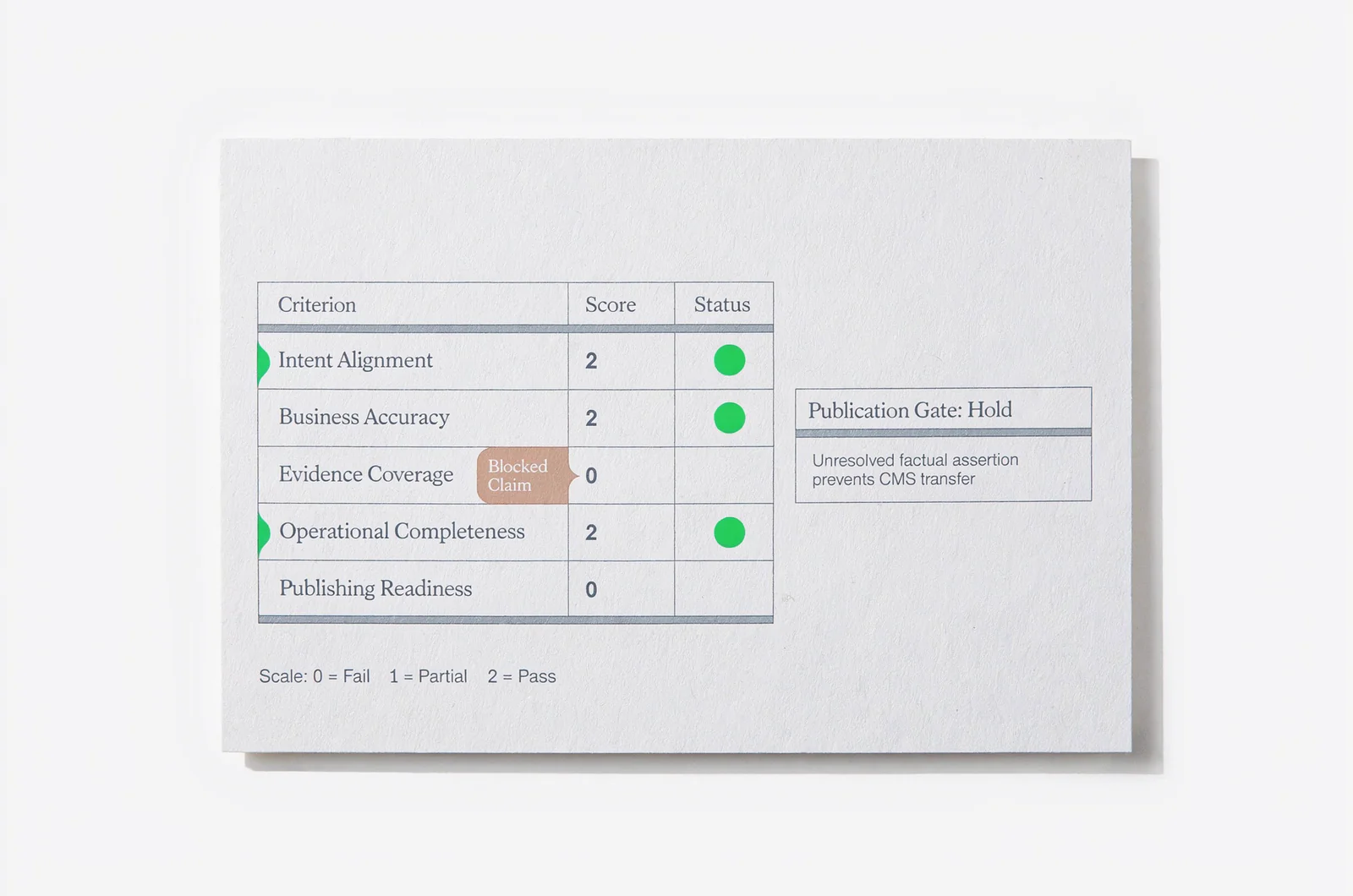
Apply a proposed 0–2 scale for this exercise: 0 means missing or contradicted, 1 means incomplete, and 2 means complete. This is an internal acceptance rule.
Score the draft across these dimensions:
- Intent alignment: the article completes the task promised by the headline.
- Business accuracy: descriptions match the approved site context.
- Evidence coverage: material claims have adequate support and attribution.
- Operational completeness: instructions include inputs, actions, outputs, and checks.
- Publishing readiness: links, metadata, formatting, and approval records are complete.
Keep the individual scores visible. Require every dimension to reach 2 before publication, with unresolved factual conflicts treated as blockers.
Use the discussion of AI blog generator quality criteria when documenting what your editorial team will accept.
Check semantic drift at the section level. Compare each section with its assigned job. If the onboarding guide expands into customer success strategy, trim or relocate that material.
Repair the underlying issue
Return a missing step to the outline. Correct an inaccurate business statement in the context pack. Replace an unsupported claim with evidence-backed wording or remove it.
Then regenerate only the affected passage and review the surrounding text for consistency.
A useful interactive checklist could accept the article’s section list, source ledger, and reviewer decisions. It would return a publication status and identify sections with unresolved claims, missing verification cues, or absent approvals. Keep its rules visible to editors.
Your output is a corrected draft and a closed issue list. Record what changed, who checked it, and which revision passed.
6. Approve the draft before the CMS handoff
Require a named reviewer to approve the exact revision destined for publication. Keep automatic publishing disabled until the review conditions have been met.
Review the article as a reader
Read the draft from the opening through the final instruction. Confirm that someone with the stated starting knowledge could complete the task without filling in missing steps.
Inspect all names, numbers, qualifications, and business claims. Check each material assertion against its source. Review the title, meta description, captions, and alt text with the same discipline.
For SiaSEO’s quality scoring and CMS publishing stages, place this human approval gate before the article becomes public. Record the reviewer, approved revision, and approval time.
If the reviewer requests substantive changes, send the revised passage through the relevant checks again. Attach approval to the corrected revision.
Check the CMS draft
Send the approved article to a CMS draft first. Preview the destination page and verify:
- The title, slug, and metadata match the approved values.
- Heading levels preserve the article’s structure.
- Internal and external links lead to their approved destinations.
- Tables, lists, and images render correctly.
- Publication status and any scheduled time are intentional.
For questions about markup and presentation, consult the guide to structured data and formatting.
Inspect any structured data against the visible page and confirmed author information. Remove unsupported fields.
Before publishing, confirm the site, destination, and approved revision. Save the CMS draft identifier in the article record, then publish through the authorized workflow.
7. Verify the live page and preserve its revision history
Check the public article after publication. Treat the rendered page as the final deliverable in this workflow.
Open the published URL and compare it with the approved CMS preview. Inspect the opening, headings, links, tables, images, and final section. Check the mobile presentation for clipped content or difficult table navigation.
Confirm the intended indexability settings and canonical URL in the rendered page. If you find an accidental publication block or a conflicting canonical destination, correct it through the approved publishing process.
Record the live URL, publication time, and revision identifier. Preserve the source ledger and reviewer approval alongside them.
Use the same record for future updates. When a product capability or cited fact changes, identify the affected passage, revise it, and repeat the relevant checks.
Separate editorial acceptance from performance measurement. Record search impressions, clicks, relevant business outcomes, and AI visibility where your measurement setup supports them. Do not interpret an editorial score as a forecast of rankings.
If the live copy differs materially from the approved revision, pause further automated publications while you investigate the handoff. Log the correction and inspect the page again after it is applied.
Questions that affect publication decisions
Use these decisions when an article reaches review with incomplete evidence, conflicting scores, or an uncertain publishing status.
Can a high quality score authorize publication?
Require the named reviewer’s approval of the exact revision. In this workflow, the score helps identify review work and document acceptance conditions. A draft with an unresolved factual claim remains blocked, regardless of its other scores. Give the reviewer the claim ledger and issue list so they can inspect the evidence behind the result.
Should every article use several models?
Use additional models only for a defined drafting or review task. Keep the same brief, context, and evidence constraints across passes. Compare the outputs against the acceptance conditions, and record why you retained a revision. If another pass adds unsupported claims or moves away from the intended task, discard that revision and preserve the approved one.
What should happen when a source cannot be verified?
Remove the claim, narrow it to what the available evidence supports, or hold the article for review. Do not replace missing support with a plausible statistic or an unattributed assertion. If the claim is necessary to complete the reader’s task, assign an owner to resolve it and keep the article in draft status.