Auto-Published Blog Posts and Google Indexing: Where Delays Start
How Google discovers and indexes auto-published blog posts, and which sitemap, lastmod, and linking choices shorten the gap between publish and index.

For content teams, scheduling automated blog posts without indexing delays means removing avoidable friction between a scheduled release and Google’s discovery process. Google still controls crawling and indexing. Your team controls whether the article becomes publicly accessible, whether discovery surfaces update, and whether the published page presents consistent indexing signals. Understanding those boundaries helps you distinguish a failed publishing job from a discovery gap or an indexing decision. Start with the different clocks involved, then examine the evidence at each handoff.
Publication, discovery, crawling, and indexing use different clocks
A scheduled blog post moves through several distinct states before it can appear in Google’s results. Treating them as separate events makes the delay measurable.
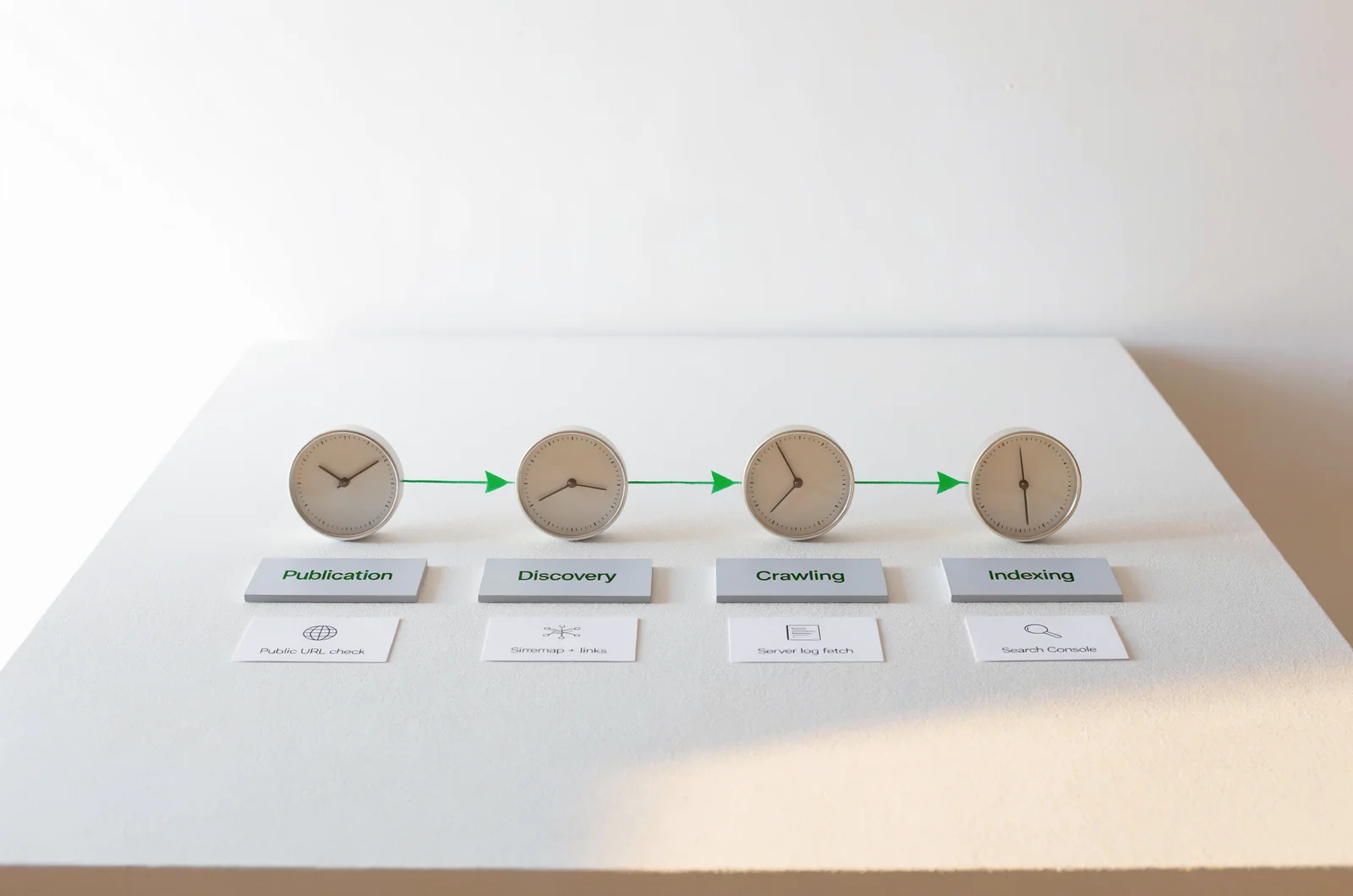
Publication is the point when your website makes the intended article publicly available. A CMS status change provides evidence about the content record. Checking the public URL provides evidence about what visitors and crawlers can receive.
Discovery concerns Google learning that the URL exists. Sitemaps and links provide discovery paths. Adding a URL to either surface does not establish when Google processes it.
Crawling is the fetch. Server logs can help establish whether a request reached your infrastructure and what response it received. A successful fetch alone cannot establish that the page entered the index.
Indexing concerns Google processing the page and deciding how to represent it in its index. Search Console provides evidence about that state. Ranking for a particular query is a separate question.
This distinction changes the investigation. If the public page still contains a draft placeholder, start with publishing. If the article is accessible but absent from its sitemap and category page, inspect discovery surfaces. If Google has fetched the article, examine the fetched content and reported indexing state.
Record each observable event separately. A single “published successfully” timestamp hides the boundaries where work can stall.
Scheduled releases need a public definition of “live”
Automated publishing needs a release boundary that reflects the public website. Otherwise, a successful scheduler event can conceal unfinished work downstream.
Check the page outside the CMS
Imagine a hypothetical Chicago marketing team scheduling an article for 9:00 a.m. The CMS changes its status at that time, but the website still serves a cached category page. The article exists, while one intended discovery path remains stale.
A release check should inspect the final public URL without an authenticated editor session. Confirm the intended response, article content, canonical URL, and indexing directives. Check the rendered page as well as the content record.
Include the schedule’s timezone in the release data. A value such as America/Chicago makes the editorial intention explicit; UTC event timestamps support comparisons across systems.
For a workflow using SiaSEO’s direct CMS publishing, the receiving website still needs these checks. A publishing integration and the public delivery layer have separate responsibilities. Assign an owner to each.
Make downstream work recoverable
A publish event may trigger page rendering, cache invalidation, sitemap changes, and internal-link updates. Design those actions so a partial failure remains visible and recoverable.
For example, a successful article release followed by a failed sitemap update should create a specific exception. Retrying the failed action should preserve the article’s existing URL and content record.
This is where API-driven content publishing becomes an operational concern: accepting a request is only one observable milestone.
Keep separate records for the scheduled time, CMS publication event, public-page verification, and completion of discovery updates. Require evidence from the public website before marking the release complete.
Sitemaps and hub links should change with the public page
A scheduled article needs discovery surfaces that reflect its actual release state. Sitemap generation and internal linking therefore belong in the publishing design.
Generate sitemap entries from public state
Build the sitemap from articles intended to be public and indexable. A scheduled draft should become eligible through the same release transition that makes its final URL available.
This does not require rebuilding every sitemap file for every post. The operational requirement is narrower: the affected sitemap must reflect the released URL, and the publicly served version must match the intended update.
Treat lastmod as a description of a meaningful page modification. Keep it tied to the article’s actual change history. Rewriting every entry’s timestamp whenever a sitemap job runs obscures that history.
Use the intended canonical URL consistently across the sitemap, article metadata, and internal links. Investigate discrepancies before adding more submission mechanisms.
These checks fit naturally into a review of headless CMS publishing risks. The content API, rendered website, and sitemap can each expose a different view of publication state.
Update links on relevant public pages
A blog index, category page, or established topic hub can provide a link to the new article. Choose pages that help readers navigate the subject.
Check the link’s actual delivery. An editorial rule that says “add to category” needs a corresponding public link with the correct destination. Inspect cached and paginated versions where those affect the intended path.
Avoid making the article depend entirely on a temporary homepage slot. A durable category or topic relationship gives the URL an ongoing place in the site structure.
For a hypothetical release, verify both the sitemap entry and the relevant hub link after the article becomes public. Record failures separately so the responsible team can repair the missing surface.
Publish cadence should follow release reliability
Scheduling cadence should reflect what your publishing system and editorial team can support. Choosing a particular hour cannot establish when Google will index an article.
Spread releases when doing so helps your team inspect failures, manage infrastructure load, or maintain editorial review. Describe those benefits as operational choices. A smoother schedule does not establish a fixed search-processing timetable.
The comparison between automated content scheduling and manual queues matters here. Automation needs explicit release checks and exception handling wherever a person previously noticed an incomplete publication.
Evaluate throughput against the whole release process. Can the website render the intended content? Do sitemap and category updates complete? Can someone investigate exceptions before another batch arrives?
Keep content review in that capacity calculation. Releasing more URLs creates more pages to assess for distinct purpose, factual support, and useful internal placement.
Avoid diagnosing every delay as a crawl-budget problem. Start with observable conditions: public access, response behavior, discovery paths, and indexing reports. Expand the investigation when those checks leave a specific question unresolved.
Use a cadence that leaves room to repair failed releases and review excluded pages. Reassess it when the volume of unresolved exceptions grows.
When Google has fetched the page, change the investigation
Once you have evidence that Google fetched a scheduled article, discovery alone becomes an incomplete explanation. The investigation should move toward the fetched page and its reported treatment.
Compare the intended article with the delivered response
Inspect the response associated with the crawl evidence. Check whether the public page contained the full article, an access challenge, a placeholder, or an error message.
A 200 response deserves a content check. The status code alone cannot tell you whether the intended article was delivered.
Review robots access, HTML and HTTP indexing directives, redirects, and canonical declarations. Compare the declared canonical with Google’s selected canonical when that information is available.
Keep live checks separate from historical crawl evidence. The page you inspect today may differ from the version retrieved during an earlier request.
Examine the article’s distinct contribution
Technical accessibility is one layer of the diagnosis. Editorial review should also ask what the article contributes beyond existing pages on the site.
Compare its reader question, examples, evidence, and practical outcome with nearby content. When several URLs address nearly the same need, examine whether each deserves a separate page.
SiaSEO’s site-aware drafting and quality scoring can support that editorial review. Treat those checks separately from public-access verification and Search Console evidence.
If a fetched page remains excluded, document the reported state and the specific change you intend to make. Avoid a cycle of cosmetic edits and repeated submissions without a defined diagnosis.
Measure the handoffs without inventing an indexing deadline
Monitoring scheduled posts should reveal which boundary needs attention. A single publish-to-index average usually hides too much context to guide a repair.
Keep local events separate from search observations
For each URL, retain the scheduled release time, actual CMS publication time, and first successful public-page verification. Add the observed sitemap and hub-link updates.
Then record verified crawl evidence and indexing observations separately. Include the observation time and the source of that evidence.
This distinction matters when measuring elapsed time. If someone first observes an indexed state on Friday, Friday is the observation date. It may not be the moment the indexing transition occurred.
An auditable AI content workflow gives these records a place alongside editorial approval and revision history.
Define internal service targets for work your team controls. For example, require failed sitemap updates to enter an exception queue. Keep Google’s processing interval outside that internal release commitment.
Compare similar releases and expose unfinished cases
Group new articles separately from revisions. Separate successful public releases from failed publishing attempts. Where useful, compare templates, content sections, or delivery systems.
Include URLs that remain unindexed at the observation cutoff. Reporting only completed cases removes the unresolved backlog from view.
A useful dashboard would show each URL’s last verified state, supporting evidence, next review date, and responsible owner. This interactive state checklist would help operators route an issue without pretending to predict Google’s timing.
Escalate according to the failing boundary. A scheduler failure belongs with publishing operations; a stale public page belongs with delivery infrastructure. A fetched article with unresolved indexing status needs technical SEO and editorial review.
Set the next investigation action from the evidence already available.
Questions that arise when a scheduled post stalls
Scheduled publishing produces recurring questions about submissions, notifications, and waiting periods. Answer them by identifying which stage the proposed action addresses.
Should every scheduled article receive a manual indexing request?
Use manual requests selectively within a documented investigation or release process. Record why the request was made and what happened afterward.
An indexing request cannot repair a stale public page, inconsistent canonical, or missing article body. Verify the released URL first. Repeated requests without a changed condition provide little diagnostic value.
Can IndexNow replace the Google discovery workflow?
Treat notification protocols as engine-specific integrations. Verify which search engines accept a notification before counting it as evidence in their discovery process.
Keep Google monitoring separate from a notification receipt elsewhere. Maintain accurate sitemap entries and relevant internal links regardless of which notification integrations the publishing system supports.
Will changing crawl-delay shorten the wait?
Check the intended crawler’s supported directives before changing a crawl-rate setting. A directive’s presence in a configuration file does not establish how a particular crawler handles it.
Keep rate controls tied to an identified crawling or server-capacity problem. Use logs and response evidence to define that problem before changing the setting.
How long should the team wait before investigating?
Use your own release history and the URL’s last verified state to set review intervals. A broken public release needs immediate operational attention. A correctly released article awaiting a new observation needs a scheduled recheck.
Keep unresolved URLs visible. Record whether each review found new crawl evidence, a changed indexing state, or a specific defect. Assign the next review date instead of repeatedly resetting the article’s publication timestamp.