B2B Content Marketing Strategy: How AI Search Rewires the Funnel
AI search is reshaping B2B content marketing strategy. Learn how to map intent, structure content, and win citations in generative search.

The B2B content funnel used to run on a simple premise: capture keywords, rank pages, convert traffic. That model still functions, but its yield is dropping fast. AI search engines now answer buyer questions directly in the results layer, stripping clicks from top-ranking pages and rerouting decision-making before prospects ever reach your site. For marketing directors and agency operators, this means the old keyword-centric playbook needs a structural overhaul.
A modern b2b content marketing strategy must now account for generative engine optimization (GEO)—the practice of engineering content so AI systems cite, summarize, and trust it when composing their own answers. This is not a replacement for SEO. It is a parallel discipline that changes how you research topics, architect information, and measure success across the entire funnel.
The Funnel Under AI Search Pressure
Traditional funnel stages—awareness, consideration, decision—still describe buyer psychology. What has changed is where and how buyers gather information to move between them.
Research from 2026 shows that 94% of B2B buyers now use large language models during vendor evaluation. Meanwhile, organic clickthrough rates for top-ranking pages have fallen sharply on queries that trigger AI Overviews. One analysis of 300,000 keywords found a 58% CTR reduction when Google's AI Overview appeared. Another measurement tracked organic CTR dropping from 1.76% to 0.61% between mid-2024 and late 2025, with only partial recovery since.
Buyers are not disappearing. They are delegating early-stage research to AI intermediaries. Your content may still influence their decision, but the interaction happens inside a chat interface or an AI summary panel rather than on your domain.
This shifts the strategic question from "How do we rank #1?" to "How do we become the source AI systems quote?" The answer requires rethinking content architecture at every funnel layer.
Mapping Intent Layers for AI Citation
Keyword research for traditional SEO clusters terms by volume, difficulty, and commercial intent. GEO adds another dimension: answerability. AI search engines favor content that resolves specific, multi-part questions with clear attribution to identifiable sources.
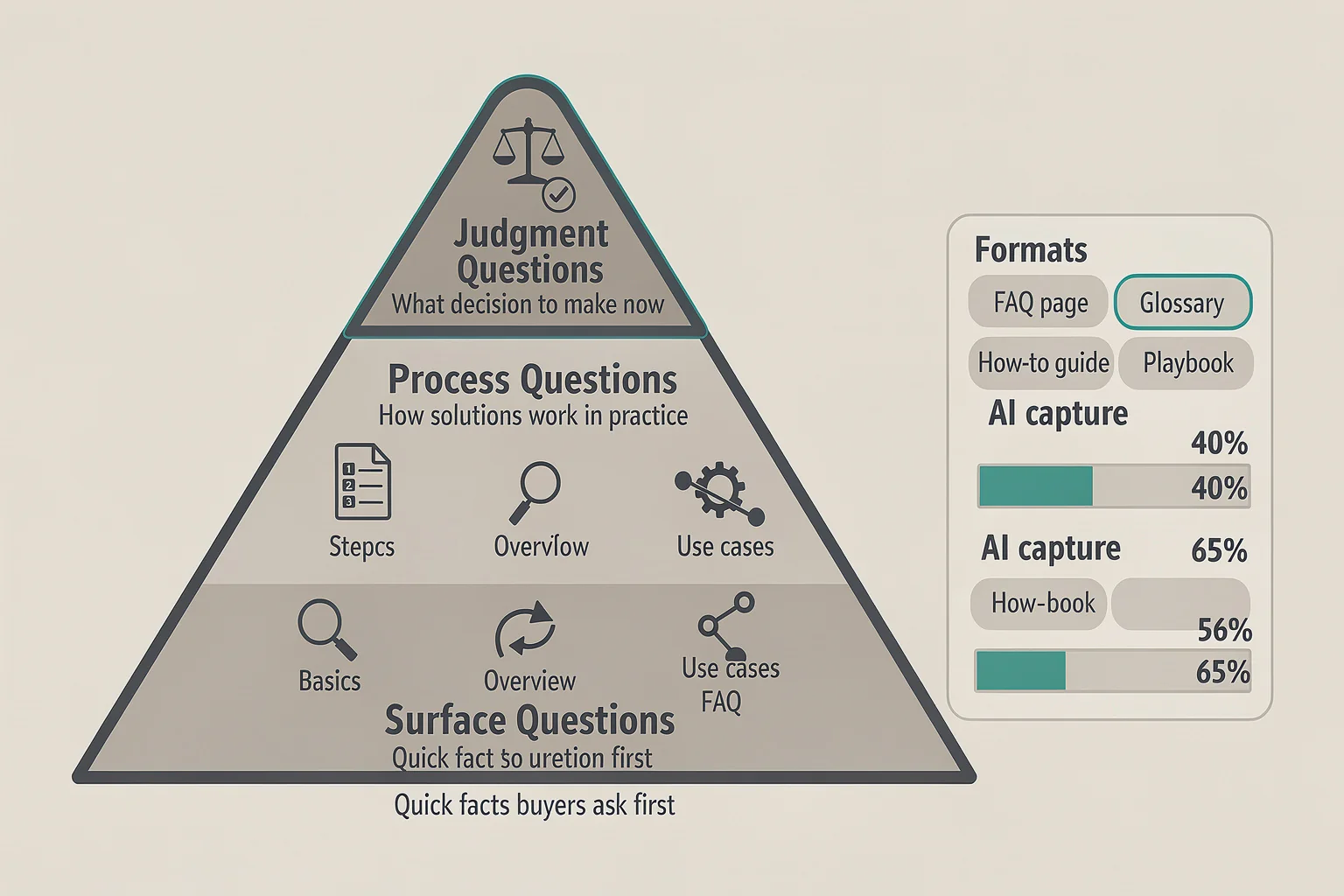
The AI search intent mapping approach treats each query as a problem state rather than a traffic target. Instead of building one comprehensive page per keyword, you decompose buyer questions into layered content modules:
- Surface questions (what, who, when): These feed AI Overviews directly. Answer them in structured, scannable formats with explicit definitions.
- Process questions (how, in what order): These require step-by-step treatments with clear sequencing that AI systems can extract and paraphrase.
- Judgment questions (why this versus that, what are the tradeoffs): These need comparative frameworks with attributed evidence, since AI engines hesitate to synthesize opinions without source backing.
Each layer demands different formatting discipline. Surface questions reward definition boxes and concise opening paragraphs. Process questions need numbered steps with causal connectors. Judgment questions require structured comparisons that cite specific data points rather than general claims.
The GEO versus SEO distinction matters here because the optimization target changes. SEO optimizes for ranking position in a list of blue links. GEO optimizes for selection into a generated answer that may never display a traditional result list at all.
Semantic Clustering for Machine Comprehension
AI search engines do not read content linearly. They vectorize it—transforming text into mathematical representations of meaning, then comparing those vectors to query representations to find the closest semantic matches. This has practical consequences for how you structure information.
Traditional content clusters often organize by keyword variants: a pillar page on "B2B content marketing strategy" with supporting pages for "B2B content marketing examples," "B2B content marketing metrics," and so on. Semantic clustering for AI search organizes by conceptual relationships and logical dependencies.
A semantic cluster for the same topic might look like:
- Foundational concept: What constitutes strategic content versus tactical publishing
- Operational mechanism: How content production systems connect to revenue measurement
- Decision framework: How buyers evaluate content quality signals during vendor selection
- Implementation pathway: How teams transition from ad-hoc creation to systematic production
Each node in this cluster links to others through explicit conceptual bridges rather than keyword repetition. When AI systems process this architecture, they can trace relationships between ideas and cite your content as authoritative across multiple question types.
The GEO SEO whitepaper framework provides a more detailed treatment of how to build these conceptual maps for enterprise content operations.
The Operational Shift: From Keyword-Centric to Answer-Centric Planning
Most B2B content calendars still originate from keyword gap analysis. Editorial teams identify underserved search terms, assign writers to cover them, and measure success by ranking movement and traffic growth. This workflow produces volume efficiently but often misses the answer-quality threshold that AI search engines require.
Answer-centric planning inverts this sequence. It starts with buyer questions extracted from sales calls, support tickets, and actual AI search queries, then builds content designed to resolve those questions completely enough that an AI system would prefer citing it over synthesizing from multiple weaker sources.
The operational differences are concrete:
| Keyword-centric planning | Answer-centric planning |
|---|---|
| Target: search volume | Target: answer completeness |
| Success metric: ranking position | Success metric: citation frequency in AI responses |
| Content unit: optimized page | Content unit: resolved question state |
| Update trigger: ranking drop | Update trigger: answer drift or factual expiration |
| Quality gate: keyword density | Quality gate: verifiable accuracy and source attribution |
This shift does not eliminate keyword research. Keywords remain the bridge between buyer language and your content. But they become inputs to question identification rather than the organizing principle of the editorial calendar.
Structuring Content for AI Extraction
AI search engines extract information more reliably from some formats than others. The AI citation structured data approach combines semantic HTML, schema markup, and intentional formatting to increase selection probability.
Practical formatting principles include:
- Lead with the answer: Place the direct response to the implied question in the first 40-60 words. AI extraction systems weight early content heavily.
- Use explicit causal language: Words like "because," "which results in," and "this produces" help AI systems understand relationships between claims and evidence.
- Separate opinion from fact: Attribute statistics to named sources with dates. Present frameworks as frameworks, not as natural laws.
- Maintain consistent entity references: If you refer to "marketing-qualified leads" in one section, do not switch to "MQLs" without re-establishing the connection. AI systems track entity identity across passages.
Structured data markup helps but is not sufficient. Schema.org Article or FAQ markup signals content type to crawlers, but the underlying information architecture determines whether AI systems find your content worth citing.
Measuring What AI Search Changes
Traditional content metrics—organic traffic, time on page, conversion rate—still matter for bottom-funnel content where buyers reach your site directly. For top and middle funnel, new metrics become necessary:
- AI citation tracking: Monitoring whether your brand, data points, or quotes appear in AI-generated responses for target queries
- Impression shift: Measuring whether your content appears in AI Overview source panels even when direct clicks drop
- Question coverage: Assessing what percentage of your target buyer questions have authoritative answers in your content library
- Semantic drift score: Tracking how much your content's meaning vectors diverge from current query vectors over time
The last metric is particularly important for B2B content with long shelf lives. Technical specifications, pricing benchmarks, and competitive comparisons decay in relevance. Without systematic review, content that once ranked well can lose AI citation authority because its factual basis has drifted from current reality.
Common Structural Mistakes in AI-Era B2B Content
Teams adapting to this environment often repeat predictable errors:
Over-optimizing for featured snippets at the expense of depth. A concise answer wins the snippet but may lack the evidentiary depth that AI systems need for citation in complex B2B queries.
Treating GEO as a technical layer rather than an editorial discipline. Schema markup and structured data help, but they cannot compensate for thin research, unsupported claims, or generic advice.
Maintaining separate SEO and content teams with different success metrics. When SEO chases rankings and content chases engagement, neither optimizes for AI citation. The teams need shared measurement frameworks.
Publishing without verification workflows. AI search engines penalize outdated statistics and contradictory claims more visibly than traditional algorithms, since their generated answers expose source reliability directly to users.
Building the Transition Roadmap
Moving from keyword-centric to answer-centric operations does not require abandoning existing content investments. A practical transition has three phases:
Phase one: Audit for answer gaps. Review your top 20% of content by traffic and identify which buyer questions it answers incompletely. Prioritize updates that add specific data, named sources, and clear causal reasoning.
Phase two: Restructure high-impact clusters. Select three to five topic clusters that matter most to your revenue. Reorganize them around question resolution rather than keyword coverage, adding explicit conceptual bridges between related pieces.
Phase three: Embed citation measurement. Add AI citation tracking to your regular reporting cadence. Treat citation frequency as a leading indicator of content authority, with ranking and traffic as lagging confirmations.
For teams managing this at scale, automation becomes necessary. The content research, drafting, and quality verification pipeline must handle semantic analysis and drift detection without manual review of every page. Site-aware generation systems that understand your existing content architecture before producing new material can maintain consistency across large libraries.
What B2B Teams Should Ask Their Tools
Whether you build or buy content operations infrastructure, several capabilities distinguish systems that support AI-era strategy from legacy SEO tooling:
- Does the system analyze your existing site structure before generating new content, or does it treat each article as isolated?
- Can it map generated content to specific buyer questions and track whether those questions are answered completely?
- Does quality scoring evaluate factual accuracy and source attribution, or only keyword density and readability?
- Can it detect when existing content drifts from current factual reality and flag pieces for review?
These questions matter because the volume of content required for comprehensive question coverage exceeds what manual editorial teams can produce and maintain. Automation without quality discipline produces noise. Quality discipline without automation cannot scale to cover the full funnel.
When the Funnel Becomes a Network
The ultimate structural change is conceptual. The linear funnel—awareness to consideration to decision—assumes buyers move through stages in sequence, with your content as the pathway. In practice, B2B buyers now loop between AI-mediated research, peer validation, and vendor contact in non-linear patterns.
Your content strategy must function as an information network rather than a conversion pathway. Any piece might be a buyer's first touchpoint, their validation source, or their decision justification. Each piece needs to stand alone as a complete answer while linking to related depth where appropriate.
This network architecture rewards modular content production: discrete units that resolve specific questions, with explicit relationships to broader topics. It penalizes monolithic guides that try to cover everything, since AI systems extract selectively and buyers rarely consume linearly.
Reader Questions
How quickly is AI search actually changing B2B buyer behavior?
The shift is already measurable. Data from 2025-2026 shows 94% of B2B buyers using LLMs in evaluation, with organic CTR falling 58% on AI Overview queries. The behavior change precedes most organizational strategy adjustments.
Does GEO replace traditional SEO investment?
No. The two operate in parallel. SEO still captures high-intent buyers who bypass AI summaries. GEO addresses the growing segment that delegates initial research to AI systems. Both require distinct but compatible content structures.
What content types do AI search engines cite most reliably?
Comparative analyses with specific data points, step-by-step process documentation with clear sequencing, and definition frameworks that establish conceptual boundaries. Opinion pieces and purely narrative content receive less citation unless they contain attributed, verifiable claims.
How small can a B2B team be and still execute this strategy?
The framework scales to team size, but the measurement and maintenance overhead is real. Teams under five people typically need automated assistance for semantic analysis, drift detection, and quality verification to maintain comprehensive coverage without burning out editorial staff.
What is the typical timeline to see AI citation improvement?
Three to six months for updated existing content, assuming systematic restructuring. New content built on answer-centric principles from inception can earn citations faster, but building sufficient coverage depth across a topic cluster takes sustained production.
References
- 2.25.101 IRS.gov Web Content Management — Purpose: This guidance outlines the business processes and standards for developing, publishing and maintaining content on IRS.gov. IRS.gov: ... The guidance establishes
- B2B Content Marketing: Ultimate Strategy — B2B content marketing is the practice of using content to promote your product or services to a business audience. It involves producing high-quality content that appeals to
- How to Create Profitable B2B — To build a revenue-driven B2B content strategy, focus on five key steps: clearly define your target audience, set goals tied to revenue, create content that solves real customer