AI SEO Tools Cost Compared for Showing Up in AI Search Results
AI SEO tools cost compared: Surfer, Clearscope, MarketMuse and Jasper priced against what each does to get pages cited in AI search results.

For B2B marketing teams, showing up in ai search results raises two budget questions: what does it cost to publish useful content, and what does it cost to measure whether that content appears? Surfer, Clearscope, MarketMuse, Jasper and Copy.ai form the shortlist here. Compare their total workflow costs against the evidence you need from each purchase.
Verified current subscription prices and comparable plan allowances are unavailable for these five products in this comparison. A numerical vendor ranking would therefore be unsupported. Instead, the comparison below uses explicit purchasing tests and hypothetical budgets to distinguish subscription cost, editorial cost and visibility measurement. Apply the same calculations to dated vendor quotes before committing.
Compare the cost of the same finished outcome
An AI SEO tool quote becomes useful when every option is priced against the same workload. Start with a defined monthly output: approved pages, maintained pages, users, websites and visibility checks.
“Ten articles” leaves too much open. Specify whether each article requires source verification, subject review, internal links, CMS formatting and approval. Record which tasks the quoted subscription covers and which your team must complete.
Use this calculation:
Monthly operating cost = subscriptions + usage charges + editorial labour + publishing administration + measurement labour.
Divide that total by approved, published pages to calculate production cost per page. Keep visibility outcomes in a separate calculation. An approved article and a cited article represent different stages of the decision.
Count your existing subscriptions where they support the proposed workflow. If the purchase requires another measurement service, include that service in the budget. Credit a replacement subscription only after confirming you can retire it.
For a team purchasing in Spain or Portugal, keep quotes comparable by recording billing currency, VAT treatment, monthly payment and annual commitment. Treat a displayed monthly equivalent separately from the cash required upfront.
Use AI content cost benchmarks as a companion when comparing software with outsourced production. Keep the scope identical: research, writing, review and publishing should appear on both sides of the calculation.
Compare three hypothetical operating budgets
Different software arrangements deserve comparison through their full operating costs. The following scenarios illustrate the arithmetic; they do not describe any named vendor’s prices or measured productivity.
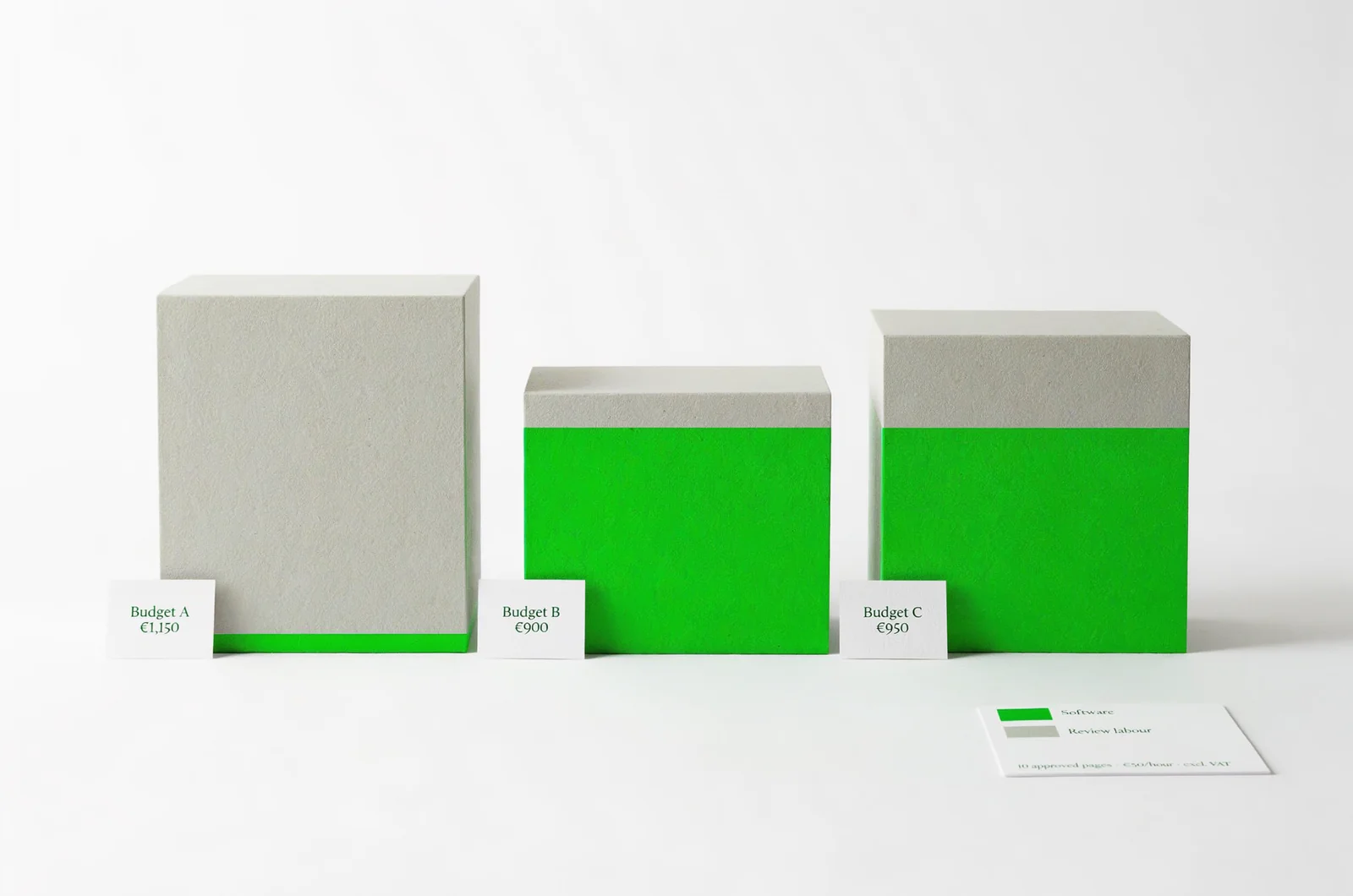
What ten approved pages could cost
Assume ten approved pages per month, an editorial rate of €50 per hour and figures excluding VAT. Subscription amounts represent hypothetical totals for the tools in each arrangement.
| Hypothetical arrangement | Monthly software | Editorial and administration hours | Monthly operating cost | Cost per approved page |
|---|---|---|---|---|
| Existing production process plus editing software | €150 | 20 | €1,150 | €115 |
| Production software with human approval | €300 | 12 | €900 | €90 |
| Production software plus separate visibility tracking | €450 | 10 | €950 | €95 |
The first arrangement has the lowest software bill and the highest total cost under these assumptions. Its extra review hours account for the difference.
The second has the lowest cost per approved page. It still requires a separate answer to the measurement question: how will the team establish whether its pages appear?
The third includes a visibility-tracking budget. Its €50 monthly premium over the second arrangement needs an operational justification, such as a defined report or a reduction in manual checking. Tracking itself should receive no credit for citations that have not been observed.
Calculate the labour saving required
Compare each proposed subscription increase with the labour it must save.
In this hypothetical example, software spending rises by €150 between the first and second arrangements. At €50 per hour, the second arrangement must save three hours per month to break even. The table assumes eight hours saved, which requires validation.
Use actual review time from a pilot before accepting that assumption. Include rejected drafts, corrections and CMS repairs in the time log.
A useful interactive estimator would accept subscription costs, usage charges, loaded hourly rates and approved-page volume. It could display monthly cash requirements, cost per page and the hours each upgrade must save.
What to request from the five shortlisted platforms
The five named platforms need dated quotes and demonstrations before a defensible price comparison is possible. Their current prices, allowances and included capabilities are unverified here.
Apply the same requirements to every platform. The lenses below organise purchasing questions; they do not establish differences between the products.
Surfer: price the revision workload
For a Surfer quote, specify how many existing pages and new drafts your team expects to assess each month. Request a demonstration using one representative page and record the time required to produce an approved revision.
Check the quoted limits, user access and any additional charges for the demonstrated functions. If the intended purchase supports an established editorial team, judge it against revision time and accepted output.
Advance it only after the quoted plan covers the demonstrated workload within your budget.
Clearscope: price the editorial handoff
For Clearscope, ask how the proposed subscription would support the handoff between strategist, writer and reviewer. Supply the same brief and acceptance criteria used for the other candidates.
Record which steps occur inside the quoted plan and which require another document, subscription or manual action. Ask whether the people responsible for approval can participate under the proposed access terms.
If your bottleneck is editorial review, compare the completed handoff and total reviewer time before judging the subscription price.
MarketMuse: price planning decisions separately
For MarketMuse, request a demonstration against a bounded planning problem, such as choosing which existing pages to refresh within a fixed production budget.
Ask for the deliverable your team would receive, the inputs it requires and the work needed to turn it into approved briefs. Confirm whether the quoted subscription includes the demonstrated workflow.
If planning is the intended purchase, calculate its cost per accepted planning decision or brief. Keep those costs separate from drafting and AI visibility measurement.
Jasper: include the full approval cycle
For Jasper, use a representative content assignment with brand requirements, evidence requirements and a named reviewer. Record the work needed to reach publication approval.
Ask which demonstrated functions fall within the quote, how usage is charged and what happens when output requires revision. Include fact checking and subject review in the labour calculation.
If drafting capacity is the intended benefit, compare accepted pages per total staff hour. Draft volume alone cannot complete that calculation.
Copy.ai: price a repeatable workflow
For Copy.ai, describe a complete recurring assignment with a start, an approval gate and a publishing handoff. Request a demonstration using the proposed subscription.
Ask how the commercial terms account for repeated runs, revisions, failed steps and reviewer access. Map any work that remains outside the platform.
If repeatable production is the intended purchase, calculate cost per completed assignment. Use the quoted charging unit to reconcile that figure with the monthly invoice.
Separate content quality from observed AI inclusion
An AI SEO purchase should have distinct acceptance tests for content quality and observed visibility. Keep those tests separate so a strong editorial result does not become an unsupported visibility claim.
Inspect the page against the brief
For entity coverage, write down the products, concepts, relationships and constraints the page must explain. Ask reviewers to identify omissions and unsupported statements.
For answer structure, choose several reader questions and check whether each has a direct, self-contained answer. Compare definitions, conditions and supporting evidence against the approved brief.
Use grounded generation tools as a separate evaluation topic where source handling matters. During a demonstration, request the evidence behind an output and inspect whether it supports the associated claim.
These are editorial acceptance tests. They do not establish that an AI search service will select the page.
Record what actually appears
For visibility measurement, define the observation before calculating a result. A brand mention, a linked domain and a citation to a specific page should have separate fields.
Request a sample report with the query, service, observation date, language, market setting and cited URL. Ask what evidence is retained for later review.
Use a stable question set for repeated checks. Record changes to that set rather than silently replacing unsuccessful queries.
If no citation is observed, report zero observed citations for that sample. Leave cost per cited page undefined when its denominator is zero; do not substitute an editorial score.
Run a pilot with a budget you can audit
A controlled pilot gives the shortlisted tools a common commercial test. Define the workload, acceptance standard and spending limit before activating paid usage.
Keep the assignments comparable
Choose a bounded set of new articles and refreshes that represents your actual publishing work. Use comparable briefs, source requirements and reviewer access.
Record where assignments differ in difficulty. A technical product comparison may need a different review allowance from a glossary entry; keep those categories visible in the results.
For English content aimed at Spain and Portugal, specify the intended market and language in each assignment. Keep those settings consistent when collecting visibility observations.
Track staff time across briefing, drafting, revision, evidence checking, approval and publication. Include unsuccessful attempts and record why a draft was rejected.
Test publishing and measurement separately
Publishing should have its own acceptance test. Check formatting, internal links, approval permissions and the ability to correct a published page.
The comparison of automated content scheduling tools can support this part of the decision. In your pilot, record whether the proposed workflow preserves the approval gate your team requires.
For measurement, collect a baseline before changes and repeat observations after publication. Keep an unchanged comparison group where practical. Record other substantial site changes during the same period.
Treat observed differences cautiously. A before-and-after result alone cannot isolate which part of the workflow caused a change.
Include broader workflows only when they fit
SiaSEO is a later candidate when the purchasing question spans site-aware drafting, semantic QA, CMS publishing and LLM visibility tracking. Its stated scope brings those activities into one production workflow.
Evaluate that scope with the same assignments and cost accounting. Request evidence of what the proposed subscription includes, inspect the approval process and review the visibility records. Its inclusion should depend on your workload rather than a presumed advantage over the five shortlisted platforms.
Finish the pilot with a reconciled invoice, a staff-time log, accepted-page counts and retained visibility observations.
Questions to settle before buying an annual plan
An annual commitment should follow answers about price, measurement and publishing control. Resolve these questions in the quote and pilot record.
Which platform has the lowest cost?
The available evidence does not establish a lowest-cost provider among Surfer, Clearscope, MarketMuse, Jasper and Copy.ai. Current, comparable prices and allowances are missing.
Use dated quotes for the same workload, then add labour and supporting subscriptions. Select on total operating cost within your required scope, and record the annual cash commitment separately.
Is an optimisation score evidence of AI visibility?
Treat an optimisation score as an editorial input unless its meaning and calculation are documented. Require a separate observation record to establish a mention or citation.
For purchasing purposes, ask whether the report identifies the actual page, the query and the observed result. Keep the score and citation fields separate in your pilot spreadsheet.
Should visibility tracking be included in the production tool?
Compare the two arrangements against your reporting requirements. An included tracker needs a usable observation record, sufficient coverage for your chosen sample and an export your team can inspect.
A separate tracker adds a subscription and a handoff to the budget. Test whether those costs buy measurement your production subscription cannot demonstrate. Retain the sample exports from both arrangements.
When does automation justify its cost?
Automation justifies its cost when the accepted output and documented labour savings meet your purchasing threshold.
Set that threshold before the pilot. Include the time required to repair failed steps, review uncertain claims and correct publishing errors. Approve an annual purchase only after reconciling those costs with the quoted subscription.