AI Search Optimization Tools That Actually Improve Citations
Which AI search optimization tools actually improve citation rates? We tested features, output formats, and integration depth to find what works.

Learning how to optimize content for AI search is now a budget question, not just a tactics question. A 2026 industry report estimated AI-related search usage at 28% of traditional search worldwide, with roughly three in four American respondents using AI for search weekly. That shift has produced a crowded category of AI search optimization tools, and most of the marketing around them promises citations without showing the mechanism. This guide evaluates the category the way a buyer should: by what each option actually does to get your pages cited inside ChatGPT, Gemini, Perplexity, and Google AI Overviews, what it costs in effort or money, and where the claims outrun the evidence.
Everything here was checked against public documentation and independent testing published through October 2026. Where a claim could not be verified, it says so.
What citation improvement actually means before you shop
A tool improves citations only if it changes something an AI engine can observe: the structure of your page, the evidence on it, your presence on third-party sources, or your ability to measure where you appear. Google Search Central's generative AI optimization guide, last updated in mid-2026, is the closest thing to ground truth here. Its core asks are unglamorous: unique, non-commodity content with a genuine point of view, crawlable pages, and clear structure. The guide also flags several popular tactics as unnecessary for its generative features, including llms.txt files and AI-specific content chunking.
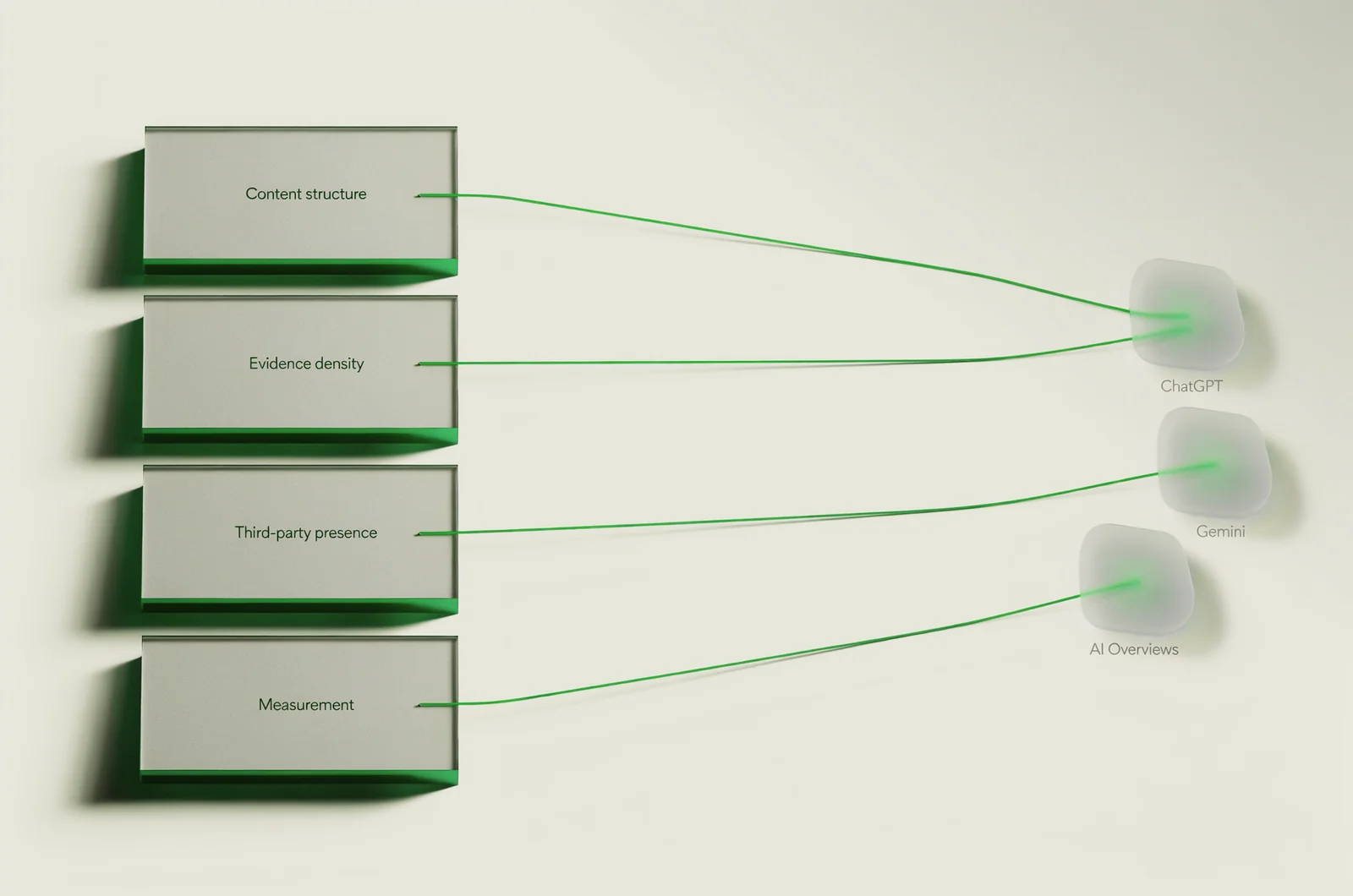
That gives you a working filter. Four levers have real support:
- Content structure. Short paragraphs, direct answers under headings, lists, and tables. Princeton's GEO research, cited across multiple 2026 guides, found that pages carrying statistics and quotations earned measurably more generative-engine visibility.
- Evidence density. Original data, named sources, and visible authorship. Google explicitly asks for non-commodity content that goes beyond common knowledge.
- Third-party presence. AI systems draw from reviews, forums, and media, so off-site narrative matters as much as on-site copy.
- Measurement. Tracking when and where your pages are cited across engines, separately from traditional rank tracking.
Any tool worth buying should move at least one of these levers in a way you can verify. A recent hands-on test of seven AI search optimization tools reached a similar conclusion: the winners were the ones that changed output or measurement, not the ones that rebranded a keyword-density score as "GEO."
If you want the on-page side of this in detail before evaluating software, our guide to AI search citation tactics covers the structured data and formatting layer these tools build on.
How the options in this guide were selected
The SERP for this category is dominated by listicles testing 14 to 19 tools at once. A roundup of 19 AI SEO tools and Built In's list of 15 are representative: broad, useful for discovery, thin on verdicts. This guide takes the opposite approach. Three options were selected because each represents a distinct buying pattern, and each had verifiable public evidence about what it does:
- A full-service agency for teams that want the work done, not another dashboard.
- An autonomous AI agent for teams that want continuous execution with minimal headcount.
- An enterprise platform for teams that want measurement and workflow inside an existing SEO stack.
Tools were excluded if their only AI-search claim was a content score, if no public documentation described the mechanism, or if they duplicated a category already covered. Pricing signals are included where public; several vendors in this space gate pricing behind sales calls, which is itself a signal about who the product serves.
The three options, reviewed on the same criteria
Each review below follows the same card: what it does, who it fits, the evidence behind it, the honest limitation, and a verdict.
WebFX: the done-for-you route
What it is. WebFX sells AI search optimization as a service rather than software. Its GEO offering targets visibility across ChatGPT, Gemini, and AI Overviews, bundling content work, technical fixes, and reporting into an agency engagement.
Best for. Marketing directors at mid-market companies who have budget but no internal GEO capacity. If your team of two is already behind on the content calendar, an agency that owns execution beats a tool nobody logs into.
Evidence. WebFX is one of the few providers ranking for the commercial query "ai search optimization services," which suggests it practices the discipline it sells. Its positioning across multiple AI engines matches the multi-engine reality that NoGood's 2026 analysis of AI search visibility tools documents: citations fragment across platforms, so single-engine optimization misses most of the opportunity.
Limitation. Agency pricing in this space typically runs into the thousands per month, and WebFX does not publish a rate card for GEO work. You are buying a relationship, which means results depend on the account team, and switching costs are real. Ask for citation-level reporting, not traffic proxies, before signing.
Verdict. The right choice when the constraint is people, not software. Wrong choice if you want to build internal capability.
SEO.AI: the autonomous agent route
What it is. SEO.AI positions itself as an AI SEO agent rather than a toolkit. Its stated scope is aggressive: create ranking content, publish it to your website, build relevant backlinks, and keep visibility growing continuously, around the clock.
Best for. Lean teams and solo consultants who need output volume and can tolerate machine-led execution. The appeal is compounding: an agent that publishes and builds links weekly does work a part-time hire cannot match.
Evidence. The end-to-end claim (draft, publish, link-build) is verifiable from the product's own description, and it matches where the category is heading. Google's 2026 guidance even includes early notes on AI agents as an emerging surface. What is not publicly verifiable is citation lift attributable to the agent specifically, so treat outcome claims as directional.
Limitation. Autonomy cuts both ways. Fully automated publishing and link building without editorial review is exactly how brands end up with commodity content, which Google's guide names as the thing generative features deprioritize. You need a QA gate somewhere in the loop, or the agent scales your mediocrity along with your output.
Verdict. A legitimate force multiplier for teams with a review process. A liability for teams hoping to skip one.
Semrush: the enterprise measurement route
What it is. Semrush points buyers to its Enterprise AI Optimization (AIO) offering and AI Visibility Toolkit, paired with basics like Google's Rich Results Test. The play is measurement and workflow inside a platform SEO teams already pay for.
Best for. Agencies and in-house teams with an existing Semrush subscription who want AI visibility tracking without adding a vendor. The AI Visibility Toolkit tracks where your brand appears in AI-generated answers, which closes the measurement gap most teams have.
Evidence. Semrush's own 2026 content on AI search is technically specific: short paragraphs, direct answers under headings, semantic HTML, schema markup, and avoiding client-side rendering because most LLMs cannot execute JavaScript. That last point is a real, checkable technical claim, and it is the kind of detail that separates measurement tools with substance from dashboards with a GEO sticker.
Limitation. Enterprise AIO pricing is sales-gated and sits well above standard Semrush tiers. And a measurement layer does not fix your content; it tells you the content is losing. If you need execution, you still need people or a production system alongside it.
Verdict. The strongest option when your problem is "we cannot see where we stand." Insufficient when the problem is "we cannot produce what wins."
Choosing by constraint, not by feature count
These three options map to three different bottlenecks. The comparison below is a decision aid, not a ranking.
| Option | Category | Primary lever | Best-fit constraint | Cost signal |
|---|---|---|---|---|
| WebFX | Agency service | Execution across ChatGPT, Gemini, AI Overviews | No internal GEO capacity | Sales-gated, agency-level monthly retainers |
| SEO.AI | Autonomous agent | Continuous content, publishing, backlinks | Output volume on a lean team | SaaS subscription, self-serve |
| Semrush AIO | Enterprise platform | AI visibility measurement and tracking | No citation-level reporting | Sales-gated enterprise tier |
A few rules of thumb that fall out of the evidence:
- If clicks are your problem, measure first. Our analysis of ranking in AI search as organic clicks fall shows why: position-one CTR on AI Overview queries dropped from 28% to 19%, so the recovery path is citation share, and you cannot manage what you do not track.
- If output is your problem, buy execution (agent or agency), but keep a human review gate. Non-commodity content is the stated requirement; volume without it buys nothing.
- If neither is clear, run the discipline manually for a month. The GEO versus SEO distinction is small enough that a competent team can test the core tactics (answer-first structure, cited statistics, schema) before paying anyone to automate them.
One practical tool idea: build a simple citation tracker spreadsheet before buying anything. Pick 20 queries your buyers ask, run them monthly through ChatGPT, Perplexity, and Gemini, and log whether your brand is cited. Four weeks of that data tells you which bottleneck you actually have, and it gives you a baseline to hold any vendor accountable against.
Where the production layer fits
A gap in all three options above is the connective tissue between strategy and publishing: keyword research, briefs, drafting, QA, and CMS sync as one disciplined pipeline. Agencies do it expensively, agents do it opaquely, and platforms do not do it at all.
This is the layer SiaSEO was built for. It reads your site to produce site-aware drafts, automates the calendar and publishing, and scores every article on semantic quality with AI-search visibility in mind, so the structural and evidence levers described above are applied consistently rather than article by article. It is a production system, not a citation tracker, so it pairs naturally with a measurement tool rather than replacing one. For teams comparing software against services more broadly, our AI SEO services comparison breaks down where platforms end and agencies begin.
Whichever route you pick, the underlying requirement stays the same: pages that answer real questions with evidence an AI engine can extract. The long-tail citation patterns that actually earn citations are consistent enough to build a checklist around, and no tool purchase changes them.
Questions buyers ask before committing budget
Do I need a dedicated AI search tool, or is classic SEO software enough? Classic SEO gets you crawlability and rankings, which remain prerequisites. What it does not give you is citation tracking across AI engines or guidance tuned to extraction rather than clicks. If AI-referred traffic matters to your pipeline, you need at least the measurement layer.
Are llms.txt files and AI-specific chunking worth doing? Not for Google. Its generative AI guide explicitly says these are unnecessary for its features. Other engines have not published equivalent guidance, so treat them as low-priority experiments, not foundations.
How long before a tool shows citation results? AI engines refresh their sources faster than traditional indexing cycles, and 2026 guides consistently note that LLMs weight recency heavily. Teams publishing structured, evidence-backed content weekly typically see citation movement within one to two months, but no vendor can promise a specific timeline, so be skeptical of any that does.
Should an agency report on citations or traffic? Citations. Traffic from AI engines is real but still a minority of sessions, and position-one CTR erosion means rankings alone understate the shift. Ask for citation share by engine and by query cluster, reviewed monthly.