Agency Comparison of AI Affiliate Marketing Tools: Attribution, API, and Integration Benchmarks
How agencies compare AI affiliate marketing tools: attribution accuracy benchmarks, API reliability tests, and integration requirements for tracking platforms.

Agencies managing affiliate programs at scale face a structural problem: the tools they rely on to track conversions, attribute revenue, and automate partner payouts are evolving faster than their evaluation frameworks. When an agency commits to a tracking platform, that decision locks in data architecture, partner onboarding workflows, and reporting standards for years. Yet most selection processes still weight surface features—dashboard aesthetics, partner marketplace size, or brand recognition—above the technical properties that determine whether a platform can integrate cleanly with a client's existing stack and maintain data integrity under load.
This whitepaper defines the evaluation criteria that technical buyers at agencies should apply when comparing AI-enhanced affiliate marketing tools. The analysis draws on platform documentation, API specifications, and industry event reporting from 2026 to establish benchmarks for attribution accuracy, API reliability, and integration architecture. The goal is not to rank vendors but to provide a reproducible framework for assessing whether a given platform can support an agency's operational requirements without introducing hidden integration debt.
The Research Problem: Why Attribution Infrastructure Matters Now
Affiliate marketing spend in the United States reached approximately $13.2 billion in 2026, representing a 10.1% increase over the prior year, with projections pointing to $15.7 billion by 2028 according to the AffNinja Industry Report published in March 2026. That growth has attracted platform investment in AI-driven features—predictive commission optimization, automated partner matching, and dynamic attribution modeling—without corresponding transparency in how those features affect data accuracy or system interoperability.
The tension became visible during the first half of 2026. Affiliyo reported in May that 71% of affiliate sites experienced ranking drops following Google's March 2026 algorithm updates, even as aggregate affiliate spending continued climbing. Wirecutter, among the largest affiliate publishers, lost an estimated 60% of its Google visibility during the same period. The divergence between spend growth and traffic volatility means agencies can no longer assume that volume-based attribution models will remain valid. Platforms must now demonstrate how their tracking survives platform shifts, privacy regulation changes, and the transition to server-side measurement architectures.
Agencies need to evaluate affiliate marketing tools against three technical dimensions that determine operational resilience: the accuracy and adaptability of attribution logic, the reliability and capability of platform APIs, and the architectural flexibility of integrations with client CRM, e-commerce, and analytics systems.
Attribution Accuracy: Moving Beyond Last-Click Defaults
The Limitations of Traditional Models
Most affiliate platforms still default to last-click attribution, which assigns full conversion credit to the final touchpoint before purchase. This model made sense when affiliate channels operated as distinct acquisition paths with minimal overlap with paid search, social, or email marketing. It collapses under modern consumer behavior, where a single purchase path may involve fifteen or more touchpoints across devices and sessions.
AI-enhanced platforms now offer multi-touch attribution alternatives, but the implementations vary in ways that affect data utility. Some apply machine learning to distribute credit probabilistically across touchpoints; others use rules-based position models (first-click, linear, time-decay) with AI-generated recommendations for model selection. The critical distinction for agencies is whether the platform exposes the underlying attribution logic for audit and adjustment, or whether it operates as a black box whose outputs cannot be validated against client analytics.
Evaluating AI Attribution Claims
Agencies should demand three properties from any platform promoting AI-powered attribution:
Model transparency. The platform should document its attribution methodology, including training data sources, feature sets, and validation procedures. If the system uses a proprietary machine learning model, the vendor should provide accuracy benchmarks against holdout test sets and disclose retraining frequencies.
Cross-platform reconciliation. Attribution data must be comparable to figures from Google Analytics 4, Adobe Analytics, or client data warehouses. Platforms that define conversions differently—counting page visits as affiliate engagements, for instance, or applying different lookback windows—introduce irreconcilable variance that complicates client reporting.
Scenario testing capability. The platform should allow agencies to simulate attribution outcomes under different model assumptions without affecting live data. This supports client conversations about model selection and provides a sandbox for validating AI recommendations against historical performance.
The 2026 Performance Marketing U.S. Brand Survey, conducted by the PMA Measurements and Insights Council between April and June, found that program growth remains strong but that budget allocation decisions are increasingly contested between in-house teams and agency partners. Transparent attribution methodology becomes a negotiation tool in that environment—agencies that can demonstrate rigorous measurement retain pricing power and client trust.
Regulatory Considerations
Attribution accuracy has legal dimensions that AI features can complicate. The FTC's Endorsement Guides require that material connections between marketers and endorsers be disclosed clearly and conspicuously. When AI systems automate partner identification or dynamically generate disclosure language, agencies must verify that the outputs comply with current guidance. The FTC's June 2023 guidance document, FTC's Endorsement What People Are, emphasizes that disclosure placement must be unavoidable, not merely present—a standard that automated systems can fail if they bury disclosures in footers or behind interaction steps.
Amazon's Associates program, which remains a significant affiliate channel for many agency clients, maintains specific disclosure requirements detailed in Amazon.com Associates Central. Associates must include a legally compliant disclosure with every affiliate link and identify themselves on their site with required language. AI-generated content that inserts affiliate links without corresponding disclosure automation creates compliance exposure that agencies must audit.
API Reliability: The Technical Foundation of Scalable Operations
Endpoint Depth and Design Philosophy
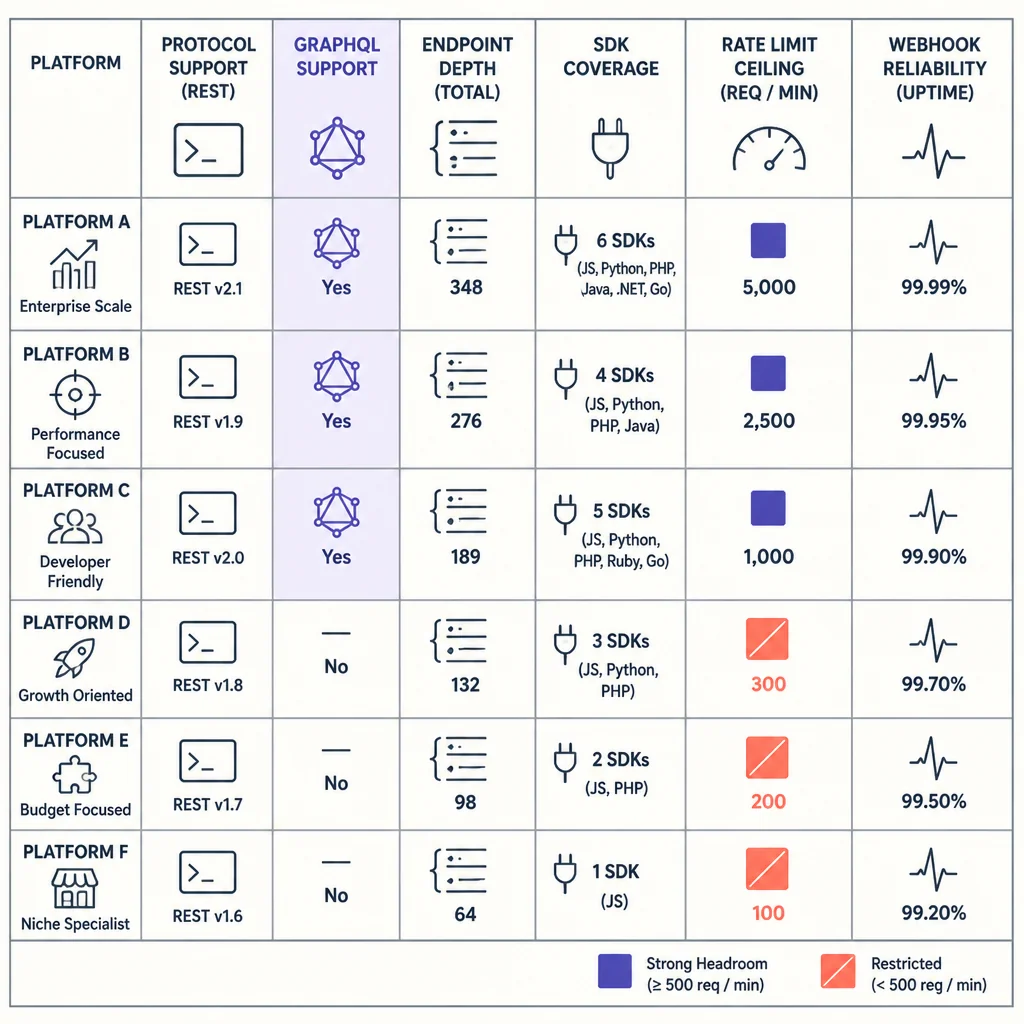
API capability varies dramatically across affiliate platforms, as documented in the Affiliate Platform API technical evaluation published in May 2026. The comparison of six major vendors reveals structural differences that affect integration complexity:
| Platform | Protocol | Endpoints | SDK Coverage | Rate Limit |
|---|---|---|---|---|
| Track360 | REST, GraphQL | 80+ | Node.js, Python | 1,000/min |
| Impact | REST, GraphQL | 100+ | All major languages | 500/min |
| MyAffiliates | REST only | 60+ | Enterprise on request | 300/min |
| Cellxpert | REST | 50+ | Partial | 200/min |
| PartnerStack | REST | 40+ | Node.js | 400/min |
| Affilka | REST | 30+ | None native | 150/min |
These specifications matter beyond raw endpoint counts. A platform with GraphQL support allows agencies to request precisely the data fields they need, reducing payload sizes and query complexity. REST-only platforms may require multiple round-trips to assemble equivalent datasets, introducing latency and failure points.
Rate Limiting and Operational Headroom
Rate limits determine how frequently an agency's systems can poll for conversion data, update creative assets, or synchronize partner information. A platform with a 150-request-per-minute ceiling, such as Affilka, may suffice for small programs but will throttle automated workflows for agencies managing hundreds of partners across multiple client accounts.
Agencies should evaluate rate limits against three operational scenarios:
Batch reconciliation. Daily or hourly synchronization of conversion data with client financial systems. High-volume programs may require thousands of records per minute during peak periods.
Real-time optimization. Automated bid or budget adjustments based on affiliate performance. These workflows need sub-minute data freshness that low rate limits cannot support.
Disaster recovery. Reconstruction of reporting databases after system failures. Recovery speed depends on how quickly historical data can be re-ingested, which rate limits constrain.
Webhook Reliability and Event Architecture
Modern affiliate tracking increasingly relies on server-side webhooks rather than client-side pixels, driven by browser privacy restrictions and ad-blocking prevalence. Platform webhook implementations differ in delivery guarantees, retry logic, and payload structure.
Agencies should verify:
- Whether webhooks include cryptographic signatures for authenticity verification
- The maximum retry duration before events are permanently lost
- Whether out-of-order delivery is possible and how sequence numbers are handled
- Payload versioning policies that prevent breaking changes without notice
The TrackCon 2026 summit in July, as reported by Affiliate Times, featured extended debate on server-side tracking implementations, with operators noting that webhook reliability varies more between platforms than documentation suggests. Live testing during trial periods should include deliberate webhook endpoint failures to observe retry behavior.
Integration Architecture: Connecting to Client Ecosystems
E-commerce Platform Coupling
Affiliate tracking must integrate with client e-commerce infrastructure at the order, customer, and product levels. Platform-native integrations with Shopify, WooCommerce, Magento, and custom storefronts vary in implementation depth:
Shallow integrations pass order totals and affiliate IDs, sufficient for basic commission calculation but unable to support product-level attribution or return-adjusted payouts.
Deep integrations access line-item data, customer segments, and inventory status, enabling sophisticated commission rules and real-time availability checks.
Agencies should map client e-commerce complexity against platform integration depth. A fashion retailer with frequent returns and size exchanges needs deeper integration than a digital product vendor with no physical fulfillment.
CRM and Customer Data Platform Connections
Affiliate marketing tools increasingly feed into broader customer acquisition analytics. Platforms that write affiliate touchpoint data directly to Salesforce, HubSpot, or Segment allow agencies to include affiliate channel performance in lifetime value calculations and cohort analyses.
The evaluation criteria here include:
- Whether the platform writes to CRM objects natively or requires middleware
- How customer identity resolution works when affiliate cookies and CRM records use different identifiers
- Whether the integration supports bi-directional sync (CRM segments informing affiliate targeting)
Data Warehouse and BI Pipeline Support
Agencies serving enterprise clients often need to extract raw affiliate data into cloud data warehouses for unified reporting. Platform support for direct Snowflake, BigQuery, or Redshift connections varies; many require intermediate ETL processes that introduce latency and transformation complexity.
The AI SEO services comparison framework published by SiaSEO provides a parallel methodology for evaluating how AI tools integrate with existing content infrastructure—a transferable approach for agencies assessing affiliate platform data pipeline architecture.
Implementation Guidance: A Structured Evaluation Protocol
Phase One: Requirements Definition
Before engaging vendors, agencies should document:
Attribution requirements. Which touchpoints must be captured, what model sophistication clients expect, and how attribution outputs will be validated against independent analytics.
Integration inventory. Complete lists of e-commerce platforms, CRMs, data warehouses, and ad platforms that must exchange data with the affiliate system.
Volume parameters. Expected partner counts, monthly conversion volumes, and peak traffic patterns that affect rate limit and infrastructure sizing needs.
Compliance scope. Which regulatory frameworks apply (FTC, GDPR, state privacy laws) and how platform features map to specific requirements.
Phase Two: Technical Validation
Vendor demonstrations should include hands-on API testing rather than dashboard walkthroughs. Agencies should:
- Execute authenticated requests against sandbox environments using their own tooling
- Simulate webhook failures and measure retry behavior
- Import historical data samples to test attribution model outputs against known outcomes
- Review API changelog history for breaking change frequency and communication practices
The API pricing breakdown analysis of Google Search API costs illustrates how agencies can model total integration cost from documented rate structures—a method applicable to affiliate platform API pricing.
Phase Three: Operational Pilot
Limited production pilots with single clients or partner segments validate platform behavior under real load. Pilot success criteria should include:
- Data accuracy measured against existing tracking during parallel operation
- Integration maintenance burden quantified in engineering hours
- Partner onboarding friction assessed through time-to-first-conversion metrics
Limitations and Uncertainties
This analysis has several constraints that affect its applicability.
First, platform capabilities evolve continuously. The API specifications referenced reflect May 2026 documentation; vendors may have released updated endpoints, SDKs, or rate limits since publication. Agencies should verify current documentation before final selection.
Second, AI attribution features are particularly fluid. Machine learning models may be retrained or replaced without versioned documentation, making historical accuracy benchmarks potentially unrepresentative of current behavior. Ongoing validation procedures are essential.
Third, the evaluation framework emphasizes technical properties over commercial terms. Contract structure, minimum commitments, and support tiers significantly affect total cost of ownership but fall outside this technical scope.
Fourth, server-side tracking and privacy regulation continue to shift. The browser changes driving webhook adoption are themselves responses to regulatory pressure; platforms optimized for current constraints may require architectural revision as privacy frameworks mature.
What Agencies Should Prioritize in 2026
The affiliate marketing tools landscape in 2026 presents agencies with genuine capability advances alongside marketing exaggeration. Three priorities separate platforms that will sustain operations from those that will require replacement:
Attribution auditability over attribution sophistication. A transparent rules-based model that agencies can explain to clients outperforms a black-box AI model whose recommendations cannot be validated.
API headroom over current feature completeness. Platforms with robust rate limits, comprehensive SDK coverage, and GraphQL flexibility accommodate client growth and integration evolution that feature-rich but architecturally constrained platforms cannot.
Integration maintainability over integration breadth. A smaller set of deep, well-documented native integrations reduces long-term engineering burden compared to broad but shallow connector libraries.
The AI SEO tools for agencies evaluation provides complementary guidance on selecting AI infrastructure that maintains quality at scale—relevant for agencies building parallel content and affiliate operations.
Agencies that apply rigorous technical evaluation to affiliate platform selection position themselves to deliver durable client value as the channel continues its rapid evolution. The frameworks here provide a starting point for that evaluation, to be adapted to specific client contexts and validated through direct technical testing.
Platform Architecture and the Content-to-Conversion Pipeline
The structural concerns that apply to affiliate tracking platforms mirror those in content operations. Agencies managing both affiliate programs and SEO content production need systems that maintain data integrity across the full customer journey—from content discovery through affiliate conversion. SiaSEO's approach to AI SEO platform pricing transparency offers a model for how AI tool vendors can document capabilities without obscuring limitations, a standard that affiliate platform evaluation should demand.
Reader Questions
How do I test attribution accuracy before committing to a platform?
Run parallel tracking for thirty days using your existing system and the candidate platform. Compare conversion counts, revenue attribution, and partner credit assignment daily. Discrepancies exceeding 2-3% warrant investigation into tracking methodology differences.
What API rate limit should agencies target for multi-client operations?
Calculate peak concurrent operations: (clients × average partners × update frequency) + (daily conversion volume ÷ batch window). Add 100% headroom for growth and peak events. Platforms below 500 requests per minute rarely satisfy multi-client agency needs.
When should agencies prefer server-side webhooks over client-side pixels?
Immediately for all new implementations. Browser privacy restrictions and ad-blocking prevalence have made client-side tracking unreliable for accurate attribution. Maintain client-side pixels only as supplementary verification, not primary measurement.
How do AI attribution features affect compliance documentation?
Require vendors to document how their AI models handle disclosure placement, partner identification, and claim substantiation. Automated systems that cannot produce audit trails for regulatory examination create unacceptable risk exposure.
Evaluating Tool Ecosystems for Agency Growth
The methodology for assessing affiliate platforms extends to adjacent tool categories. Agencies building comprehensive marketing stacks can apply similar technical rigor to AI writing tool rankings and AI competitor research tools, ensuring that each layer of the technology stack integrates cleanly with adjacent systems.
Agency Infrastructure Beyond Affiliate Tracking
Agencies scaling operations across multiple clients need evaluation frameworks that transfer across tool categories. The technical discipline applied to affiliate platform selection—documented requirements, hands-on API validation, and limited operational pilots—applies equally to content generation infrastructure. Teams managing both affiliate programs and organic search content can benefit from structured approaches to AI blog writer alternatives and SEO audit tool comparison methodologies, maintaining consistent standards for integration depth and data transparency across the marketing stack.
For agencies navigating pricing complexity across multiple SaaS tools, the Semrush pricing tiers analysis demonstrates how to model feature-value tradeoffs at scale—a transferable skill when negotiating affiliate platform contracts. Similarly, the SEO type selection framework provides a decision structure for matching tool capabilities to client needs without overcommitting to overspecialized solutions.