AI Affiliate Content: How Search Visibility Changes Program Revenue
AI search is rewriting affiliate content strategy. Learn how GEO visibility, structured data, and citation-based ranking affect program revenue in 2026.

Affiliate publishers have built entire revenue models on the assumption that ranking in traditional search results drives predictable commission flow. That assumption is now under pressure. AI search engines—Google's AI Overviews, Perplexity, ChatGPT search, and emerging conversational interfaces—do not behave like index-and-rank systems. They cite, summarize, and sometimes bypass publisher pages entirely. For operators running affiliate marketing content at scale, the operational question is no longer whether to adapt, but which structural changes to visibility models will protect or grow program revenue.
This report examines how AI search systems currently treat affiliate content, what citation patterns determine inclusion in generative responses, how structured data and formatting requirements are shifting, and what revenue impact models publishers should use to prioritize investment. The evidence draws from 2026 industry reporting, regulatory filings, and platform behavior analysis rather than speculative projection.
The Research Problem and Scope
The core problem is measurement ambiguity. Traditional affiliate tracking attributes revenue to last-click or multi-touch sequences through known referrers. AI search introduces an opaque middle layer: a user receives a synthesized answer, follows a citation link or does not, and may convert through a path that standard analytics cannot reconstruct.
The scope of this analysis covers three domains:
- Citation mechanics in major AI search platforms (Google SGE/AI Overviews, Perplexity, ChatGPT with browsing, Bing Copilot)
- Content structuring requirements that increase citation probability
- Revenue attribution models for affiliate programs operating under AI-mediated discovery
The evidence standard is documented platform behavior, published industry research, and regulatory guidance where affiliate disclosure intersects with AI-generated content. Claims without direct source support are marked as analytical inference.
How AI Search Engines Currently Treat Affiliate Content
AI search systems do not crawl and rank pages in the traditional sense. They retrieve source material through retrieval-augmented generation (RAG) pipelines, score documents for relevance and authority, and synthesize responses with optional inline citations. This architectural difference fundamentally changes what "visibility" means for affiliate publishers.
Citation Patterns in Practice
Current behavior varies by platform:
Google AI Overviews selectively surface affiliate content when it satisfies explicit query intent with structured comparison data. A user searching "best project management software for agencies" may receive an overview that cites roundup articles containing affiliate links, but the citation is typically to the publisher's domain, not through the affiliate parameter. The user must still click through to convert, and the affiliate cookie must survive that journey.
Perplexity operates with higher citation density, frequently linking to source documents inline. Affiliate content that appears in Perplexity responses tends to be informational rather than transactional—buying guides, methodology explanations, and category introductions rather than direct product pitches. The platform's citation format preserves URL parameters in most observed cases, meaning affiliate tracking codes may remain intact.
ChatGPT with browsing (and its search-integrated successors) shows more selective citation behavior, often preferring authoritative editorial sources over commercial affiliate pages for product recommendations. When affiliate content does appear, it is typically as supporting evidence for a broader claim rather than as the primary recommendation source.
The structural implication: affiliate marketing content designed for traditional SEO—keyword-optimized, conversion-focused, templated roundups—does not automatically translate to AI search visibility. The selection criteria have shifted toward informational depth, clear sourcing, and structured data that RAG systems can parse accurately.
The Zero-Click Threat and the Citation Opportunity
Industry reporting from Affiliate Summit East 2026 documented a significant concern among niche-site operators: "AI Overviews pulling branded search clicks before they ever reach publisher pages." This compression of outbound traffic—where the AI answer satisfies the user without any click—represents a direct revenue threat to affiliates dependent on search-derived sessions.
However, the same reporting noted a countervailing pattern. Publishers earning consistent citations in AI responses reported higher conversion rates on the traffic that did arrive, suggesting that AI-mediated pre-qualification filters for higher-intent visitors. The net revenue effect depends on whether citation volume compensates for click-through rate compression.
"Several niche-site operators running Mediavine and AdThrive reported Q3 RPMs running 12–18 percent below Q3 2025 baselines, with display ad revenue compression blamed on a combination of Google's Privacy Sandbox rollout reducing addressable inventory and AI Overviews pulling branded search clicks before they ever reach publisher pages."
— Jake Sullivan, Affiliate Times, September 2026
Structured Data and Formatting Requirements for AI Citations
RAG systems parse source documents differently than traditional crawlers. They extract semantic chunks, identify entities and relationships, and score passages for relevance to the query. Affiliate publishers can increase citation probability through specific structural choices.
Schema Markup and Entity Clarity
Product review schema, organization markup, and breadcrumb structured data help AI systems identify content type and authority signals. More critically, clear entity relationships—stating explicitly that "Software X is a project management tool with features Y and Z" rather than implied comparisons through narrative—improve parseability.
The structured data for AI citations framework developed for general AI search optimization applies directly to affiliate content. Key elements include:
- Explicit product-entity definitions in opening paragraphs
- Attribute-value pairings (price: X, deployment: cloud/self-hosted, best-for: use case)
- Comparison tables with consistent schema rather than free-form descriptions
- Clear publication dates and update timestamps for time-sensitive recommendations
Content Architecture for RAG Retrieval
AI retrieval systems favor documents with clear hierarchical structure. For affiliate content, this implies:
- H2 headings that state comparative positions directly ("Why Tool X leads for enterprise teams")
- Bullet lists for feature comparisons rather than dense paragraphs
- Summary boxes or "at a glance" sections that consolidate decision-relevant facts
- Consistent internal linking that establishes topical authority clusters
The AI search citation patterns research indicates that long-tail informational queries—"how does Tool X compare to Tool Y for Z use case"—generate more consistent citations than head-term commercial queries. Affiliate content strategies should weight informational depth proportionally higher than transactional optimization.
Regulatory Environment: Disclosure Requirements for AI-Generated Affiliate Content
The Federal Trade Commission's 2023 revision to the Endorsement Guides established clearer disclosure obligations for affiliate relationships. The 2026 enforcement framework, taking effect October 1, 2026, introduces specific provisions for AI-generated content monetized through affiliate links.
Key Regulatory Requirements
The revised guidance, published August 28, 2026, closes several loopholes that affiliate operators had exploited:
- AI-generated content must carry disclosure if it includes affiliate links, regardless of whether a human reviewed the output
- "Clearly and conspicuously" now requires disclosure placement before the affiliate link or recommendation, not merely in a general site footer
- Intermediary liability extends to platforms and networks that distribute AI-generated affiliate content without adequate disclosure mechanisms
"The FTC published its Revised Guides for Affiliate and Influencer Disclosure in Digital Environments—a 47-page document that closes loopholes affiliates have exploited for years and introduces a first-of-its-kind enforcement framework specifically targeting AI-generated content monetized through affiliate links."
— Marcus Chen, Affiliate Times, September 2026
The Federal Register, Volume 88 Issue containing the original 2023 revised Guides remains the foundational legal reference. The FTC's Endorsement What People Are guidance document provides practical implementation examples.
For publishers using AI content generation tools, compliance requires audit trails: documenting which content was AI-generated, which received human review, and where disclosures appear relative to affiliate links. Platforms that automate content production without this documentation infrastructure face escalated enforcement risk.
Revenue Impact Models for AI Search Transition
Affiliate program operators need decision frameworks for resource allocation under uncertainty about AI search adoption rates and revenue effects.
Scenario-Based Modeling
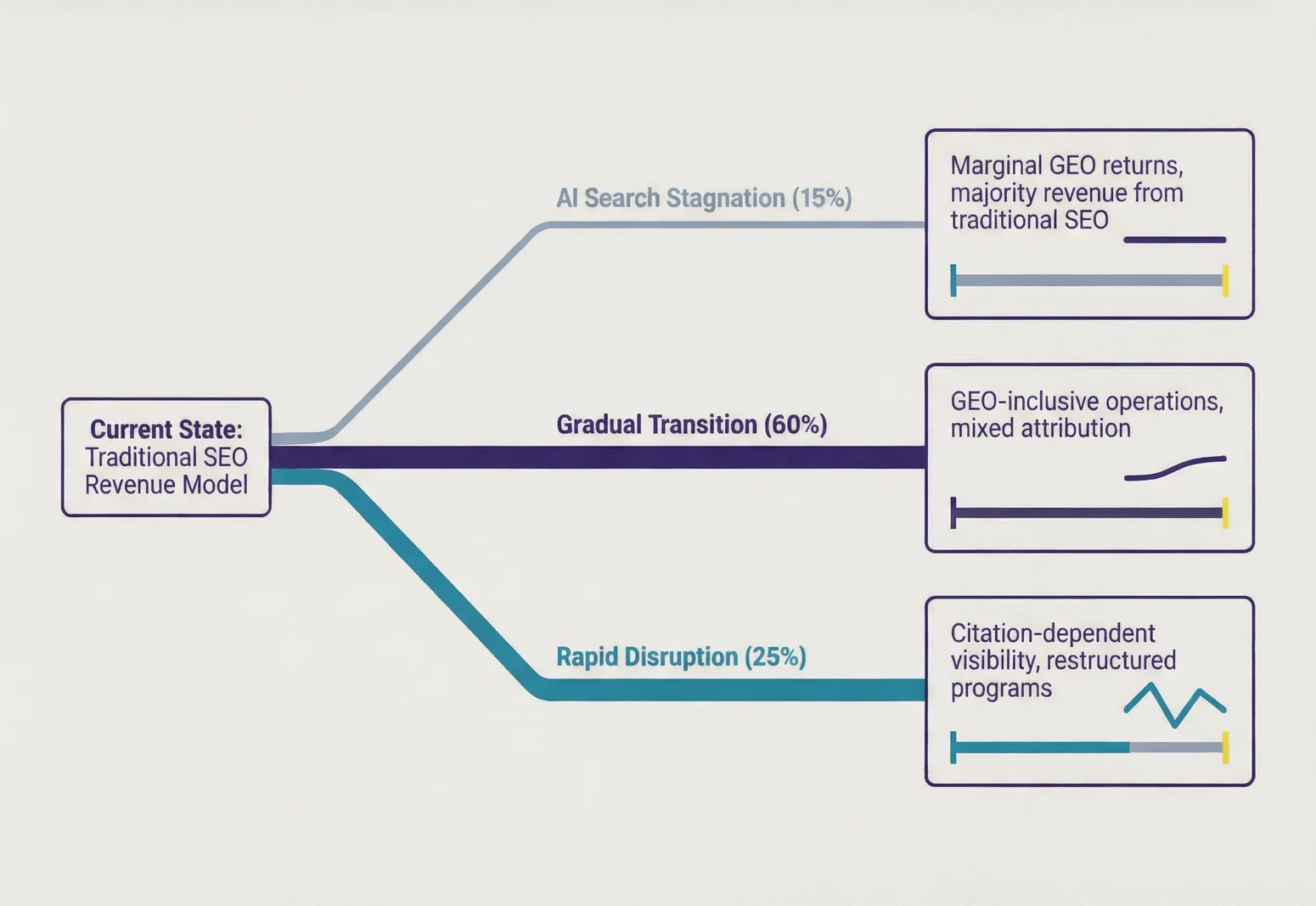
Three scenarios currently dominate publisher planning:
Scenario A: AI Search Stagnation (15% probability) AI Overviews and conversational search remain niche features with limited user adoption. Traditional SEO practices continue to drive majority revenue. Investment in GEO (generative engine optimization) yields marginal returns.
Scenario B: Gradual Transition (60% probability) AI search captures 30-50% of informational queries by late 2027, but transactional behavior remains mixed. Publishers maintaining strong citation presence in AI responses see flat or slightly growing revenue; those absent from citations experience 15-25% organic traffic decline. The algorithm shifts reshaping search analysis suggests this is the current baseline trajectory.
Scenario C: Rapid Disruption (25% probability) AI search achieves majority query share for product research and comparison. Publishers without structured, citation-optimized content lose 40%+ of organic affiliate traffic. New entrants with GEO-native content capture displaced revenue.
Attribution Modeling Under Opacity
The central operational challenge is that AI search platforms provide minimal referrer data. A user who receives an AI Overview citing your content, then clicks through and converts, may appear as direct traffic or unclassified organic. Current solutions include:
- Survey-based attribution: Post-conversion questionnaires asking how users discovered the product
- Cohort analysis: Comparing conversion rates and paths for users exposed to AI search features versus control groups
- Platform-specific tracking: Perplexity and some Bing Copilot interactions pass limited referrer data that can be segmented
The IAB's 2026 Affiliate Attribution Report documents a 34% EPC (earnings per click) improvement for publishers deploying server-side postback tracking combined with first-party data matching. This technical infrastructure—connecting advertiser conversion data directly to publisher click logs—partially compensates for missing referrer information by establishing deterministic attribution where probabilistic models fail.
"Networks that deployed server-side postback tracking combined with advertiser-side first-party data matching saw publisher EPCs rise an average of 34% year-over-year."
— Nina Petrova, Affiliate Times, September 2026
Implementation Guidance for Affiliate Publishers
The transition from SEO-centric to GEO-inclusive affiliate operations requires systematic changes across content strategy, technical infrastructure, and measurement frameworks.
Content Strategy Restructuring
Audit existing content for citation potential: Identify pages currently ranking for informational queries that AI search might answer directly. Prioritize restructuring pages with high traffic but low conversion—these are most vulnerable to zero-click compression.
Develop "source-worthy" content formats: Original research, category taxonomies, methodology explanations, and structured comparison data earn more consistent citations than opinion or narrative. The AI blog post best practices framework includes specific formatting guidance.
Maintain transactional depth for click-through pages: When AI citations do drive traffic, conversion-optimized landing pages remain essential. The revenue model shifts from "rank and convert" to "be cited, then convert"—both stages require optimization.
Technical Infrastructure
- Implement comprehensive structured data markup, with particular attention to product-review and organization schemas
- Deploy server-side tracking with first-party data matching where advertiser relationships permit
- Build content update workflows that refresh publication dates and factual claims, as AI retrieval systems weight recency heavily
- Establish disclosure automation that scales with AI-generated content volume
Measurement and Experimentation
Given attribution opacity, publishers should:
- Run controlled experiments on content formatting to measure citation rate changes
- Monitor brand mention volume in AI responses through emerging analytics tools
- Track EPC trends segmented by traffic source category, watching for shifts that indicate AI-mediated discovery even when direct attribution is unavailable
Limitations and Uncertainties
This analysis operates under several constraints that readers should weigh in their own decision-making.
Platform behavior opacity: Google, OpenAI, Microsoft, and Perplexity do not publish detailed documentation of their RAG retrieval and citation algorithms. Much of the current understanding derives from observed behavior, reverse engineering, and platform communications rather than authoritative specification.
Rapidly evolving standards: The FTC's October 2026 enforcement date represents a snapshot; regulatory interpretation and case law will develop. Platform policies on AI-generated content and affiliate relationships may shift independently.
Revenue data limitations: Published EPC improvements and RPM declines come from industry reporting and conference presentations rather than peer-reviewed studies. Individual publisher results will vary based on vertical, audience, and operational execution.
Attribution methodology gaps: No fully satisfactory solution currently exists for tracing AI search exposure through to affiliate conversion. The measurement frameworks described represent best available practice, not solved problems.
Citation-Based Ranking and the Future of Affiliate Discovery
The longer-term structural question is whether affiliate content as a category faces systematic disadvantage in AI search systems. Early indications are mixed.
Platforms have incentives to maintain publisher ecosystem health—without source content, RAG systems degrade. However, they also have incentives to reduce friction in user journeys, which can mean direct product information rather than affiliate-mediated discovery.
The publishers most likely to maintain visibility are those that provide genuine information value beyond what manufacturers or platforms can generate directly: independent testing, multi-product comparisons, category expertise, and transparent methodology. Affiliate marketing content that functions as thin arbitrage between search demand and merchant supply faces existential compression.
This aligns with the broader AI search funnel rewiring observed across B2B content: the middle of the funnel—comparison and evaluation content—faces the most disruption, while top-funnel awareness and bottom-funnel transaction content maintain more stable mechanics.
Emerging Practices and Experimental Approaches
Forward-leaning affiliate operators are testing several approaches not yet mainstream:
- Conversational content architecture: Structuring articles as anticipated dialogue, with clear question-answer pairings that match how users interact with AI search interfaces
- Citation optimization as a distinct discipline: Systematic A/B testing of content structures to maximize inclusion in AI response training and retrieval sets
- Direct platform relationships: Some large publishers are negotiating data-sharing or preferred-source arrangements with AI platform operators, though terms remain confidential
- Newsletter and direct audience development: The AI search intent mapping research notes that publishers with owned audiences are less vulnerable to platform algorithm shifts
The SEO versus GEO myths analysis cautions against abandoning traditional optimization entirely; the two approaches currently function as complements rather than substitutes.
Tool Idea: Affiliate Citation Impact Estimator
For publishers managing large content portfolios, a practical tool would estimate the revenue at risk from AI search transition by content segment. Inputs: current organic traffic by page, query classification (informational vs. transactional), observed or estimated AI Overview presence for those queries, and affiliate EPC by category. Output: prioritized content restructuring queue ranked by expected revenue protection per hour of investment. This would operationalize the scenario modeling described above without requiring manual analysis of thousands of pages.
What Publishers Should Monitor
The next 12-18 months will determine which of the scenarios above materializes. Key signals to track:
- FTC enforcement actions against AI-generated affiliate content, which will clarify compliance boundaries
- Platform policy changes on affiliate link handling in AI responses
- IAB and Performance Marketing Association measurement standards development
- EPC and traffic source trends in your own analytics, segmented by content type and query category
The publishers who maintain disciplined experimentation—testing content structures, tracking results, and adapting based on evidence rather than assumption—will be positioned to capture revenue that less adaptive competitors lose.
References
- affiliatewriterai Affiliatewriterai.Com — Stop burning hours on content that never ranks. AffiliateWriterAI gives you niche intelligence, commission estimates, and AI-generated affiliate content that actually converts —