SaaS Pricing Strategy Examples: Freemium, Tiered, and Usage-Based Models
Discover SaaS pricing strategy examples that scale: freemium, tiered, usage-based, per-seat, and value-based models with real implementation frameworks.

Choosing how to charge is the highest-leverage decision most SaaS founders never revisit. Research spanning three decades shows pricing as the single most powerful margin lever a company controls, yet leadership teams routinely prioritize headcount cuts and infrastructure spend over structural pricing changes. The right pricing strategy example for your stage and customer base determines not just revenue trajectory but also sales cycle length, support burden, and product roadmap priorities.
This list ranks six proven SaaS pricing models by their fit for specific business contexts: early-stage acquisition, mid-market expansion, enterprise negotiation, and AI-native delivery economics. Each entry includes the mechanical logic, a concrete company running it in production, the hidden cost most teams miss, and a verdict on when to adopt or abandon it.
How the Ranking Works
The order below reflects reader-fit evidence rather than universal superiority. A pricing model earns its position based on three operational signals: how cleanly it maps to customer value, how predictably it scales with your cost of goods sold, and how defensibly it separates you from competitors running identical features. The SaaS Pricing Playbook from Huber Consulting, published July 2026, provides the foundational benchmarks for these assessments.
Tiered Subscription Pricing: The Default That Still Works
HubSpot, Slack, and Notion all run variations of this model for a reason. You create two to four packages—typically Free, Starter, Professional, and Enterprise—each unlocking feature sets rather than usage quotas. The psychology is straightforward: the free tier captures email addresses, the middle tier captures credit cards, and the top tier captures procurement departments with annual contracts.
The mechanical advantage is revenue predictability. Customers self-select into buckets, reducing sales friction for the bottom two tiers while preserving negotiation room at the top. Semrush tiered pricing analysis shows how SEO platforms gate keyword tracking volumes, project limits, and API access across Pro, Guru, and Business tiers—each boundary carefully placed to capture a 10-20x revenue multiple between adjacent levels.
The hidden cost is feature bloat. Teams inevitably pack mid-tier plans with capabilities that belong in higher tiers, or worse, withhold table-stakes features that should be universal. This creates the "tweener" problem: customers who need one Enterprise feature but cannot justify the 5x price jump, leading to churn or perpetual discounting.
Verdict: Adopt when your product has natural capability cliffs—admin controls, API access, white-labeling—that cleanly separate user segments. Abandon when your feature differentiation becomes arbitrary or when usage intensity varies more dramatically than team size.
Usage-Based Pricing: Aligning Revenue with Customer Success
Twilio, Snowflake, and AWS built empires on this model. Customers pay for what they consume: API calls, compute hours, data egress, or tokens processed. The value proposition is theoretically perfect—your revenue grows exactly as your customer's business grows, eliminating the "shelfware" objection that kills so many SaaS deals.
The 2026 B2B software monetization benchmark from Nalpeiron found 66% of companies now use usage-based pricing for AI features, with 52% layering in credit or token bundles. This reflects a structural shift: unlike classic SaaS where marginal delivery costs approach zero, AI inference has real per-unit economics. Every token has a cost, and Google Search API usage pricing demonstrates how pure per-query billing creates transparency that flat subscriptions cannot match.
The danger is revenue volatility. A customer's usage can spike unpredictably—seasonal traffic, viral content, model fine-tuning runs—creating billing shocks that damage trust. Smart implementations add spend caps, prepaid credits, or hybrid models that blend a base platform fee with overage rates.
Verdict: Essential when your cost structure is genuinely variable and your customers' value correlates with consumption volume. Risky when your customers cannot forecast their own usage, or when competitors offer predictable flat-rate alternatives that simplify budgeting.
Freemium: Acquisition Engine with a Burn Rate
Dropbox and Slack popularized this approach: a genuinely useful free tier, often with storage or user limits, designed to spread through organizations virally before converting to paid seats. The math is brutal but well-understood: you subsidize 95% of users to monetize 5%, hoping network effects and habit formation create switching costs before competitors arrive.
The model works when three conditions align. First, the free tier must solve a real problem without artificial crippling—users smell hobbled products instantly. Second, the upgrade path must address a pain point that intensifies with scale: more users, more storage, more integrations. Third, your marginal cost per free user must approach zero, or your burn rate becomes unsustainable. Free SEO audit tool tiers illustrate how audit tools limit crawl depth or report frequency on free plans, creating natural upgrade pressure without rendering the free version useless.
The 2026 landscape adds complexity. The FTC's proposed enforcement policy on personalized pricing, announced August 2026, requires disclosure when businesses tailor prices based on individual customer data. While primarily targeting retail, this signals broader regulatory attention to pricing transparency that freemium models—often opaque about what features unlock at what thresholds—may face.
Verdict: Deploy when viral coefficient exceeds 0.7 and your free-to-paid conversion timeline is under 18 months. Avoid when your product requires heavy onboarding, customer success touch, or when enterprise buyers perceive free tiers as security risks.
Per-Seat Pricing: Simple to Sell, Hard to Scale
The original SaaS model: one user, one monthly fee. Microsoft 365, Salesforce, and countless vertical SaaS tools still run this way. It is easy to explain, easy to forecast, and easy to implement in billing systems.
The problem is misalignment with AI-era value creation. As noted in Bain & Company's August 2026 research, per-seat pricing assumes value correlates with headcount, which breaks down when a single user with AI assistance produces output that previously required ten. The YC Founder AI Report from July 2026 found per-seat pricing at just 20% of founder respondents, down from historical SaaS norms, while usage-based models led at 43%.
Per-seat also caps your expansion revenue. A 50-person company pays 50x the base rate regardless of how deeply they use your product. This creates a natural ceiling that usage or outcome-based models avoid.
Verdict: Retain when selling to regulated industries with strict user-audit requirements, or when your product's value is literally access-based (compliance training, secure document review). Migrate away when AI features, automation, or API usage become primary value drivers.
Value-Based Pricing: The Enterprise Negotiator's Playbook
The most sophisticated and least implemented model. You price based on the economic outcome your customer achieves: revenue uplift, cost reduction, risk mitigation. This requires deep understanding of customer P&Ls, credible measurement frameworks, and sales teams comfortable with consultative selling rather than feature checklists.
Value-based pricing dominates in vertical SaaS serving industries with clear ROI metrics—think Shopify charging percentage of GMV, or payment processors taking basis points on transaction volume. The Bessemer Venture Partners research from July 2026 highlights how AI founders increasingly tie pricing to proof of ROI at renewal cycles, with outcome-based models rising from 21% to 29% between early and late July 2026 cohorts.
The implementation barrier is measurement. You need data infrastructure to track outcomes, legal frameworks to define "success," and customer trust that you will not manipulate the metric. AI SEO platform value proposition discussions increasingly center on whether traffic growth, ranking improvement, or revenue attribution becomes the pricing anchor.
Verdict: Pursue when you serve a narrow vertical with quantifiable outcomes, when your product creates 10x+ measurable value, and when your sales team can sustain six-month proof-of-concept cycles. Avoid when your impact is diffuse across multiple customer departments or when competitors offer simpler pricing that accelerates procurement.
Hybrid and AI-Native Models: The Emerging Standard
The most interesting 2026 development is deliberate model stacking. Companies are not choosing one approach but combining elements: a base platform fee (per-seat or flat) plus usage overages for AI features, plus outcome bonuses for premium tiers.
Bain's research identifies "capacity rather than consumption" as the emerging preference—customers pre-purchase committed capacity (predictable budgets) while vendors gain revenue stability. This mirrors how scalable keyword tool pricing structures work: tiered access to core features with metered overage for high-volume operations.
The AI-native complication is token economics. Unlike traditional software where marginal costs trend to zero, every LLM inference, image generation, or embedding search has measurable compute cost. The Bessemer research emphasizes that "delivering AI isn't free"—COGS specifically from inference and human-in-the-loop support fundamentally changes monetization strategy. AI SEO platform pricing examples show this in practice: base subscriptions cover platform access, while AI-generated content volumes or semantic analysis depth trigger usage charges.
The regulatory frontier matters too. The FTC's August 2026 personalized pricing disclosure requirement, detailed in Consumer Reports coverage, creates compliance overhead for any model using customer data to adjust pricing dynamically. While currently retail-focused, B2B SaaS with account-based pricing or industry-specific discounts should monitor this trajectory.
Verdict: Design for hybrid from day one if building AI-native. Separate platform value (predictable subscription) from consumption value (usage-metered AI) from outcome value (performance-linked enterprise tiers). This preserves pricing optionality as your product and cost structure evolve.
Choosing Your Model: A Decision Framework
No single pricing strategy example wins universally. The right choice depends on four variables you can assess today:
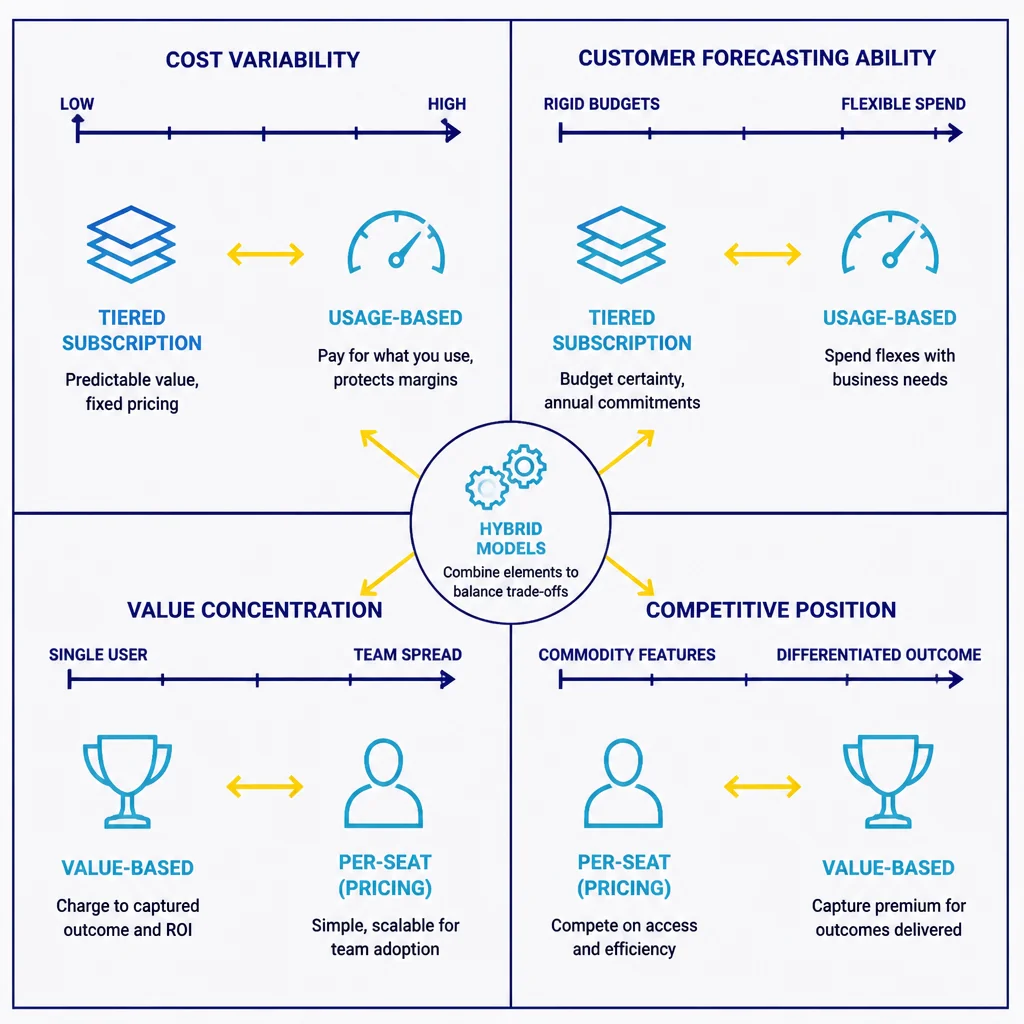
Cost variability. If your COGS scales with customer usage—AI inference, data storage, API calls—usage-based or hybrid models prevent margin erosion. If delivery is genuinely fixed, subscription predictability may outweigh alignment benefits.
Customer forecasting ability. Enterprise buyers with annual budget cycles often prefer fixed commitments. Startups and growth-stage companies may value flexibility over predictability.
Value concentration. Does one user generate disproportionate value? Per-seat undercharges. Does value spread across a team? Usage-based or tiered may capture more.
Competitive positioning. In crowded markets, pricing transparency can differentiate. In nascent categories, value-based pricing may capture more surplus while educating the market.
When Pricing Strategy Becomes Content Strategy
Your pricing page is not a spreadsheet—it is a narrative about who you serve and how you create value. The models above succeed when their presentation matches their mechanics: tiered plans need clear comparison tables, usage-based models need cost calculators, value-based offerings need case studies with verified outcomes.
For teams producing this content at scale, the operational challenge is maintaining accuracy across pricing changes, feature launches, and competitive responses. AI SEO training costs reflect how education products face similar versioning challenges: every pricing update requires content audit, internal link updates, and SERP refresh.
The companies winning in 2026 treat pricing as a living system rather than a set-and-forget decision. They instrument conversion funnels by tier, monitor usage patterns for upgrade signals, and A/B test presentation before changing underlying mechanics. The framework above provides the starting structure; your data provides the optimization direction.
Questions About SaaS Pricing Models
How do I know if my freemium tier is too generous?
Track two metrics: time-to-first-value for paid features, and free-to-paid conversion rate by acquisition channel. If conversion lags 18+ months or trails industry benchmarks by more than 50%, your free tier likely substitutes for paid functionality rather than previewing it.
When should a startup switch from per-seat to usage-based?
The transition makes sense when three conditions align: your largest customers have 10x+ usage variance compared to median users, your infrastructure costs scale measurably with that usage, and you can instrument transparent metering that customers trust. Premature transitions create billing complexity without revenue benefit.
Why do enterprise buyers resist pure usage-based pricing?
Procurement teams budget annually. Unpredictable spend complicates financial planning and can trigger additional approval layers. Hybrid models—committed base with overage—balance vendor alignment with buyer predictability.
How does AI feature pricing differ from traditional SaaS?
Traditional SaaS marginal costs approach zero; AI inference does not. This requires either explicit usage metering, capacity pre-purchase, or outcome-based models that share risk. The 2026 benchmark data shows 66% of B2B software companies using usage-based pricing specifically for AI features, often alongside existing subscription structures.
References
- Subpart 15.4 — Subpart 15.4 - Contract Pricing | Acquisition.GOV ... # Subpart 15.4 - Contract Pricing ... ## 15.400 Scope of subpart. ... This subpart prescribes the cost and price negotiation
- 15.402 Pricing policy. — # 15.402 Pricing policy. ... (a) Purchase supplies and services from responsible sources at fair and reasonable prices. In establishing the reasonableness of the offered prices,